
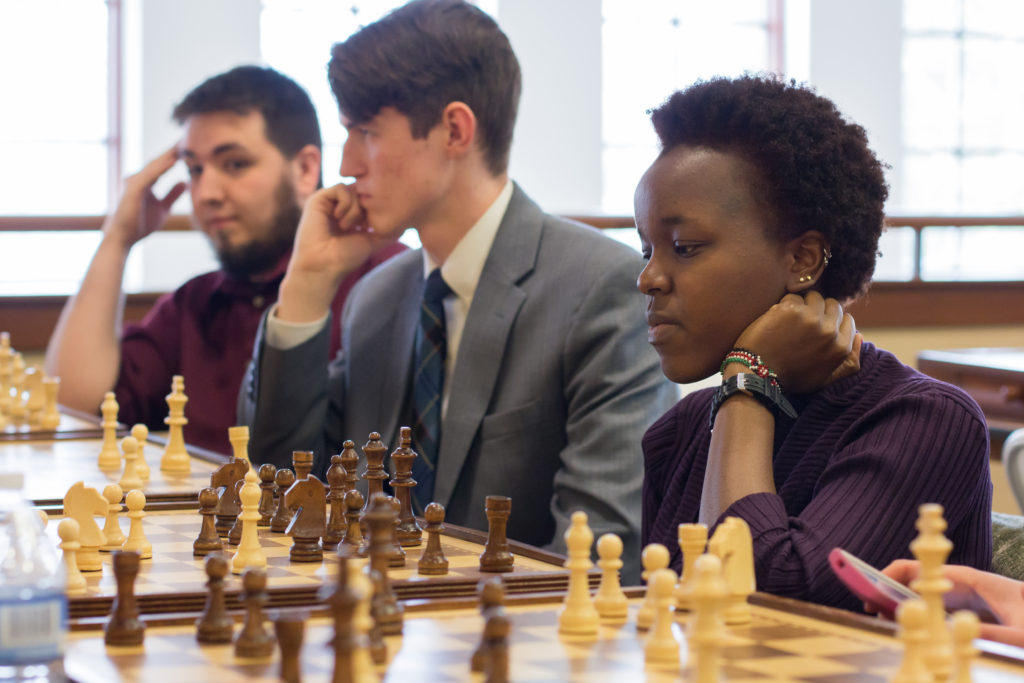
Members of the Hillsdale College chess club performed well at a tournament Saturday.
The tournament, sanctioned by the U.S. Chess Federation and held in Toledo, Ohio, was formatted in the “Swiss system,” in which players who win their first match play other winners, and losers play losers. Unlike a simple bracket, the system allows all participants to play the same number of games against players of similar skill, while still crowning a winner.
Hillsdale’s four participants were split across three skill divisions, according to their USCF ratings. In the second division, sophomore Gregory Bonvissuto and junior Thomas Reusser, the club’s vice president, each won three games and drew one. Their three-win performances placed them first and second in the division, respectively.
Junior Sam Cassels, the club’s president, chose to play above his rating in the tournament’s most difficult division, and placed twelfth out of fifteen. “Last time I played in the middle,” he said. “I went 4-0. And then I played up and went 3-1 in the top section. So I think I belong there, I just need to give my rating some more time to catch up and that only happens by playing up.”
Founded three years ago, the club was initially a venue for players who enjoyed “puzzles and a few friendly games,” according to Cassels. A recent influx of talented members, however, has injected new energy.
The club does not receive money from the school, so participants covered their own registration fees and expenses. Cassels and Reusser hope to get money to replace the existing timers in the Union, which they say are low quality and breaking down with use. “We use them every week,” Cassels said. “And we use them for hours.” They also believe funding for tournaments could encourage students turned off by the cost “to feel more welcome to come.”
In an effort to reach out to a broader base of players, Cassels also plans to start offering simple lessons on the fundamentals of the game during the club’s Friday meetings. He said that even rudimentary instruction could significantly help inexperienced players. Serious players study the game extensively— Reusser, for instance, estimates that he studies about an hour per day. He appreciates that “there is no luck involved whatsoever. It’s just your skill versus your opponent’s skill… and there is no bound to how much you can improve.”
Cassels said diligent study of the game also yields benefits in other arenas.
“There is so much about chess that’s really relevant to real life, like time management, planning things out, consequences to actions, preparation and study skills [and] concentration,” Cassels said.
The club’s newly instituted ranking system also presents an opportunity for players to map their improvement. Each week, members can challenge another player on the club ranking ladder; if the lower ranked player wins, they leapfrog their opponent’s ranking.
Club leadership hopes to take the club further by increasing tournament participation and by holding tournaments on campus for all interested students.
Cassels says the future is bright for chess at Hillsdale, and that the club merits college support.
“The virtues of chess are similar to many of the virtues that the liberal arts stand for,” Cassels said.
