
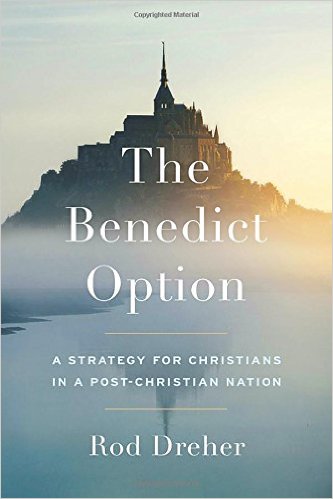
Before “The Benedict Option,” there was just Rod Dreher and his new book’s eponymous idea. But come March 14, the American Conservative blogger promises a full explanation of the murky term with “a strategy for Christians in a post-Christian nation.”
Although Dreher delivers, his strategy tempts his audience to believe Christians can only survive modernity’s depravity by creating a “parallel polis,” a spiritual utopia where they can live undisturbed.
Dreher wedges his argument between alarming images — first a flood that drowns unprepared Christians and then a similarly destructive earthquake — and supports his proposal with a dangerously nostalgic view of history. Like a postmodern Raphael Hythloday from St. Thomas More’s “Utopia,” Dreher concludes that since society will not heed the wisdom of Christianity, Christians must forsake trying to influence society at all.
Years before Dreher wrote “The Benedict Option,” he began throwing around the idea that the father of European monasticism, St. Benedict of Nursia, had abandoned fifth century Rome because he felt the society was too corrupt to support him as a Christian any longer. That, combined with a little rhetoric from Alasdair MacIntyre’s 1981 “After Virtue,” in which the Scottish political philosopher calls for “another — doubtless very different — St. Benedict” for the modern world, gave Dreher the phrase “the Benedict Option,” apparently meaning that Christians should make a spiritual retreat from the secular world.
Dreher ignited debates in every Christian conservative corner, from the dorky tables in the cafeteria up to the hallowed lobby of The Heritage Foundation, over just how far and just how spiritual this retreat should be. Some said the Benedict Option was a political call for Christians to remove themselves from society entirely. When pressed on the issue, Dreher himself would say he was only reminding Christians to put prayer and work at the center of their lives.
Regardless of the term’s meaning and origin, Dreher would have done well to actually read Pope Gregory the Great’s fifth-century biography of Benedict, which nowhere says that he became a monastic because society failed him. All we know about the hermit of Nursia is that he answered a vocation to serve God in the wilderness.
But with his new book, Dreher attempts to put all debate about the Benedict Option to rest by claiming all Christians must follow Benedict’s example — according to the Dreher version of Benedict. But those apocalyptic images and the contradicting arguments — like a blogger who advises his readers not to use the internet — turn a well-intentioned book into a bumptious disaster.
At the outset Dreher declares, “The culture war that began with the Sexual Revolution in the 1960s has now ended in defeat for Christian Conservatives.” He then leads his readers on a tour of history — which he envisions as a great battle for control over chronological narrative which Christians started losing in the High Middle Ages when the Franciscan friar William of Ockham divorced the transcendent and material worlds with nominalism. Christians lost even more during the Renaissance and the Protestant Reformation, when humanist thinkers and evil popes made the church worldly and weak. Finally, Christianity melted into a wax of sentiment with the advent of modernity, and any power it might have held was replaced with the ideas of Marx and Nietzsche.
Dreher diagnoses the majority of Christians today as “Moralistic Therapeutic Deists,” susceptible to the leanings of an over-encroaching secular culture. He also tears into the conservative project — especially Reagan and latter-day Republicans — and blames failing Christians by only trying to safeguard pro-life issues and the integrity of the traditional family.
His solution: Christians must abandon ship and create a utopia within the bounds of American society, but distinctly removed from it through active prayer and a faith-based community.
It all sounds so simple, pure even — if you buy into Dreher’s historical narrative. For Dreher, the world is an evil place and history a lost battle for Christians. And although he insists he doesn’t want to “turn back the clock,” by denouncing his own society as failed, he takes a gloomy position where one bad thinker — Marx, for instance — forces everyone to think in his terms from then onward. If that’s the case, the sometime writer for The Atlantic Sam Kriss is correct: because Marx thought, we are all Marxists.
This view of history is unworkable and has never been the tradition of sane Christians. In “The City of God,” the early Christian thinker Augustine asserts that the great society of his time, Rome, fell because its stewards failed to take care of it. But he does not assert — as Dreher wrongly concludes — that Rome was a society separate and distinct from Christianity. In Augustine’s world, Christians live in Rome, and they face a constant battle to care for Rome, while remaining cognizant of heaven above. All cities of men exist as earthly estates portioned over to the best safeguards — Christians — on their journey to the eternal city of God.
So in sounding the alarm for the end of society, Dreher positions himself not as a new Benedict, or even as a new John the Baptist, crying out in the wilds of Louisiana to alert Christians of the coming peril. He best fits the role of Hythloday, the speaker of nonsense who proposes in Thomas More’s 1516 dialogue “Utopia” that misanthropy is the key to salvation.
Hythloday argues that since man so often falls and since rulers rarely listen to the advice of good men, it is best just to give up on society. More sympathizes with Hythloday in the dialogue, but as a man who participated in the highest strata of society and even tried to raise a king to be a virtuous man, he cannot agree with the embittered Hythloday.
More compares Hythloday and his vision of Utopia to a man who is reciting a great tragic speech of Sophocles when he should be acting in a Plautus comedy. His point is that we’re never born into the role we want to play, but trying to create our own reality won’t do ourselves or our fellow men any good. It’s like abandoning a ship because we cannot control the wind.
The same could be said of Dreher. While the ora et labora sections of “The Benedict Option” could strengthen the faith of Christians everywhere, the apocalyptic tone in which Dreher writes about the rest of his plan diffuses the potency of his book.
Crying out about the end of the world goes against man’s role as steward over society, even if his society is dirtied by sin. But instead of retreating in themselves or creating a parallel polis, Christians should be taking positive initiatives to influence the next generation of common people — who are the modern day princes — to govern with justice and virtue.
These sorts of programs were started by the Romans and have not been attempted in civil society with any real effort since the Renaissance. Those who implemented them understood that, in the end, there can be no successful society with a secular state distinct from a Christian enclave. A good society is led by men who are trying to help others live virtuously, while trying to serve God themselves.
We are not waiting for a Benedict, but for another — and hopefully very similar — Thomas More.
