
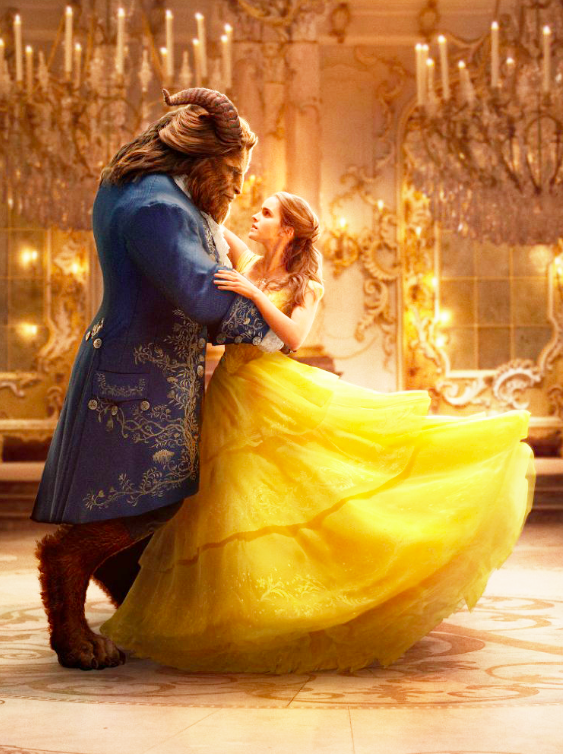
Disney’s live action remake of “Beauty and the Beast” took $170 million from American moviegoers in its opening weekend, making it the biggest opening ever for a Disney live action remake or a PG-rated movie.
Those are impressive stats, and although “Beauty and the Beast” dazzles, it does not deliver.
By clinging tightly to the storyline of the original 1991 animated film, except for a few minor deviances (more on that later), Disney offers an easily forgettable film that is mostly a shadow of the original. The frustrating part is, it’s hard to pinpoint where exactly Disney went wrong. Disney overshot the film’s storyline while conserving the story’s traditional themes of love and courage, and as a result “Beauty and the Beast” is lukewarm and mediocre.
The film opens with the narration of the Prince’s downfall and transformation into the Beast (Dan Stevens), then transitions into the familiar “Bonjour” opening number featuring misfit bookworm Belle (Emma Watson). From there the film follows the original storyline, with a few embellishments: In the remake, Belle is an inventor like her father Maurice (Kevin Kline), and Maurice is a likeable and respectable character, unlike the bumbling, absent-minded fellow in the animated version. Disney adds a few scenes for Belle and the Beast to spend more time getting to know each other by sharing their love of books and then throws in a random scene where Belle resolves the story of her mother’s death.
There isn’t anything inherently wrong with these additional scenes, but Disney tries to go too deep with a fairy tale that is supposed to be much simpler. The point of the original Grimms’ fairy tale of “Beauty and the Beast” and the beloved animated film is not to tell a realistic, explainable story about a strong woman saving a man with a troubled past. The point is to show viewers what selfless love and courage look like, and encourage you not to be deceived by appearances. You don’t need extra scenes about Belle’s past or her burgeoning relationship with the Beast to do that, and the overall effect makes the film feel rushed and haphazard.
Then there’s Disney’s obvious LGBTQ agenda roaring through a few brief moments in the remake. Two stand out: first, during the attack on the castle, the Wardrobe (the amazing Audra McDonald) defends herself by magically dressing three townsmen as women in a dizzying whirlwind of ribbons and lace. The men react with glee and dance off down the stairs. Second, during the ending ball scene of the film, Gaston’s henchman LeFou (Josh Gad) — a very effeminate character — begins dancing with another man.
Really, Disney?
These moments weren’t in the Grimms’ story or the original animated film, so it doesn’t make sense to add them to the remake other than to push an LGBTQ agenda. Disney created a gay character for the sake of starring a gay character, and as a result casts itself as a bad publicist and a subpar storyteller.
The film boasts a few redeeming features, but they aren’t strong enough to overcome the shortcomings.
From a visual standpoint, the film is lovely. Favorite numbers like “Be Our Guest” and “Tale As Old As Time” are glamorous and nostalgic. But for some reason, Disney cut the song “Human Again” from the remake, which is a major disappointment. The “little town” where Belle and her father live is full of bright, colorful characters, several of whom provide charming little anecdotes throughout the film. One thin grouchy townswoman, for example, turns out to be the wife of Cogsworth (Ian McKellen).
Sweeping panoramic scenes of the French countryside are thrilling and delightful, but drown Watson’s weak voice. Watson acts well, and although her voice is sweet, it isn’t strong, and doesn’t match Belle’s strong personality. Belle is the star of a musical, but Watson’s lack of worthy vocals makes her forgettable.
Fortunately, themes of love, sacrifice, and courage are still the lifeblood of the film: Belle bravely sacrifices herself (and then her friendship with the Beast) to save her father, and her father does everything in his power to get her back. The Beast lets Belle go to save her father, even though he knows that by doing so he’s dooming himself to eternity as a beast. The Beast’s servants — Mrs. Potts (Emma Thompson), Chip (Nathan Mack), Lumiere (Ewan McGregor), Plumette (Gugu Mbatha-Raw), Cogsworth, and others — acknowledge their failure to love the Prince and raise him properly, and routinely give up their own desire to be human again. The local chaplain (Ray Fearon) is portrayed as a kindly, knowledgeable character who graciously lends Belle books from the chapel library, which subtly casts religion — specifically the Christian religion — in a positive light.
Over and over again, the characters prove themselves to be brave and noble. They learn humility, and they learn to love.
Although “Beauty and the Beast” fails to enchant, it retains the classic story and effortlessly promotes virtue. It may be worth watching for that fact alone, but if you want to watch a well-made, praiseworthy live-action remake of a Disney classic, then you’re better off watching 2015’s “Cinderella” or 2016’s “The Jungle Book.”
