
At least 2.7 million Americans are affected by a heart condition called atrial fibrillation, a type of irregular heartbeat that can lead to blood clot, stroke, or heart failure, according to the American Heart Association.
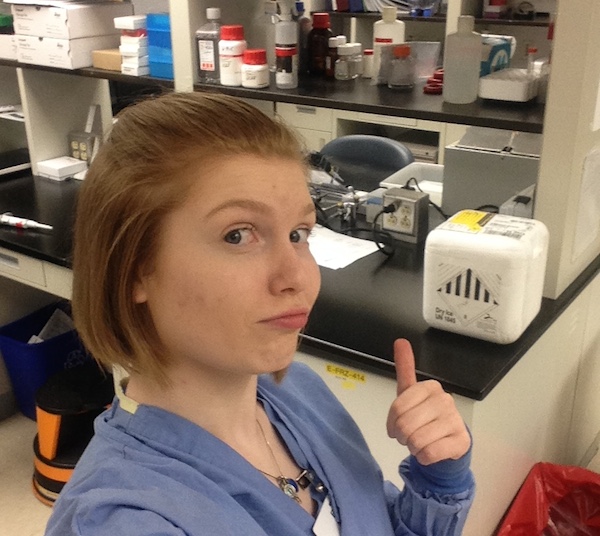
This summer, senior Emily Nelson helped research the effects of two drugs that, when used in conjunction, may help lower their harmful side effects for heart tissue. Her project, conducted through the Center for Integrative Research on Cardiovascular Aging at Aurora St. Luke’s Medical Center in Milwaukee, Wisconsin, helped lay the groundwork for future projects involving these drugs.
For patients with a history of heart failure, the drug dronedarone can worsen the symptoms of atrial fibrillation, increasing oxidative stress in the heart tissue. Oxidative stress occurs when reactive oxygen atoms, which can cause cellular damage, build up in cells.
“The real issue with the drug is it causes oxidative stress, so cells that are already having a hard time have to work even harder to survive,” Nelson said.
Nelson used human heart tissue samples collected from patients during surgery and frozen for future research in her project. But before she could test the effects of the two drugs when used together, she first had to dethaw and cultivate the cells, a process Nelson said was delicate and required finesse. In the first few cultures, she started with about half a million cells, but only a fraction survived.
“I have to say, the plating and culturing took the longest of anything I had to do,” Nelson said. “It’s defrost it, give it the first treatment, wait a couple hours, do another treatment, let them sit overnight, and then do your drug treatment, which is another whole day of waiting.”
After the cells were treated with the drugs, Nelson used fluorescent dyes to determine the oxidative stress within the mitochondria, where the reactive oxygen atoms originate, and within the larger cell using a specialized microscope for looking at different cross-sections of a 3-D sample.
Nelson’s supervisor, Larisa Emelyanova, a research scientist at Aurora, said the project successfully demonstrated the detrimental effects of dronedarone. Additionally, Nelson found that the second drug helped protect the cells from oxidative stress when used in conjunction with dronedarone.
“Another interesting thing we noticed was that between older patients versus younger ones, the younger patients had a much better response rate to the two drugs together, whereas the older ones still had some trouble,” Nelson said.
According to Nelson, researchers at Aurora will continue to examine the effects of these two drugs using fresh heart cells. Nelson’s work contributed preliminary data for the ongoing project. After Nelson’s previous experience shadowing cardiothoracic surgeons two summers ago, she said the research project provided a different type of insight into heart-related medicine.
“It was kind of neat because I got to see the flip side of things,” Nelson said. “After the heart sample comes out, the surgeons seal it up, put it in liquid nitrogen, and then hand it off to the research people. That was where the story ended for me two summers ago, and now I got to see it from the other end.”
