
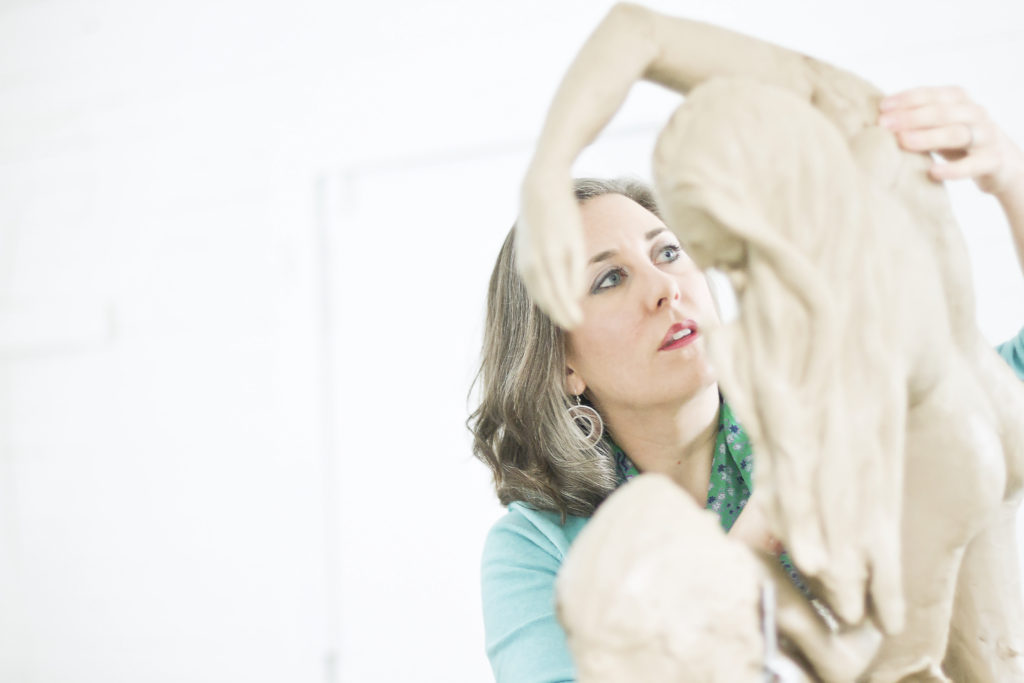
For sculptor Sarah Hempel Irani ’00, chasing Michelangelo is a life’s work.
Irani will share her knowledge of sculpting, when she leads a tour to Italy July 3-13, tracing the career of the Renaissance sculptor Michelangelo from the quarries of Pietrosanta in Tuscany to the cities Florence and Rome, where his most famous works are. The trip costs $3,566, and those interested can apply online at clayandchisel.com.
“We’re going to see all of the sights that most people want to see when they go to Italy anyways,” Irani said. “But this trip is unique, because we’re going to Pietrosanta. Tourists don’t go there — it’s still a working city.”
Pietrosanta is one of the few cities in the world that relies on sculpture for its existence. Located in the foothills of Apuan Alps, the mountains’ readily available marble has made the town a hub for stonecutters and masons since Roman times.
As a sculptor who has worked in Pietrosanta herself, Irani said the chance to lead a tour there will make the trip unique.
“Artists come from all over the world to be there for the same reason,” she said. “There’s an incredible vibe to the city because of that.”
Before she became a professional sculptor, Irani majored in classical studies at Hillsdale College and practiced many forms of art, including drawing, painting, and, of course, sculpting.
“She was the kind of student I’d love to work with, because she has imagination, motivation, and good observation,” Professor of Art Sam Knecht said.
Irani’s love of classics and art often carried into her extracurricular life. As the president of Eta Sigma Phi, the classics honorary, during her junior year, she made the “sacred sash,” a draping that Eta Sigma Phi still uses at its meetings 17 years later. She also handmade Greek-styled dresses for female members of the honorary the same year, when Hillsdale went to its first Eta Sigma Phi national convention in Athens, Georgia.
“Since we dressed as Greek women, everybody knew who Hillsdale was,” Irani said.
Shortly after she graduated Hillsdale, Irani moved to the Washington, D.C., area, putting her faith in her abilities to become a sculptor of religious pieces.
“I just put everything in my car and drove out to D.C.,” she said.
Upon arriving in the nation’s capital, she became a sculpting apprentice, making sacred art for the Washington National Cathedral.
“I didn’t know anybody or have any friends, so I volunteered at the Washington Irish festival and fell in with a troupe of Irish dancers — so they were my family,” she said.
Some of of the dancers Irani befriended belonged to the Roman Catholic parish, Our Lady of Mercy, in Potomac, Maryland. The parish wanted new sculpted stations of the cross, and Irani received the commission in 2002. Since then, she has donated two fiberglass casts of her Stations of the Cross to Hillsdale College. They hang on the wall in the Sage Center for the Arts.
After completing her work for Our Lady of Mercy, Irani received another commision from the church. This time, she would sculpt larger-than-life statues of Saint Joseph and the Blessed Virgin Mary.
“I was 25 at the time, so I feel like they took a very big risk, and I’m very grateful for it,” she said. “It was right after my birthday, too.”
To make the figure of Joseph, Irani made a plaster cast of her sculpture and then shipped the mold over to Pietrosanto to have it finished.
Irani explained this process is common in the sculpting community — artists view the process as a methodical and mathematical art.
“Most people approach the art by first making a small clay model and then a large-scale clay model,” she said. “You then take measurements on the X and Y-axes, but also on the Z-axis, which goes into space. Carve until you hit the point. Take measurements over and over again until you have the figure.”
Irani said only at the very end of the process will a sculptor get out her chisel and free-form sculpt. Even Michelangelo — arguably the greatest sculptor since the ancient Greeks — did not free-form sculpt until his work was nearing completion.
“There are a lot of myths about Michelangelo — that he whacked at the marble and released the figure within — that’s not true,” Irani said. “Taking a block of marble and hacking at it and trying to get a good image — it’s just not going to happen.”
In the case of the Joseph statue, Irani did not carve any of the marble until the artists in Pietrosanta had finished carving the basic figure. She then went to Italy to put the finishing touches on the statue herself. Once Irani had completed her work, the sculptors at Pietrosanta gave her a chip of marble to commemorate the occasion.
“I loved working with them — it was one of the highlights of my life. Other than, you know, childbearing, family — all that,” she said.
Professor of Classics Joseph Garnjobst said Irani’s love of classics continues to influence the way she works.
“Some of her sculpture is from Scripture: She’ll take a passage and bring it to life,” he said. “It’s kind of the liberal arts put into action.”
Garnjobst said he has kept in contact with Irani in the years after she graduated and has attended art shows with her near her home in the Washington, D.C., area.
“I like to appreciate the arts,” he said. “And being able to talk to someone who can talk about how an arm can be attached to a sculpture or how difficult it is to deal with drapery on a statue — places I don’t have a full appreciation — she can understand and explain it all.”
Irani said she looks forward to bringing her knowledge to life by leading a trip to Italy — and especially to Pietrosanta — because the town has a special place in her life’s work.
“To be where Michelangelo stood — it’s a very cool place for me.” she said. “I’ve only been once, but I’m excited to go back.”
