
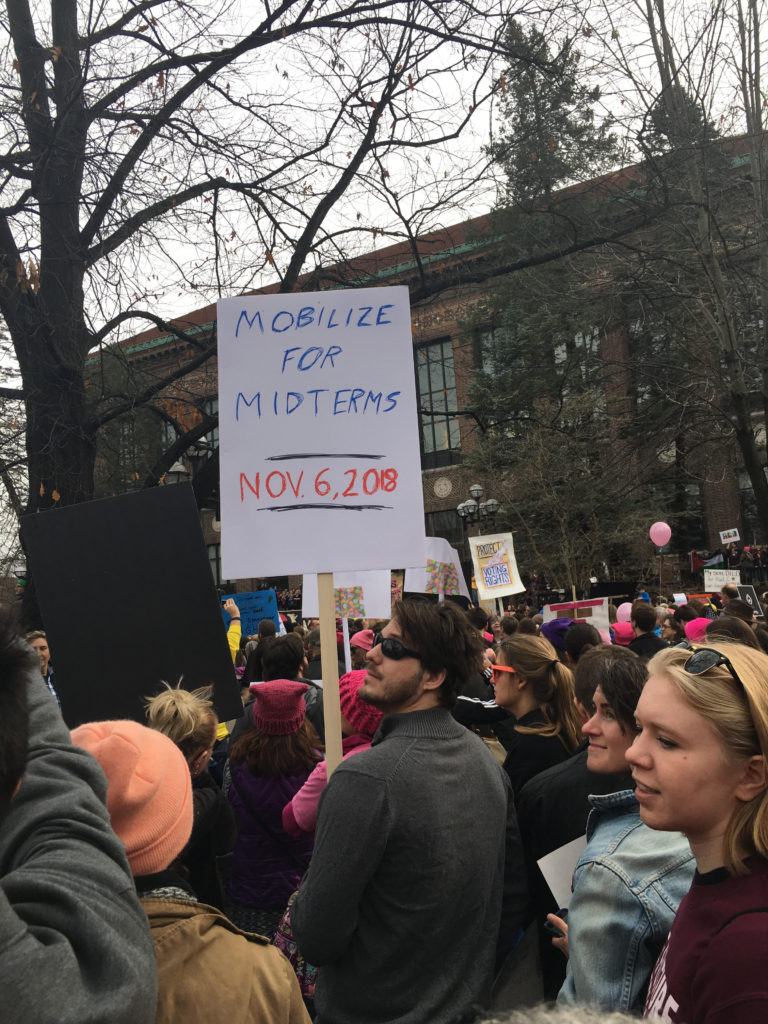
The Women’s March on Washington was not a protest against the inauguration of our 45th president. It was a response to it. While President Trump’s shadow loomed large over the proceedings of the most local outpost of the event, The Women’s March Ann Arbor, the atmosphere was more joyful and less vitriolic than one might’ve expected. As the marchers wound their way through downtown Ann Arbor, the chants that normally dominate demonstrations like these — “My body, my choice,” “Keep your tiny hands off my underpants,” etc. — seemed muted, drifting briefly over the crowd and fading, to be replaced by the chattering of the crowd, the cheering of spectators, and sometimes even music. As we began to march, I was gratified to hear the women behind me sing a rendition of “My Country ‘Tis of Thee.”
The signs the protesters held offered more insight into the motivations of the marchers. These ranged from the winkingly profane (“Hands off my…” followed by an oversized picture of Hello Kitty) to the steadfastly practical (one sign simply said “Mobilize for Midterms Nov. 6, 2018”). Signs touched on issues ranging from abortion to the ongoing water crisis in Flint, from immigration to LGBT rights. These people, it was clear, were not drawn to the Women’s March by one specific issue, but by a variety of experiences and opinions that, somehow, they felt the march represented.
This aggregation of issues and individuals have led some to write off the Women’s March altogether, saying that its purpose was unintelligible, or that there wasn’t one at all. On the contrary, this march proved itself to be more than a simple complaint: It was the rallying of a generation, and a new source of hope for the Democratic Party. Hillary Clinton failed, not because of her disputed record, or the vindictiveness of her opposition (President Trump faced both obstacles, and overcame them, seemingly, through sheer force of will), but because she failed to excite her constituents. Her campaign apparatus, in its hubris, put no effort into stirring up Democrats in states it thought secure. As a result, some pundits believe the American people repudiated the aims of the Democratic Party as a whole this election, and not just of Hillary Clinton.
The Women’s March is a direct rejection of this hypothesis. Around 500 cities hosted Women’s Marches last Saturday, and an estimated 3.3 million people attended — around 11,000 showed up at the Ann Arbor Women’s March, and over 500,000 marched in D.C. Speakers and celebrities rallied the troops, reminding them what was at stake, in the hopes that they’d come back for the next march, donate money to the next fundraiser, and, most importantly, come out to the polls for the next election.
Ms. Hedrick is a freshman studying political economy.
