
42 Union — a recently developed apartment complex — took under a year to build and open, largely due a $785,000 grant given to the city of Hillsdale.
According to alumnus Tyler Groenendal, this is the latest example of Hillsdale’s participation in crony capitalism. Those involved with the city government, however, argue these grants are not only a necessity, but are beneficial to the community as a whole.
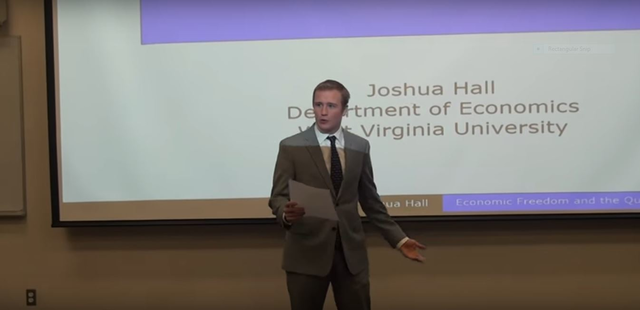
In a lecture delivered on Nov. 17, Groenendal took an in-depth look at crony capitalism — where a government inordinately involves itself with businesses — in Hillsdale, specifically in regard to grants and subsidies. These government hand-outs, he argued, do not lead to economic development. According to Groenendal, they lead to economic regression, and are detrimental to the city’s commercial health. His conclusion was that the city of Hillsdale — and millions of other towns across the nation — are addicted to cronyism.
Hillsdale’s addiction to crony capitalism is evident due to the city’s repeated pattern of behavior in its application for government-funded grants, Groenendal said in his lecture. Though it may be driven by good intentions, this insatiable hunger for money from the state is ultimately misguided, he said.
In his first example of what he said was crony capitalism in Hillsdale, Groenendal returned to 42 Union, which peaked his interest in cronyism. The apartment complex was developed due to a $785,000 grant, he said, and will take 33 years to recoup the initial investment.
The second was Mar-Vo Mineral, which received a $82,685 grant to promote economic growth, and has provided Hillsdale with a four new jobs.
“I see this failure every day out my back window,” Groenendal said.
These examples, among many others, he said, point out an irreconcilable flaw in the system, but others claim they are necessary to the city’s economic development.
Groenendal argued that regardless, the city should not pursue grants.
“Instead, we should be marketing the city by its strengths — the cheap cost of living and the college,” he said.
However, this solution is not feasible to others in the community.
“Everyone in the room agreed that it’s not the best or most efficient way to spur economic development,” Mary Wolfram, director of Economic Development, said.
These government programs will exist regardless of whether or not Hillsdale takes advantage of them, she argued.
By applying for these federal grants, the city of Hillsdale is able to get some of its tax dollars back, even though Mary Wolfram acknowledged it’s inefficient.
According to Mary Wolfram, our tax dollars are funneled through several government agencies until they are eventually returned to the states, and then given back to cities in the forms of grants — a process which can take several years.
“If this is the only way to get our tax dollars back, then we should be doing it,” she said.
Professor of Political Economy Gary Wolfram agreed and said if the the opportunity is there, Hillsdale should take advantage of it.
Gary Wolfram said Groenendal is focusing on the wrong thing. The question is not about whether or not Hillsdale should take the money, but it is about why the money is there in the first place.
Groenendal disagrees, and thinks the city is motivated to solicit grants in times of desperation.
“They see crumbling roads and a lack of economic development and think it’s an easy answer,” Groenendal said.
Mary Wolfram, however, said grants can be an incentive for private investment. Last year alone, private investment in Hillsdale due to grants was over $1 million.
This simply means that when a grant is invested into an area of the city, the private sector responds by spending more money, fostering the development of the city’s struggling economy.
Relying on her experience, Mary Wolfram said she found Tyler’s critique of the city ironic.
“I come here every morning and do economic development. I don’t get to sit up there and theorize. The real world is different than the theoretical world,” she said.
Associate Professor of Economics Charles Steele, however, sided with Groenendal and asserted these grants are not beneficial to the community as a whole.
“It’s difficult for me to see how someone can claim this is good for all of Hillsdale. I can see how it’s the other way — people get hurt,” Steele said.
Steele claimed that is the problem with crony capitalism. Special and connected interests benefit, while the average citizen does not. As an example, Steele cited government interference in the sugar industry, in which the government props up the industry, hurting individual consumers.
Groenendal also emphasized this point in his presentation. It is an unbreakable trend — the taxpayers and residents lose, while the government and crony businesses thrive.
The overarching problem, Groenendal said, is that once a town gets involved in crony capitalism there’s no way out of it, and it is accepted as the new economic system.
And it is this, according to Groenendal, that leads to the inevitable addiction that plagues the city of Hillsdale.
Steele asserted that those who try to defend this cronyism are preaching against the free market and advocating for government interference.
This reality, he said, is what the Wolframs have become caught up in.
“I don’t think the Wolframs believe that,” Steele said. “But what they argue for does.”
According to Steele, Gary Wolfram has long been an advocate of the free market, but in his defense of Hillsdale’s insatiable craving for grants and subsidies, he is defending crony capitalism — even advocating for it.
“My impression is this: it seems that the city of Hillsdale is engaging in the very thing Dr. Gary Wolfram has spoken against. This became an issue because there was an attempt to after-the-fact claim it’s economically warranted,” Steele said. “It’s not.”
Steele said that the justifications for these grants are contradictions.
“I get the idea that he’s gotten himself into a corner and now he’s flailing. If this is really a benefit why couldn’t it be handled by the market? Because I believe it could,” Steele said. “It strikes me that if our city council would take a different approach to economic development, it could be quite successful.”
The general mentality in Hillsdale is different than in other places, however. Steele argued that an entrepreneurial attitude is lacking here, and the go-to question is ‘How do I get more hand-outs?’
“That’s why so many are hesitant to frequent businesses in Hillsdale — they don’t like the attitude,” Steele said.
Councilman Adam Stockford agreed that the root cause of crony capitalism lies in the heart of the community.
“It’s a cultural problem. We don’t have a willing workforce — this has to be a communal effort to revitalize, not a governmental one,” he said.
Groenendal believes this recurring trend of reaching for government hand-outs will ultimately hurt the city of Hillsdale.
“We can’t solve all the problems in the city of Hillsdale overnight,” Groenendal said. “But taking grants definitely won’t solve them.”
