
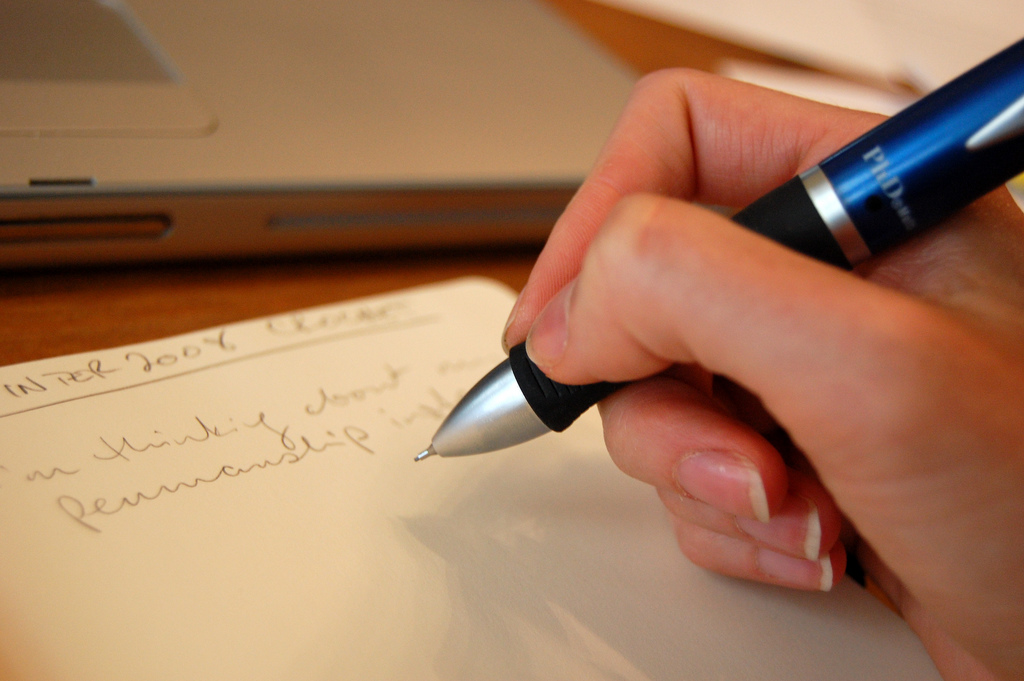
Chirography is an obsolete talent today, but most people don’t have a problem with this. Most people don’t even know what chirography means.
Debates over the necessity of good chirography (or penmanship) in today’s digital society have intensified ever since the creators of the Common Core excluded handwriting from their state standards. According to the Common Core guidelines, public schools need only require manuscript handwriting lessons through first grade, and needn’t require cursive lessons at all.
A recent editorial in the New York Times quoted an elementary school principal who questioned whether quality penmanship was “really a 21st-century skill.” When students can type everything and even sign documents with digital signatures, the argument goes, why should they be graded on good handwriting and not merely the writing process itself?
This new attitude toward handwriting is not only detrimental to children’s educational development, it’s an attack on the unique human capacity for both language and beauty. Good handwriting—both good print penmanship and good cursive—is not expendable. We must resist this modern war on the art of handwriting and reinstate a love of quality penmanship in our culture.
Fortunately, some continue to cling to their quill pens and ink. A few states—such as Alabama, California, Florida, Louisiana, Texas, and Virginia—even make handwriting lessons mandatory in their public schools, resisting the Common Core suggestions and defending themselves by pointing out that it hones hand-eye coordination and helps students retain information.
Indeed, research shows that good handwriting is indispensable. For one thing, writing by hand directly aids the memory. Occupational therapist Katya Feder, an adjunct professor at the University of Ottawa School of Rehabilitation, says that if you write yourself a list or a note—then lose it—you’re much more likely to remember what you wrote than if you just tried to memorize it.
Good handwriting is also crucial for optimal learning and cognitive development. According to Virginia Berninger, professor of educational psychology at the University of Washington, the sequential finger actions required to form letters (as opposed to the single action required to type a letter) activate massive regions of the brain involved in thinking, language, and working memory—the system for temporarily storing and managing information. A study she did in 2010 found that “in grades two, four and six, children wrote more words, faster, and expressed more ideas when writing essays by hand versus with a keyboard.”
When very young children learn to write well, they also become better readers, according to recent studies published by Karin Harman James of Indiana University. Her research demonstrated that “printing practice improved letter recognition, which is the No. 1 predictor of reading ability at age 5.”
And even when students get to highschool, they may end up wishing they had cultivated good handwriting just so that they were forced to learn to write semi-legibly. As Gwendolyn Bounds of the Wall Street Journal notes, “in the essay section of SAT college-entrance exams, scorers unable to read a student’s writing can assign that portion an ‘illegible’ score of 0.”
Clearly, countless practical arguments for the importance of good handwriting exist. Yet even these sorts of arguments for good handwriting succumb, in a way, to the utilitarian mindset of their Common Core-toting opponents. They argue for handwriting merely as a means to other things—for its usefulness in improving memory or motor skills.
But this is like advocating learning German or French merely because it will improve your own English grammar or increase your vocabulary. We should ultimately cultivate good handwriting because it is a good in itself, and a reflection of our humanity.
To insist on quality penmanship is to insist that man is not merely a machine with an automatic signature. To insist on beautiful, well-formed letters is to insist that words—unique to us rational animals—are beautiful and therefore deserving of being beautifully-formed. Practicing good penmanship—even in a digital world—is one small way we can resist the modern world’s attack on our humanity.
As a child, I spent hours with my father at the kitchen table, dotting i’s and crossing t’s. His watchful eyes never permitted me to make an “o” taller than an “l,” to round the top of a capital “A,” or to slant my lines downward. Words were valuable, he insisted. They deserved to be written with care.
The skill of good penmanship teaches children the importance of language and words. Letting go of cursive, letting go of the unique script of the individual, and letting go of the sense that one’s writing should be beautiful, on the other hand, reduces the writer to a typing, texting automaton. The human capacity for communication and writing is not merely functional, however; it is an expression of our unique position as rational animals who appreciate beauty. The lessons of good penmanship teaches the child our nature as human beings even in an age when most of our work is typed.
So next time someone suggests good handwriting is unnecessary nowadays, fight back. To take a stand for cursive is to take a stand for the human being.
