
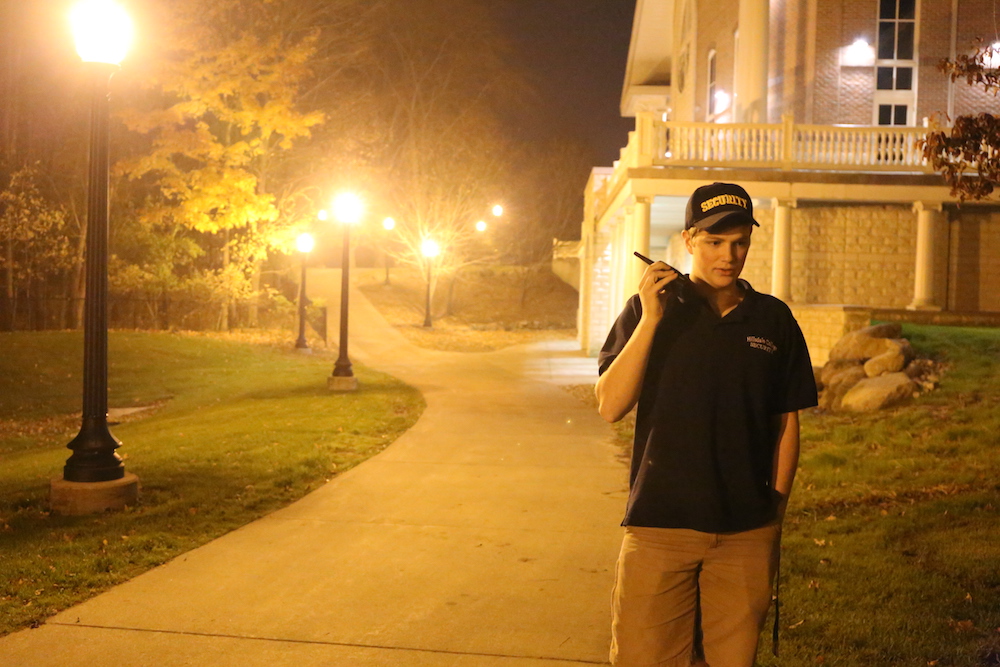
Hillsdale College altered its procedures for active-shooter situations this semester, though it still doesn’t permit licensed students, including veterans, to conceal carry on campus, a topic in national discussion following an attack on the Ohio State University’s campus Monday.
After the Hillsdale Police Department changed its procedure for active shooters this summer, the college’s campus security office followed suit to align with the steps taken by city police, Director of Campus Security Bill Whorley said. Although college administrators discussed allowing licensed students to conceal carry on campus in the spring, following several shootings across the country, no such policy has been adopted, Chief Administrative Officer Rich Péwé said.
“It could happen,” Péwé said. “We continue to think about that and listen to one another.”
Monday’s attack on Ohio State’s campus in which Abdul Razak Ali Artan, a Somali-born student at the university, injured 11 people by driving his car into a crowd and then stabbed individuals with a knife has increased discussion on campus carry and procedures for an active-shooter situation nationwide.
Ohio State’s security department recommended students remember to “Run, Hide, Fight” Monday when the campus went into lockdown. It is similar to the measures the college now teaches its employees called “Avoid, Deny, Defend.”
A product of Texas State University from research on shooting situations and their survivors, “Avoid, Deny, Defend” reminds people to avoid attackers, deny attackers access to their location, and defend themselves, if necessary.
“It’s very common sense, very basic,” Whorley said.
Hillsdale Chief of Police Scott Hephner said city police uses research on active shooter events to update its private protocol. City police also works with local schools and businesses to prepare for such situations.
“All of our officers are trained in responding to these situations, and we are always looking to update equipment that may be used in our response,” Hephner said. “These changes are to minimize casualties and decrease the time to stop the threat.”
Whorley said he works with city as well as county and state police to align the college’s procedures and recommendations with theirs.
Additionally, Hillsdale’s security office has implemented new initiatives to keep campus safe.
The department introduced the new Hillsdale College Emergency Response Team, or HCERT, this semester. It is a group of trained student volunteers that can assist with crowd and traffic control, first aid, and other tasks, during an emergency on campus.
Security also has recommended professors now close and lock classroom doors during instruction to prevent attackers from gaining access to them and their students.
Some faculty members, however, have criticized this policy, arguing locking classroom doors is too much of a disturbance, Professor of History David Raney said. The doors in many academic buildings lock from the outside and require a key.
“It can disrupt class, when a student leaves to go to the bathroom and is locked out or when a student arrives late,” Raney said. “The professor has to walk over and open the door and interrupt class.”
But the topic of campus carry has been met with even greater controversy at Hillsdale.
While it is illegal for people to carry firearms at the Ohio State University because state law forbids it, Michigan law prohibits campus carry only for the unlicensed and in classrooms and dormitories. As a private institution, Hillsdale, however, can add restrictions of its own.
The college does allow faculty members with concealed pistol licenses to have a firearm on them when not in a classroom, though it requests they notify Péwé’s office. This allows faculty members to be able to defend themselves, students, and colleagues in the case of an emergency and when first responders haven’t yet arrived, Péwé said.
Other than that, the college recommends students and visitors save the guns for the college’s John A. Halter Shooting Sports Center. The security office has a gun safe for students living on campus to store their weapons. It is also planning to build a separate holder for the increased amount of archery equipment students are bringing to campus, Whorley said.
Permitting faculty members to carry and forbidding students from doing so on campus aims to balance safety and security, Péwé said.
“We’re not interested in it being a gun-free zone,” Péwé said. “We’re trying to be practical.”
Raney — who is the John Anthony Halter chair in American history, the Constitution, and the Second Amendment — said he, however, disagrees. He said the college’s “one-size-fits-all” approach is “short-sighted,” especially when it comes to not permitting students who are veterans from carrying on campus.
“You end up effectively excluding a number of students who are eminently qualified and well-trained to be able to respond to a situation involving some kind of campus shooter,” Raney said.
Beyond safety, Raney said he and some of his colleagues have discussed how the college’s campus carry policy hurts the credibility of the institution that markets itself as “Pursuing Truth and Defending Liberty Since 1844,” he said.
“The college essentially opens itself up to hypocrisy on this issue by, in fact, seriously limiting a student’s ability to exercise a constitutional right,” Raney said.
Péwé said the policy, however, rests within the mission statement of the college.
“What’s the essence of the college? Truth, liberty, high moral character, high learning,” Péwé said “It’s important we carry out the mission and do so in the most effective way. We want to be safe and effective and have responsible people who want to do that as a deterrent.”
But Raney said the policy shows that the college doubts the responsibility of its students.
“In the end, it boils down to trust,” Raney said. “Does the institution trust its faculty? Yes. Does the institution trust its staff? Yes. Does it trust its students? At this point, the answer seems to be no.”
Although Péwé said the college does have concerns over liability when it comes to campus carry, Raney said the college could also become culpable, if an active shooter situation were to occur and a student couldn’t defend him or herself, though he or she is legally eligible to do so. Individuals must be at least 21 years old to have their concealed pistol license in Michigan.
“It deprives them, not only of a constitutional right, but a natural right to protect themselves, to life,” Raney said. “That should not be a problem at a place like Hillsdale…We need to make sure theory and practice come together as one.”
The chance of an active shooter situation happening on campus, however, is low. Nevertheless, Whorley said it is important to be prepared.
“In any scenario, you should respond calmly, reasonably, and without panic,” Whorley said. “We’re trying to get people to stop and think.”
