
Brooke Conrad | Collegian
It is not uncommon for the Hillsdale Humane Society to receive calls from people who have 90 cats living near their homes.
“People are just tired of the cat over-population,” said Renee Goshorn, the shelter’s manager. “They’re swarming.”
Dog and cat over-population in Hillsdale and surrounding counties is not a recent development. Litchfield Veterinarian Dr. John Lobdell said he has observed the over-population in the county for decades, especially with cats.
Cat populations can multiply very quickly. A conservative estimate from the Branch County Humane Society is if two cats have two litters each year over the course of eight years, and around 2.8 cats survive per litter, they and their offspring will produce 2,072,514 more cats.
Natural animal reproduction is not the only reason for the overpopulation, however. According to Goshorn, county citizens contribute to the problem by feeding stray animals they find on their farms, and by neglecting to spay or neuter them, either out of ignorance of the problem or being unable to afford such an operation.
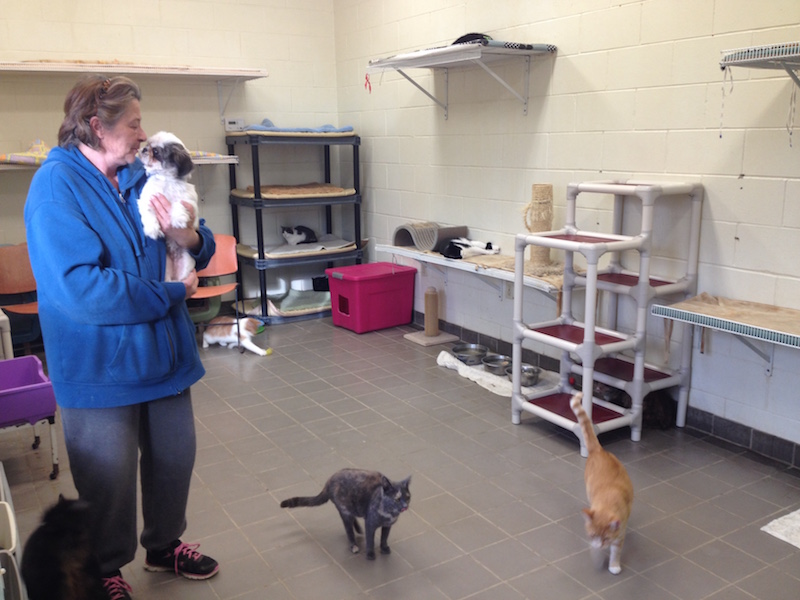
Goshorn said the Hillsdale Humane Society currently takes in around 300 cats per year. The shelter is usually at about 100 cats over capacity on any given day, as many people, without notice, simply drop off cats in the shelter’s outdoor pen.
Stray dogs are not as abundant in the area, in part because, according to Lobdell, most people assume cats can fend for themselves better than dogs can and so they kick them outside.
Hillsdale County has attempted to reduce the number of stray cats and dogs through two spaying and neutering programs, Barc and Catsnips, both of which operate through grants and community fundraisers. Barc charges $30 to $35, and Catsnips charges $20, which are both much cheaper than the usual clinic cost of $100.
The Branch County Humane Society also contributes to the cause through a monthly program in which they spay and neuter 15 to 20 stray cats and then release them. Hillsdale College students and other volunteers help out with the program each month. The initiative is based on an idea similar to that of the national Trap-Neuter-Return program, which attempts to reduce stray animal populations nationwide.
The Trap-Neuter-Return program is, in Lobdell’s opinion, very helpful in reducing the population, and Branch County Humane Society Manager Jan Nageldinger thinks it is just now catching on in the area. But according to owner of Hillsdale Veterinary Hospital Dr. Kim Baker, the Trap-Neuter-Return program has not been as effective in the county as people had hoped.
“The population can rebound so quickly,” he said. “Take just a couple of reproducing cats, and it doesn’t take long for the population to go up.”
Even though cats are more abundant in the area, there are still many dogs that need a home, and a lot of people in the area choose to buy dogs from a breeder instead of adopting them from the Humane Society.
According to Animal Control Deputy John Gates, dog breeders in the county often try to sell their dogs at the fairgrounds or on social media sites as a way of making money. But since there are no laws concerning animal litters in the county, the only thing Animal Control can do about the so-called “puppy mills” is make sure the dogs are healthy, properly vaccinated, and properly housed.
“It’s not illegal, even though it may be immoral or unethical,” he said.
There are no laws in the state of Michigan concerning cats either, since the state considers them to be feral animals. Animal Control deals only with dogs, and the most they can do with cats is tell people to spay and neuter the ones they find. Also, as temperatures decrease throughout the winter, people often call Animal Control to come check on the cats living near their homes, and Gates said that about 90 percent of the time he responds to a call, the animals are not in danger of harm.
Unless dogs show very aggressive tendencies, Animal Control transports strays to the Branch County Humane Society, and about 60 percent of these dogs are returned to their owners. Nageldinger said that over the past decade, Animal Control has greatly reduced the number of dogs it euthanizes, putting down only 7 in the past 5 years, all of which were “very aggressive.”
Despite efforts in the county to reduce cat and dog over-population, Goshorn said the prospects of alleviating the problem are not very positive.
“Spaying and neutering is the only way out,” she said, “and most can’t do it.”
