
For Assistant Professor of Physics Timothy Dolch, the night sky holds much more than mere starlight. As a specialist in astronomy, Dolch said he has long been fascinated with space.
“At night, I lie awake thinking of pulsars,” Dolch said. “I fell in love with astronomy as a high school freshman while building antennas in my backyard.”
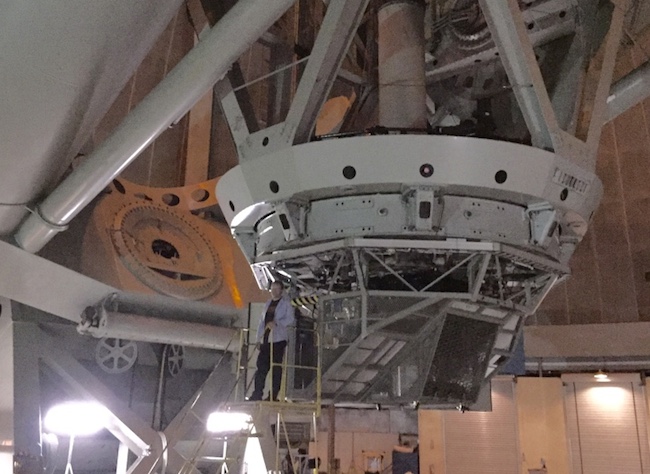
Beyond the doors of Strosacker 116, Dolch has a gateway to the radio telescope that can see into the vast galaxy. He also has access to the Green Bank Radio Telescope — almost 500 feet tall and 16 million pounds — situated in the United States National Radio Quiet Zone.
“It’s the largest moveable object in the world and we operate that radio telescope from this room,” Dolch said. “We also operate the Arecibo Observatory, which is another radio telescope located in Puerto Rico.”
These radio telescopes can detect phenomena like pulsars, which emit electromagnetic radiation.
“Pulsars are collapsed remnants of exploded stars,” Dolch said. “Stars have a life cycle to them and when they get old and explode they leave behind this remnant of a collapsed core of the star. This remnant is so dense that it is like the mass of our sun packed into a 10-kilometer sphere.”
A spoonful of material from one of these pulsars would weigh as much as a mountain.
“It’s so dense that regular atoms don’t even hold up,” Dolch said. “It turns into pure neutrons. It’s like an enormous atomic nucleus and it’s a very extreme form of matter.”
No Hillsdale students have ever seen a pulsar in the night sky because pulsars are impossible to image within the visible spectrum, hence the necessity for radio telescopes.
“Visible light, the light we see, is only a small part of the entire electromagnetic spectrum. There’s ultraviolet, x-rays, and radio waves. Radio waves that we use for communication are essentially waves of light that are redder than we can see, which corresponds to longer wavelength,” Dolch said.
With a radio telescope, he can observe pulsars at any time of day or weather condition, even during a cloudy afternoon.
“If we had eyes to see the sky in other wavelengths, we’d be able to see a lot of different things,” Dolch said.
Recently, Dolch, along with NANOGrav, an international collaboration on pulsars, observed an oddity about a particular nebula, which is a cloud gas in outer space, that resembles a guitar.
“Something about the shape has changed about that pulse and we don’t know why,” Dolch said. “I’m totally in love with figuring out why that is.”
Discovery of phenomena like massive nebulae and pulsars pose new questions for scientists, but can also lead to questions about fundamental aspects of science.
“We’re using pulsars to detect gravitational waves. As space is stretching out, the distance between these radio pulses [becomes larger] too,” Dolch said. “[This is] why we study it, because it’s new. When you study new things, you end up learning physics fundamentally.”
Dolch aims to create an environment in the classroom in which he can let the wonder of nature speak for herself. Freshman Alex Ancede, who is enrolled in one of Dolch’s introductory physics courses this semester, attests to this.
“I learned about the recent discovery that confirmed Einstein’s theory of distant black holes due to the detection of distortion of space-time at the LIGO Centers in Louisiana and Washington,” Ancede said. “It is fascinating.”
Dolch appears to teach in voracious manner, according to Ancede.
“He is very inspired by what he teaches,” Ancede said. “He loves to get his students involved. He keeps the class fun and entertaining and we are able to learn something at the same time.”
Freshman Jack Duffy agreed.
“Many humanities majors can have a tendency to write off science majors in much the same way a science major may view the humanities as subservient to his own field of study,” Duffy said. “Dr. Dolch entertained many different opinions on the matter, but was careful to present physics as integral to a complete understanding of the universe.”
Dolch said the proper study of nature and the universe should be a moving experience.
“Why is the universe beautiful? You have these experiences by letting nature move you,” Dolch said. “If that’s not happening [within someone], if you don’t get that sort of wow moment from nature, then I think something’s missing.”
