
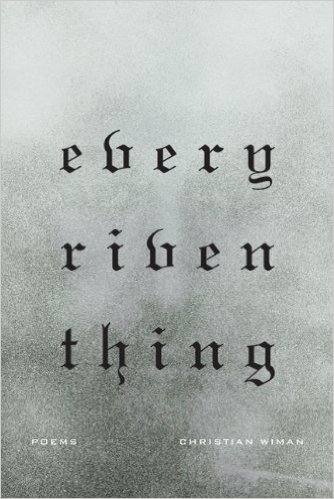
The silence of God can be suffocating. The modern God, whom Wiman refers to as his “Bright Abyss,” is not an unquestioned cornerstone. We find ourselves bereft of a habitually stated vision of God. No longer do we have the rituals or rhythms to spiritually cope with tragedies, the death of a daughter, a diagnosis of cancer. Poetry can be a way of speaking to God, crafting messages that do not await response.
Mark Jarman, in the final stanza of his poem “Questions for Ecclesiastes,” writes, “God who shall bring / every work into judgment, with every secret thing, / whether it be good or whether it be evil, who could / have shared what he knew with people who needed / urgently to hear it, / God kept a secret.” This silence is at the center of “Every Riven Thing” by Christian Wiman.
This slim volume contains prayerful poetry which earnestly chews at the modern notion of God. Divided into three sections, the book acts as a record of Wiman’s thoughts after his diagnosis of incurable blood cancer: a progression from existential quandary, to earthly meditation, to divine contemplation. Poems such as “After the Diagnosis” and “Darkcharms” discuss his diagnosis of cancer overtly, while others explore brokenness in the abstract through spare, heavy poems and longer narrative poems.
It is a somber ninety pages, but it is not without its joys. Within his tense passages, he wonders and delights in his words in the opening of his poem “Given a God More Playful”: “Given a god more playful / more sayful / less prone / to unreachable peaks / and silence at the heart / of stone.” The levity begins with a neologism —“sayful”— and follows with the double entendre couched in the word “prone.” Wiman offers an element of vulnerability or of a sleeping God. These lighter elements exist in tension with the content of the stanza in which Wiman likens God to a cold mountain. The complexity of this small stanza show that his poems are technically excellent as well as incisive.
Despite his tragic condition, Wiman contrasts his woeful reflections with poems that hope for salvation. In the title poem of the collection, he writes, “God goes belonging. To every riven thing he’s made / there is given one shade / shaped exactly to the thing itself.” God makes imperfect things, allowing for the possibility of perfection. Later, in the poem “One Time,” he writes, “And praise to the light that is not / yet, the dawn in which one bird believes, / crying not as if there had been no night / but as if there were no night in which it had not been.” This passage tells that the light will come. A departure from his earlier work, “Every Riven Thing” offers mature Christian contemplation along with the technical mastery displayed in his first collection, “The Long Home.” Wiman’s diagnosis forced him to confront human imperfection and salvation, to find the light in the pain.
Though the overall tenor of this collection is somber, there is great joy found in the realization of temporality, an idea with which he punctuates the collection. In the final poem, “Gone for the Day, She is the Day,” Wiman writes, “To love is to feel your death / given to you like a sentence, / to meet the judge’s eyes / as if there were a judge, / as if he had eyes, / and love.”
Wiman accepts the tensions between life and death, “bright abyss” and dark abyss, joy and sorrow.
Wiman uses his poetry to subvert the anxiety of unanswered prayers and unrelieved suffering. Wiman offers his poems to whoever is listening, even if he does not know exactly who it is, even if they do not respond.
