
“When your name is Antigone, there is only one part you can play; and she will have to play hers through to the end.”
Thus announces the narrator at the beginning of Jean Anouilh’s retelling of Sophocles’ “Antigone,” which opens tonight in the Quilhot Black Box at the Sage Center for the Arts.
The story is a World-War-II Era adaptation of Sophocles’ original tragedy, written as an anti-Nazi play that could subtly criticize the fascist regime under the veneer of an ancient Greek drama. The storyline is that of the original tragedy: Oedipus has died, and his daughters Antigone and Ismene live with their uncle King Creon. As the play begins, the girls’ two brothers, Eteocles and Polynices, have died in battle, and Creon has issued a decree forbidding anyone from providing Polynices proper burial. Antigone, however, determines to give her brother this final dignity and bury the body herself, despite Creon’s orders.
“People in the cast have said that it’s much more of a gray area of who’s right,” junior Dani Morey, the play’s director, said of how Anouilh’s adaptation differs from the original play. “In Sophocles it’s much more like Antigone’s right and Creon’s wrong. This time, it’s more of a gray area: well, sometimes when I watch it I think Creon’s right, and sometimes when I watch it I think Antigone’s right.”
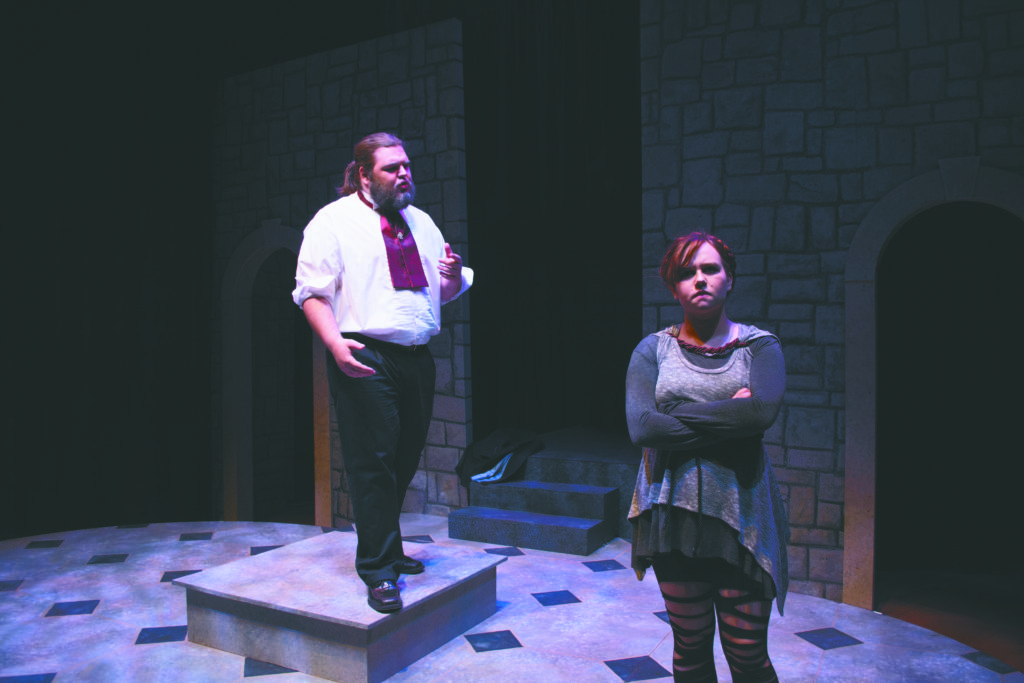
The set is a simple platform with two archways, a bare design reflective of the play’s tone.
“The world is bare, Haemon. And you are alone,” King Creon says to his son near the end of the play.
“Monochromatic and minimalist — that was my design vision,” Morey said.“That really appealed to me, just because I really enjoy minimalist theater, and focusing on the characters and the actors instead of big flashy sets and costumes.”
Indeed, the simplicity allows the acting itself to create the setting: sophomore Mark Naida portrays a passionate Haemon, Antigone’s lover, and sophomore Nikolai Dignoti delivers a convincing performance as King Creon, a man persuaded that there can be no such thing as heroism, but that all is merely — and absurdly — “politics.”
But while questions of heroism and the absurd permeate the play, Morey said the theme she felt particularly drawn to as a student director was that of coming-of-age.
“At the very end, Creon tells Haemon that he has to grow up and cease to be a child,” Morey said. “We feel a connection with that in college. This is our period of growing up and ceasing to be children. What do we do with the time that we have? We’re leaving childhood behind.”
Sophomore Chandler Lasch as Antigone, meanwhile, seamlessly transitions between the different facets of her complex character, going from silently brooding in a corner, to shrieking passionately at her guards, to tenderly embracing Haemon.
“She has this ability to be completely closed-off and hardened but also let the audience into what she’s thinking and feeling,” Morey said of Lasch. “She spends a lot of the show talking or a lot of the show sulking, and so her ability to make both of those equally interesting and kind of let the audience into her thought process in her way was what I really wanted for Antigone.”
The student-produced show plays April 7-9 as part of the Tower Players’ festival of student work, following the one-act “The Man of Destiny” which begins at 8 p.m. each night.
