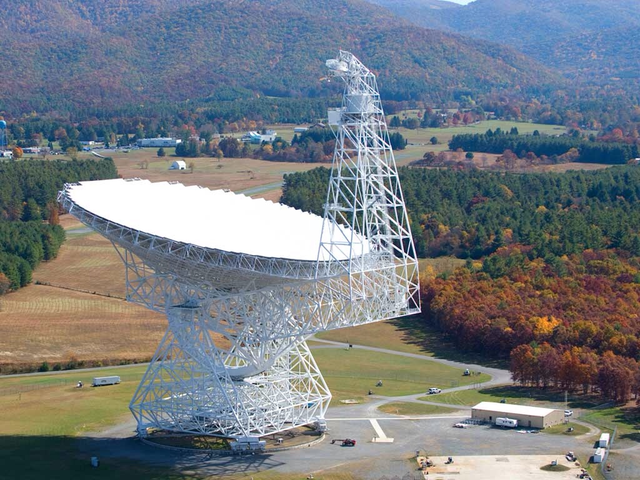
The 8,500-ton, 450-foot tall device can be controlled from a desktop computer in Hillsdale College’s physics department. Photo: National Radio Astronomy Observatory
In Green Bank, West Virginia, cell phones don’t work. There is no AM or FM radio or wireless devices of any kind. The town uses landlines and cables for internet and telephone.
That is because, in this “radio quiet zone,” the world’s largest movable land object rests. Amidst farms and forested hills, a massive white dish, capable of holding a football field while still comfortably seating thousands on either side, stands. Barns lie like pebbles in its shadow.
This gigantic dish receives radio signals from space and helps scientists detect gravitational waves. The 8,500-ton, 450-foot tall device can be controlled from a desktop computer in Hillsdale College’s physics department.
“We’re in a new frontier of astronomy,” senior physics and politics major Cody Jessup said.
Twice a month, Assistant Professor of Physics Timothy Dolch and an independent study group enter the Strosacker Science Center at 6 a.m. to record data from the world’s largest steerable radio telescope. Dolch is a member of the North American Nanohertz Observatory for Gravitational Waves, a group that hopes to detect gravitational waves, just as senior Joshua Ramette did with LIGO.
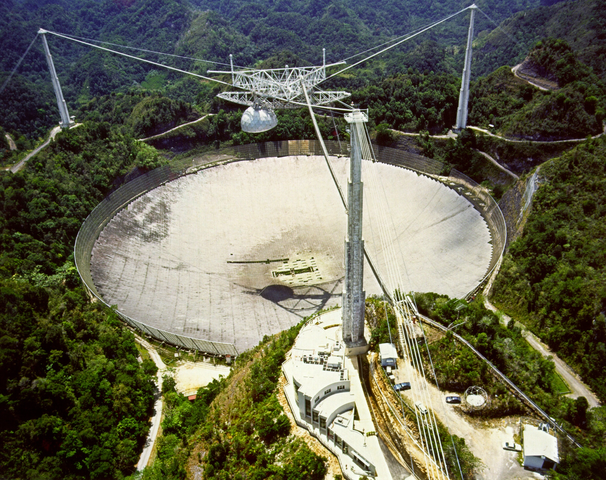
Along with the Green Bank telescope, the students also take readings from a radio telescope at the Arecibo Observatory in Puerto Rico. This device, the largest single dish in the world, sits in the ground and tracks movement across its surface. Measuring 1,000 feet in diameter, it was a major set piece for the James Bond film, “GoldenEye,” but its practical use is far more exciting.
The Arecibo Observatory in Arecibo, Puerto Rico. The telescope was featured in Goldeneye. Photo: National Astronomy and Ionosphere Center
Jessup and junior physics and math major Daniel Halmrast have been working with Dolch, as the first Hillsdale undergraduates to participate in NANOGrav’s research. Dolch has been a part of the project for five years, and NANOGrav has passed 12 years in collecting data. The research involves waves with year-long periods, and the scientists finally have enough data to search for a pattern that may indicate a gravitational wave.
“There are many different ways of detecting gravitational waves,” Dolch said. “Ours are with pulsars.”
Pulsars, according to Dolch, are stars made entirely of neutrons that rapidly spin and shoot a beam of radio emission at the telescope. NANOGrav studies an array of 49 pulsars, using the two radio telescopes to receive signals from the stars.
“We see it like a pulse,” he said. “It goes ‘doot-doot-doot-doot’ if you put it through a speaker. These are scattered throughout our galaxy, and we can use those as a tool to detect gravitational waves.”
NANOGrav is searching for gravitational waves, like LIGO, but on a much larger scale.
“These waves come from pairs of black holes that are spinning towards each other and ultimately merge,” Dolch said. “What LIGO detected are a pair of black holes in which each was 30 times the mass of the sun, which is pretty big to begin with. The kind of gravitational waves we’re looking for come from merging supermassive black holes. Each one is 1 billion times the mass of the sun.”
The scientists are looking for disturbances in the time it takes a pulse to reach each telescope. If the signal reaches the telescopes at different times, then a wave may have caused the change.
“If you receive a radio pulse, you form what is called a timing model,” Jessup said. “The timing model is going to predict when the next wave or the next radio signal is supposed to come in. The way we’re going to detect a gravitational wave is due to a change in the time of arrival of a radio pulse.”
According to Halmrast, the detection of these signals could radically change the way scientists study the universe. The field of radio astronomy was established in the 1930s, but scientists hadn’t been able to directly detect gravitational waves until LIGO’s discovery last September.
“It’s opening a completely new area of astronomy,” Halmrast said. “It’s likened to when we first discovered that we could look at X-rays and radio waves, and all that from space and not just the visual band. That opened up astronomy.”
He explained that gravitational waves, like light, can be measured by frequency over a spectrum. While the radio emissions aren’t visible light, they offer a new perspective on the universe.
“This is the same thing,” Halmrast said. “Now instead of just looking at it through the electromagnetic spectrum, we can look at these gravitational waves.”
“It turns out the universe sends in radio signals and we can hear the universe,” Jessup said.
On March 13, Halmrast and Jessup traveled with Dolch to his alma mater, the California Institute of Technology, to attend a two-day NANOGrav conference. Each day, the students heard a lecture and worked on a different project. The work was meant to improve their understanding of the detection of the waves.
“We’d simulate the data and then we’d try and extract the information about the sine wave using data analysis techniques,” said Halmrast.
The data wasn’t a clear line at first, because of interference with the signal. The s-shaped curve of the sine wave was only visible once the researchers ignored the extra “noise,” Halmrast explained. The readings could be distorted by the material between earth and the stars, called “interstellar medium.”
“If there were nothing at all between us and distant stars, we would receive the radio signals exactly as they were sent from the pulsar,” Dolch said.
Because they spent more than 25 hours observing the telescope data, Jessup and Halmrast are both authors on NANOGrav’s next data release. While they shared excitement over their work and accomplishments, the students said using one of the world’s largest telescopes and studying groundbreaking scientific evidence was just part of class.
“It was just an independent study for us,” Halmrast said. “It was a fantastic opportunity though.”