
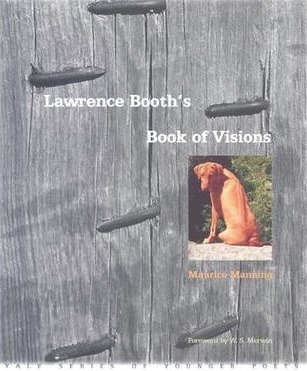
 First, let’s introduce the characters. There’s Red Dog, the loyal companion, and Black Damon, the trusty friend. There’s Mad Daddy, “with the shotgun full of history, / The horse and the flame, and the domino shoes.”
And then there’s Lawrence Booth, self-styled hero, lover of nature, brilliant, boisterous, starry-eyed dreamer, and “bull’s-eye boy.”
The setting is a 37-acre plot in rural Kentucky: young Booth’s home and the Great Field of his dreams.
The playwright and poet is Maurice Manning in his first collection of poetry, “Lawrence Booth’s Book of Visions,” a comet of a coming-of-age tale that won the Yale Younger Poets Award in 2001.
This book of visions didn’t come in a flash of lightning for Manning, who spent 10 years on the project while completing his master’s degree in English at the University of Alabama. But in its slow refinement by fire, the work reached mythic proportions. Manning incorporates his rural setting, realistic characters, and a compelling narrative into a fiery tale of growing up in a South that is not what it once was.
Enter Lawrence Booth, a poor Kentucky farm boy from a family struggling with poverty and substance abuse, for whom life in the South is still a grand, romantic tale of heroes, beautiful women, breathtaking landscapes, and big dreams.
Young Booth loves his “blood brother” Black Damon fiercely, but he may love Red Dog more. He likes to hear his father’s old war stories, but he doesn’t like when Mad Daddy drinks and hits his dog. He loves playing outside, and he can’t stand math or technology or TV.
Booth’s voice is that of a modern prophet: his visions are brilliant and inspired, and he’s
unafraid to set the world on fire with his dreams for a better future.
Yet Manning allows readers to see the young prophet as an idealist whose dreams are sometimes too grand for this world. The poet’s master stroke lies in this self-conscious earnestness, mixing rapturous odes to nature with brutally honest depictions of Booth’s poverty-stricken, violent family life. Thus, the reader’s knowing smile is not without compassion when Booth rails against modern culture’s disrespect for nature: “Oh, you, and your cantankerous visions of peace.”
Manning is often compared to writer and poet Robert Penn Warren — both for his Southern settings and narrative-driven poetry. And though Manning and his narrator are no strangers to poetic flights of fancy in wordplays like “featherweightiness” and a rock called “unforgettenite,” it’s the power of Booth’s story that drives the poetry.
Form makes a frame for the collection’s content, as well. A mathematical proof of misery sketches Booth’s family troubles as a schoolboy, rapturous odes to nature reveal Booth’s love for his rural home, and the “wanted” section of a newspaper advertises his quest for love.
With his down-to-earth characters and familiar settings, Manning aims to revive a “populist poetry” that is “accessible to more people.” Though he employs a wide variety of poetic forms, cloaked literary references, and an impressive array of voices, Manning remains intensely focused on his “bull’s-eye boy,” driving readers relentlessly toward a fiery climax — “I love you like a furnace, boy!” — that pits Booth against his father in a fiery confrontation.
In “Lawrence Booth’s Book of Visions,” Manning writes the life of a small-town Southern boy as a drama of mythic proportions. And whether Booth’s drama is ultimately comic or tragic, it’s certainly cathartic to read.
Through the character of Lawrence Booth, Manning’s readers squint at the bright flame of collision between dream and reality and come away cleansed — if singed and a bit tender — from the experience.
