
Rachael Reynolds | Collegian
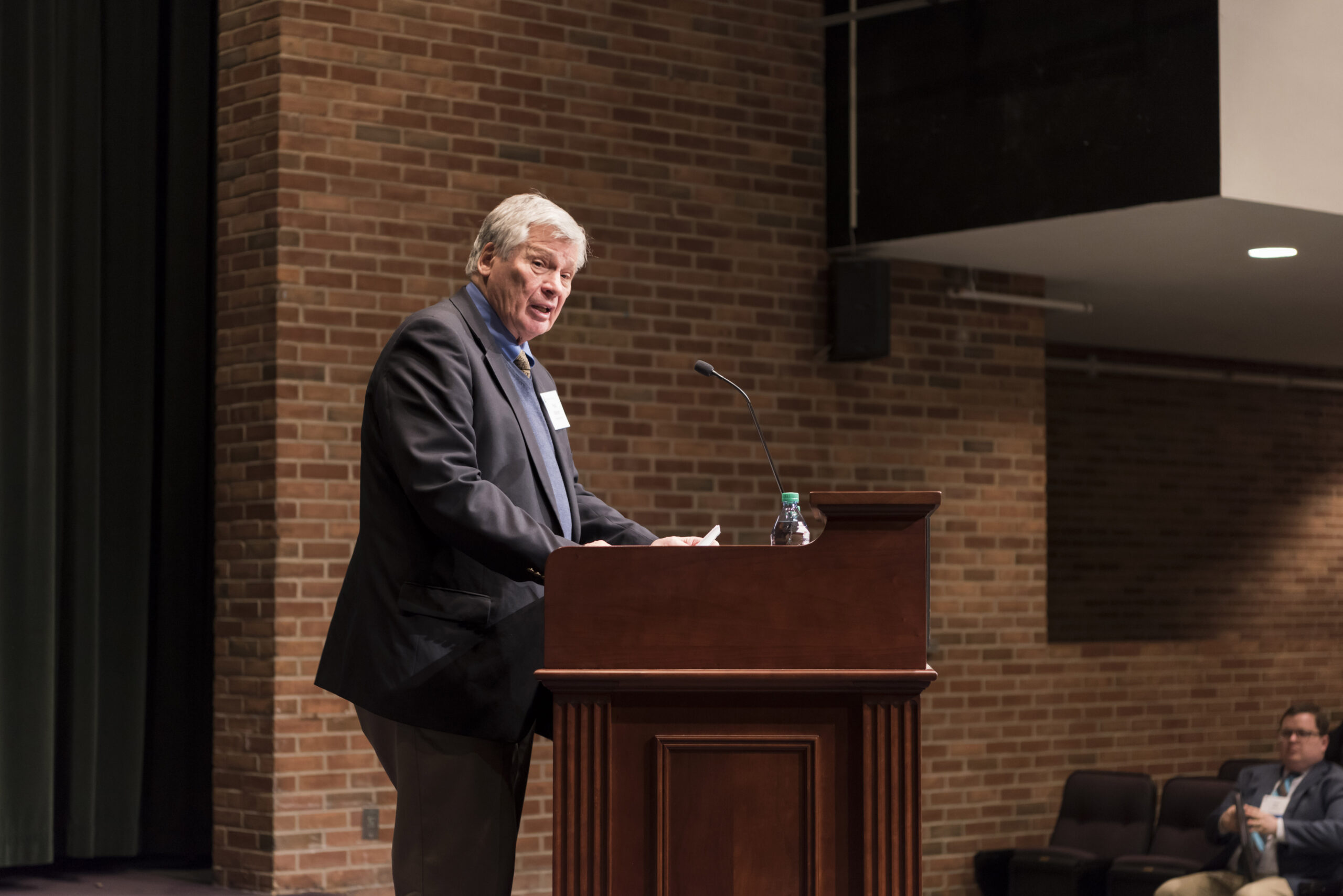
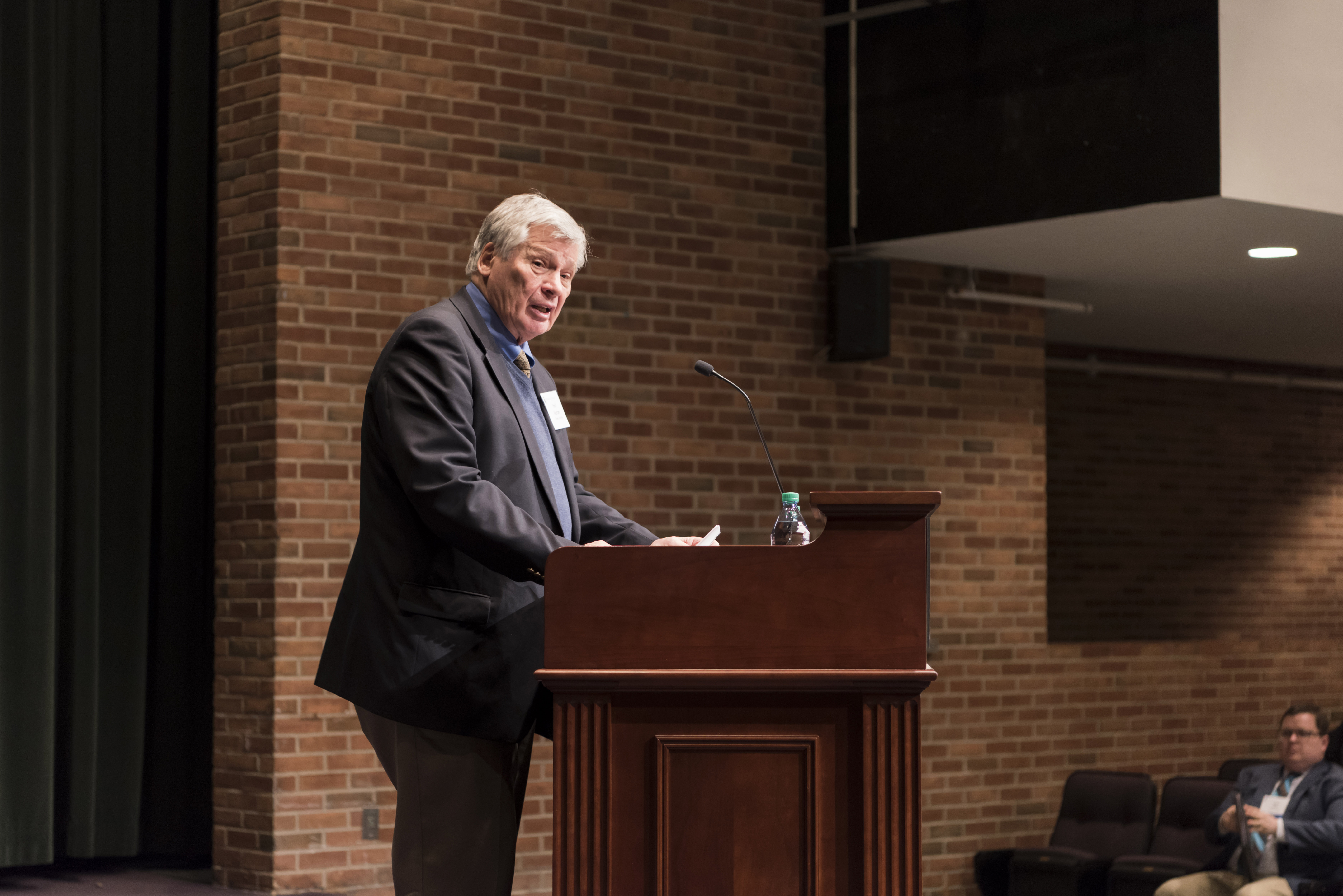
Author of “The Whole Harmonium: The Life of Wallace Stevens” Paul Mariana speaks on Tuesday, Feb. 2 in Phillips Auditorium for CCA III.
How did you begin with biographies?
My first biography was on William Carlos Williams. My mother’s family is from Paterson, New Jersey. I was working on my Ph.D., and I went into a bookstore in Queens and I saw this book of poetry and it said “Patterson.” I thought: “Who in his right mind would write a poem about Paterson, NJ.” Because there’s the Passaic River there, which was sort of like Flint in a sense or lower Massachussetts, you know, an industrial city. My relatives—Aunts and uncles, great grandfather worked in the mills along the Passaic River. There was that connection with my mother’s family but I had studied to be in Victorian literature, but when I went to University of Massachusetts they needed someone in modern and I couldn’t believe my luck because that was exactly what I wanted to teach.
I found myself reading more and more Williams, and I said, “this guy is good.” I just couldn’t get enough of him. But I said, “I’m not a biographer.” There were no courses in writing biography, at least then, so I thought I’d write a history of Paterson. How Williams came to write “Paterson.” I remember speaking with an editor at Oxford University Press who said, “I’m not interested in this book that you’re doing, but if you’re willing to write a biography of Williams, that’s something I’d really be interested in, and we could actually give you $1,000. Back then, salary was $10,000, starting out with a doctorate as an assistant professor. Anyway, I was in love with the idea. Obviously, it wasn’t for the money. So I said okay. I spent years researching and then writing it. I was lucky enough to meet the family: two sons, daughters-in-law, the grandchildren. He grew up in the Rutherford area of New Jersey. To meet them, to interview them, I just fell in love with the subject.
What was it about Williams that you loved?
I’m from a working class background, the oldest of seven children. There was a guy who at the time that T.S. Eliot was writing “The Wasteland,” or Wallace Stevens was writing the poems for “Harmonium,” or Ezra Pound was writing the poems that would lead to the Cantos, you know, very complex stuff, here’s this poet who’s interested in the language of New Jersey. What did people sound like on the streets of New Jersey? Sort of like what Robert Frost was doing for New England. But being from New York or being from New Jersey, I mean, he got it. I wanted to be a poet myself, and that’s why I’ve done biographies only of poets. There weren’t many classes for this in the MFA, and the first way I got into them was through the manuscript: How the poet wrote this line or crossed out that line, etc. So I was learning two things: How to write a life, and how to write poetry. So that’s where it began.
Besides the manuscripts of the poets, what other sources did you use to come to know the poets?
I looked at a lot of letters and it was fascinating because they hadn’t been published. So in a sense, it was like being an insider. Here I am, looking at letters to and from Williams and Ezra Pound or Marian Moore, a lot of poets whose names we don’t remember now, and then on top of that, there were the actual poems — these weren’t finished ones. They were crossed out, ex-ed out, etc. And I began to see, “Oh, that’s why he’s breaking it this way. That’s why he’s writing that line.” This is why he’s crossing this out. It was very economistic. That was one of the big lessons. In other words, let’s cut this out and get to the heart of it. He caught the American idiom as it was actually being spoken on the streets of New Jersey. That’s what he wanted to get. What was the music of American language? In that sense, he follows in the tradition of Walt Whitman, for example. And that fascinated me, because he sounded like my relatives.
