
Breana Noble | Collegian
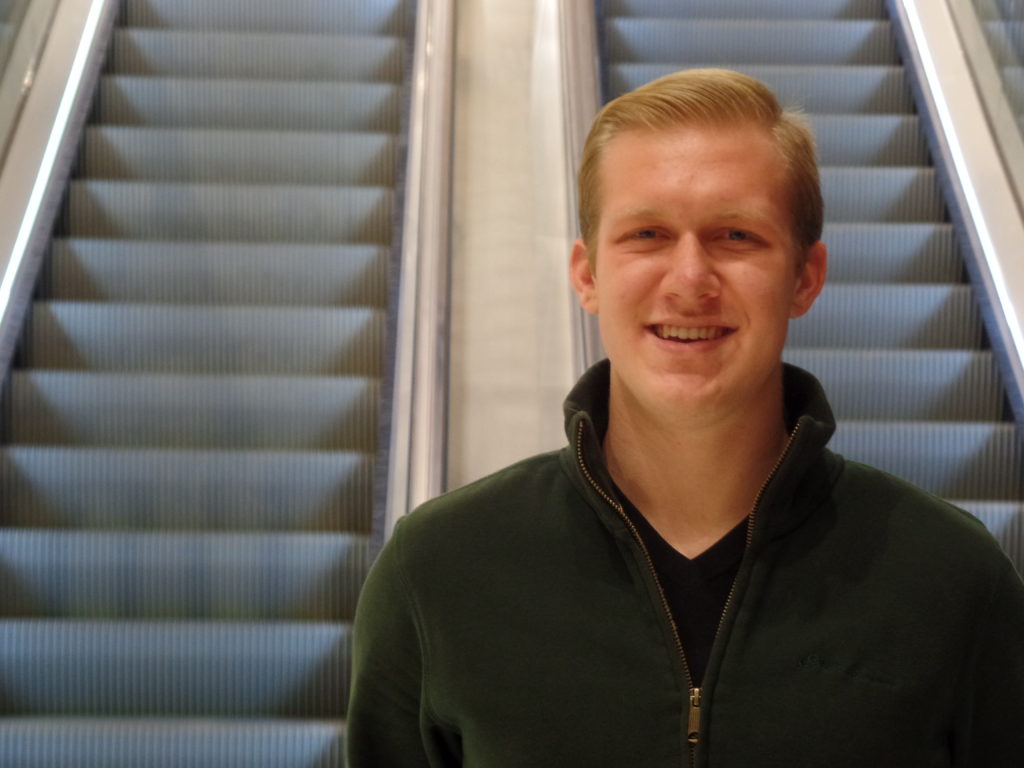
Sophomore Noah Weinrich stands in front of the Searle Center’s escalators after earning scholarship for searching the Web of ways to make them start and stop when people walk up to them.
Fifteen minutes could save you $250 or more on tuition. At least, that’s what happened for sophomores Madison Frame and Noah Weinrich.
After Hillsdale College President Larry Arnn announced a challenge to students at the Sophomore Sunday Brunch on Sept. 27, the students answered the call with an Internet search on their cellphones, and he rewarded them monetarily. Arnn requested the sophomores find a way in which the Searle Center’s escalators could turn on and off depending on use.
“I think it inefficient to have them running all the time when not being used (we do not), but a shame not to have them available anytime anyone wants to use them,” Arnn said in an email.
Frame and Weinrich did a quick Web search to find already-existing technology that fulfilled the challenge, and they forwarded the links to Arnn.
“I was sitting there thinking, ‘Dr. Arnn is a really intelligent man, but there’s no way he’s the first to come up with this concept,’” Frame said.
Frame said she submitted several links with technology that looked like they were in commercial use, and Weinrich emailed a URL from Hitachi’s website. Several days later, both received a message from Financial Aid Director Rich Moeggenberg congratulating them on a one-time $250 scholarship from the president’s discretionary fund.
The original proposition made by Arnn at the luncheon stated the individual who finds a legal loophole to allow the escalator to stop when no one is riding and start up when a person walks toward it would receive a $1,000 scholarship. A student who invented the technology to complete the challenge would earn $25,000, half the cost of tuition.
Frame and Weinrich did not earn the full amount because they “hadn’t really done anything special,” Frame said.
“For taking 15 minutes, this was the best work-to-reward payment I’ve gotten ever,” Frame said.
If the college decides to use one of the products they sent to Arnn, however, they could receive a larger scholarship.
Chief Administrative Officer Rich Péwé said the submission mostly involved light sensor and motion sensor technology, used for knowing when someone is walking toward the escalator so that it can speed up to the rate at which it must run.
“It’s possible, but there’s a cost factor,” Péwé said.
As for the other half of the challenge, Péwé said the college was originally told it could not install the technology. Upon further review of Michigan and federal regulations, however, Péwé said administrators found their goal of switching on and off the escalators depending on use to be legal under certain conditions.
These specifications, however, require an escalator that can change speeds, a capability the Searle Center’s escalators lack, Péwé said. In order to have the mechanisms that allow for variable speeds, the college would have to pay around $30,000 for the upgrade.
“If it is feasible, we can think about doing it,” Péwé said.
Frame and Weinrich both said they weren’t at the luncheon if Arnn’s proposition was legit because when he got to the stage to make his presentation at the brunch, his typed speech had disappeared from his tablet.
“I really wasn’t sure how serious he was because the speech was so off-the-cuff,” Frame said. “I sent the links out like a note in a bottle. I didn’t really expect anything to come out of it.”
Frame and Weinrich said it shocked them more people didn’t think to do it.
“I think people need to be more opportunistic,” Weinrich said. “We all have access to these things right at our fingerprints.”
