
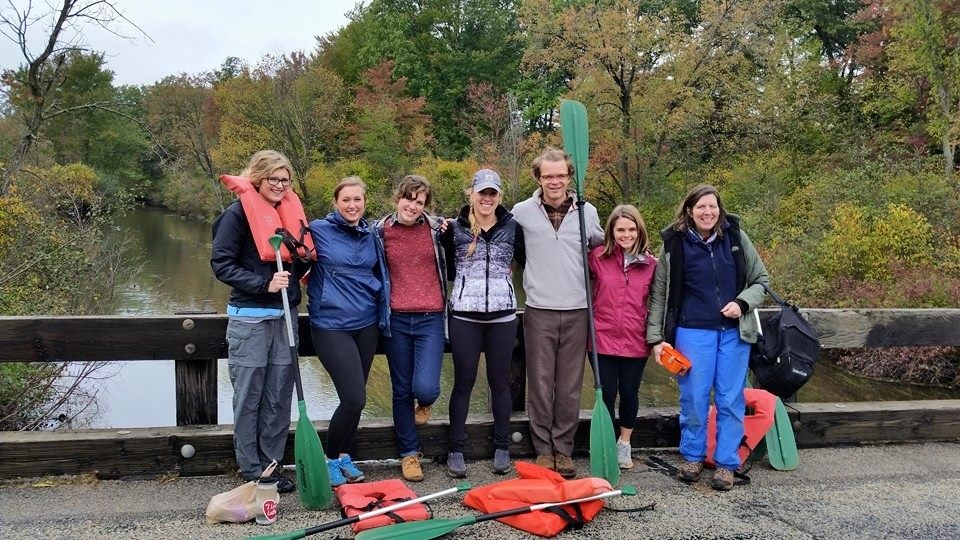
The path leading to her interest in the environment was long and difficult, but ultimately worth it. Now, Rosenberg shares that passion with Hillsdale locals and college students.
As program coordinator, Rosenberg organizes fun, informational events including nature walks, classes on plant pressing and seed saving, and larger events such as Autumn in the Arb and the Winter Lights Festival and Open House. At the college, she teaches an introductory horticulture class, as well as an Environmental Stewardship class offered for the first time this semester through the biology department.
According to Ranessa Cooper, professor of biology and director of Slayton Arboretum, the class allows Rosenberg to share her dedication to the arboretum through teaching and facilitates student participation.
“I helped to facilitate it, but this was really Laurie’s suggestion and idea,” Cooper said. “She really enjoys teaching, and I was glad to help give her an opportunity to do that, as well as give our students an opportunity to participate in a restoration project.”
Although the class is new to the college, student work in the arboretum is a long-standing tradition.
“The arboretum has always been maintained by students. If you look at everything in the arboretum — this goes back to the 1920s — Dr. Barber and his students built all the walls, the buildings, made the trails, and they planted the trees,” Rosenberg said. “Students were involved with everything in the arboretum. This was just a way to continue that tradition, and do it in a more formal way.”
Students in the class are working on restoring a witch hazel collection started by the arboretum’s first director, former Professor of Biology Bertram A. Barber. The witch hazel collection was one of several others in need of restoration, including Barber’s magnolia and lilac collections.
“It seemed like the best one to start with, since a little bit of effort would create a large return,” Rosenberg said.
Part of the restoration process involves planning out the specific work that needs to be done. Students in the class are divided into three groups: those working to map the plant community, those assessing the soil quality, and those managing the threat that deer pose to the plants.
Through the class, Rosenberg is able to share one of her favorite parts of ecology: figuring out the challenges to restoration projects posed by specific environments.
“That to me is what science is all about — trying to figure something out that hasn’t been figured out before. It’s like solving a puzzle.” she said.
Rosenberg’s involvement with the arboretum has allowed her to share her interest in the environment with students at the college, such as freshman Caroline Andrews, who works with Rosenberg in the arboretum.
“I really like learning about all of the plants,” she said. “A lot of it is things that I never knew. I was never really interested in plants until I started working there.”
Although Rosenberg has devoted her career to studying the environment and teaching others about it, science was not always her a primary interest.
“When I was in college, I was going to be a music major,” she said. “I was going to be a junior high band director.”
Her plan changed after taking an ecology course in the Rocky Mountains through one of Michigan State University’s study abroad programs.
“I could have gone to a class, to a lecture hall, and had labs, but I had an opportunity to take a course in the Canadian Rockies,” Rosenberg said. “To me, that was killing many birds with one stone — it was an adventure, it was someplace I’d never been. It was fulfilling a science credit. It was going to be a cool class.”
“I wanted to do something that was interesting and exciting, and I wanted to see the world. I wanted to challenge myself,” she said.
While encountering nature firsthand, she developed a riveting interest in the class’s subject matter.
“It completely changed my life,” she said. “I ended up falling in love with the field of ecology.”
As she backpacked through in the mountains, she became interested in learning more about the processes that shaped the breath-taking environment. Her curiosity only deepened while she wrote the research paper for the class.
Her new-found interest, however. posed a challenge when she changed her major from music to natural resources and environmental education as a junior. Rosenberg worked hard to master the demanding coursework despite having little background in the sciences.
During the struggle, Rosenberg equated the challenge of mountain climbing during the ecology class to the challenge of changing majors and taking tough classes. She also had little experience with camping.
“I was backpacking and climbing mountains in grizzly bear country, and I had never even camped before that class,” she said. “I made a lot of strides during the three weeks that I was out in the Canadian Rockies in terms of taking on challenges that were very difficult that I was able to overcome.”
Through the class, Rosenberg went from being the last in the backpacking group to leading the pack during a treacherous storm.
“It was an experience for me where I started out a very low level, and through perseverance, I conquered and came out at a higher level.” she said. “I took what I learned from that experience and applied it to going into the sciences. I was able to do that and succeed.”
Now, as a teacher, Rosenberg uses her own encounter with nature to fuel her passion for teaching others.
“To me, that is one of the big pluses about being involved in the natural environment: it gives you the opportunity to have experiences that can be life-changing,” she said. “That’s one of the reasons I’m such an advocate about experiencing the natural environment and getting out there and doing things, because it gave that to me.”
