
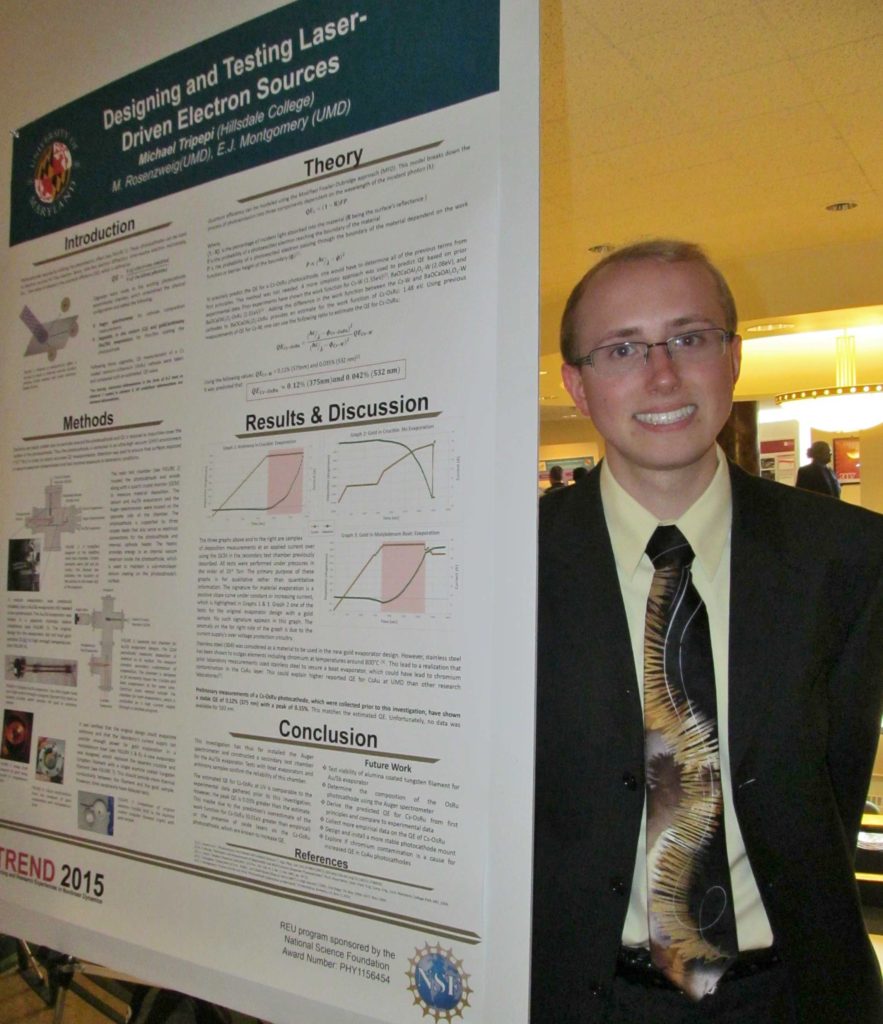
Junior physics major Michael Tripepi’s eyes light up when he hears “photoelectric experiment.”
At his summer internship at the University of Maryland, College Park, Tripepi researched the photoelectric effect, testing the efficiency of materials in creating high-power laser technology. His dedication to physics shines through in his work at Hillsdale, lighting the way for future research in solid state physics.
Tripepi was accepted into Training and Research Experiences in Nonlinear Dynamics, an internship program sponsored by the National Science Foundation offering research opportunities for undergraduates studying physics.
For ten weeks, Tripepi worked under Faculty Research Associate Eric Montgomery on a project that tests photocathodes, materials that emit electrons when struck by light. This phenomenon is known as the photoelectric effect, and electrons generated in this way can be used to create high-powered lasers for use in the military and medical fields.
Montgomery and his team worked to create a model for testing what materials produce electrons efficiently.
“We simply ask, ‘What is the number of electrons that come off the surface, and what is the laser energy we put into it?’ That’s useful information for those who want to use photocathodes in future applications,” Tripepi said.
He said more research is needed, however.
“You want lasers with high power, which is hopefully what these photocathodes can be used for. We’re trying to research what materials can be put together to create an electron source for electron microscopes that will be well equipped for many purposes.”
Though the concepts behind his research are abstract, Tripepi said that much of his work in the laboratory was both practical and technical.
“Most of my days were spent working on equipment, setup, and a lot of troubleshooting,” Tripepi said. “I learned how to use a lot of new equipment.”
According to Tripepi, involvement in Hillsdale’s physics program provided the basic skills necessary for his internship. A physics and math double major, Tripepi spends time doing homework with Joshua Ramette, a fellow junior also studying physics and math.
“We basically took over the physics lounge sophomore year,” Ramette said.
Professor of Physics Jim Peters introduced Tripepi to quantum mechanics.
“It’s a great joy to share a marvelous theory with people, and he got caught up in it,” said Peters.
Tripepi’s dedication to physics is evident in his leadership in the subject, as well. As president of the Society of Physics Students, Tripepi hosts public presentations, shows weekly educational videos, and plans research.
As a member of a department that graduates about five students a year, Tripepi said he aims to foster greater appreciation for physics as a discipline within the liberal arts.
“In this assembly of truth, it’s natural to ask what the natural world itself has to say,” Tripepi said. “Physics makes us aware of the assumptions we make. It gives us a sense of perspective.”
According to Tripepi, physics offers an opportunity to describe the world in new ways.
“People often use analogies to describe the world,” Tripepi said.
Research in physics provides new angles from which to view and explain the universe.
For example, “Entropy is a physics concept that changed how we see things,” he said.
Peters claims that the study of physics, with its emphasis on problem solving, prepares students for success in many fields.
“In physics, we teach problem solving using math applied to the practical world,” Peters said. “All jobs require that you solve problems. We’re masters at teaching problem solving.”
In the future, Tripepi plans to pursue further research in solid state mechanics.
Peters said it is work like Tripepi’s that promises to illuminate the exploration of the liberal arts through physics.
“His research will make the world a better place,” Peters said. “The field of solid state physics will make materials for better computers, better sensors, and better cell phones in the future.”
