
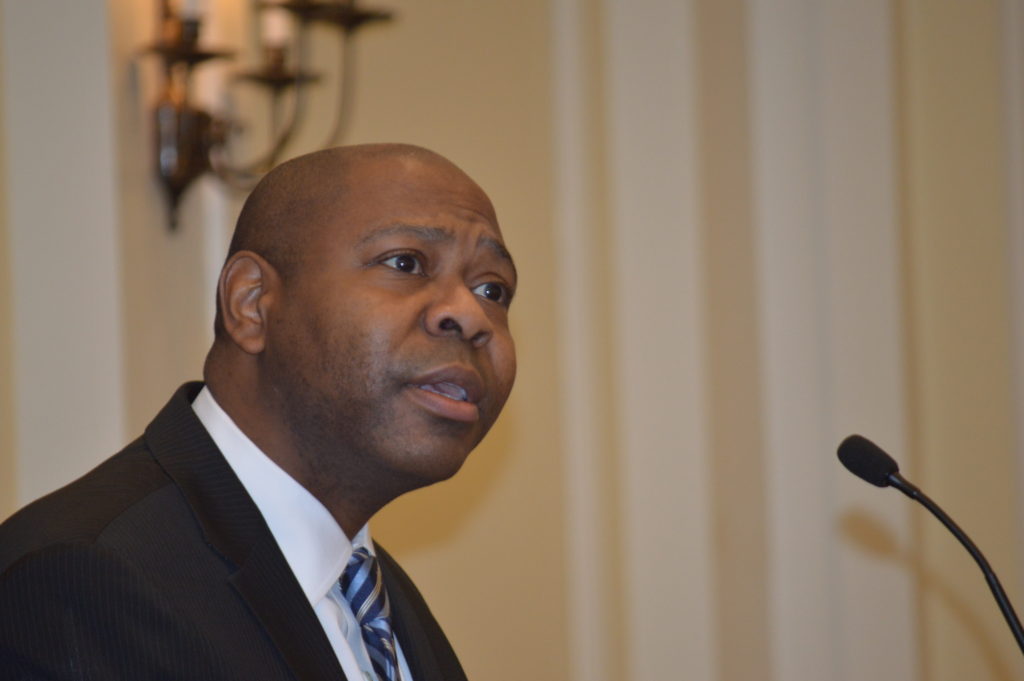
Jason Riley is a member of The Wall Street Journal editorial board, and often appears on Journal Editorial Report on Fox News. He is the author of two books: “Let Them In: The Case for Open Borders,” and “Please Stop Helping Us: How Liberals Make It Harder for Blacks to Succeed.” Riley spoke at the Allan P. Kirby Center for Constitutional Studies and Citizenship in Washington, D.C., as part of the Kirby Center’s monthly AWC Family Foundation Lecture series on Jan. 30.
As a conservative, if you were talking to someone who was claiming racial injustice, how do you sensibly respond to those claims?
You’d have to ask them to define racial injustice. I think too often today, people look at the racial makeup of the police force and if they don’t see a proportionate number of blacks as represented in society on that police force, they assume there must be racist practices going on. That’s not necessarily the case. They’re looking at outcomes and assuming racism is producing those outcomes.
A few months back, you had Jesse Jackson complaining about the dearth of blacks on the staffs of Google, Facebook, Yahoo, Oracle, and Intel, assuming racism was the reason. We know those companies are hiring from the most selective schools in America — not only the most selective schools, but the kids that graduate from the most difficult disciplines of those schools. And blacks are simply underrepresented in that pool of people.
There’s no evidence that a black person who met the same credentials as the typical hire at Yahoo or Google has been turned away. All Jesse Jackson or Al Sharpton is looking at is the outcomes: who’s on staff. And if they don’t see “X” percentage of blacks, they’re assuming racism is at play.
The Department of Housing and Urban Development has sued various suburban counties because of the residential housing patterns. They look at a map and they see too many whites bunched together in certain communities and not enough blacks living there. And they assume something nefarious is going on here.
With the recent events in Ferguson, Missouri, and the history of events like the Trayvon Martin case, why is it so important for young people to understand how the media affects trials and the public’s perception of them?
My problem with how the media has covered these events has been the failure to put them in context. There’s a narrative out there — a false narrative — that the black homicide rate in America is what it is because cops are shooting black people. The reality is that 98 percent of black shootings don’t involve cops.
Yet you have these protesters marching all over the country pretending that our morgues and cemeteries are full of young black men because they’re being gunned down by cops. And everyone from the president on down has been playing along with this narrative.
If you care about black lives — and we see these ‘black lives matter’ banners all over the place — it seems to me that you would be focused on the 98 percent of killings that do not involve the police, not the two percent that do. That two percent are unjustified and justified killings of blacks by cops — and most of that two percent are of course justified killings like people resisting arrest, people not cooperating with the police, people attacking the police, and so forth.
The media has failed to make that point clear. You get a Ferguson, and you get a Trayvon Martin, and we start getting conversations about tensions between the police and black community. Rarely do we talk about black crime rates, which I think are at the root of the tensions between the black community and the police. If you want to alleviate those tensions, you need to address the behavior driving those tensions. But we don’t like to talk about that: If you’re black and you talk about it, you’re a sellout. If you’re white and you talk about it, you’re a racist.
And then you have a whole black civil rights industry out there who has a vested interest in blaming all bad outcomes in the black community on racism. So they see situations like this and they pounce.
Why do you think the crime rate in the black community is so high?
If you go back to as recently as the early 1960s, you’ll see that most black children in America were raised by mother and father. Today more than 70 percent are not. And in some of our inner cities, it’s as high as 80 or 90 percent. I think a lot of these outcomes can be traced to the breakdown of the black family, which began in earnest in the 1960s — which is ironic because that is also the start of the great society programs, which were aimed at helping the black family.
-Compiled by Vivian Hughbanks
