
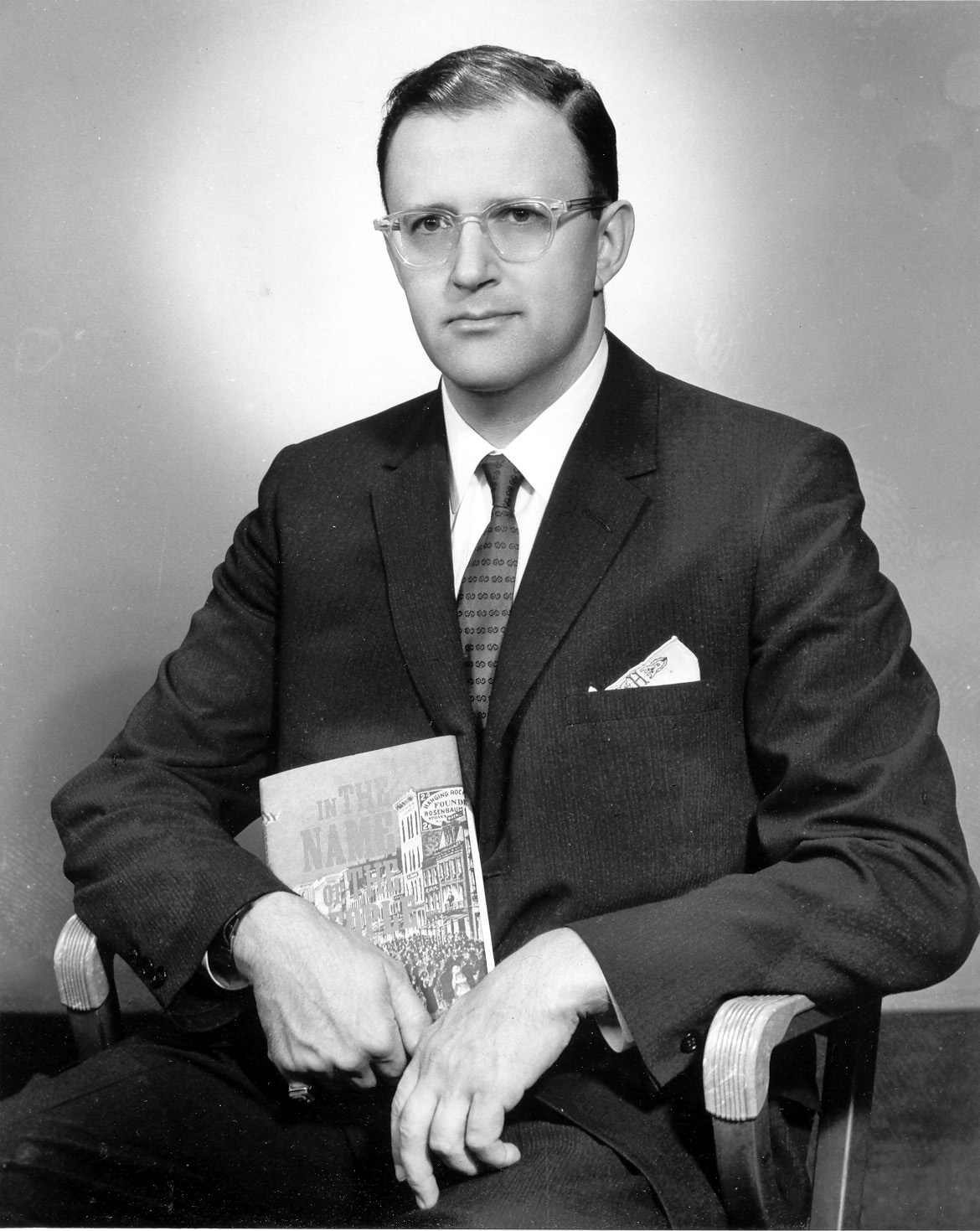
Harry Victor Jaffa — renowned historian, political theorist, and intellectual godfather of Hillsdale College — died on Jan. 10 at the age of 96. President Larry Arnn and Professors of Politics Ronald Pestritto and Thomas West were among those in attendance at Jaffa’s funeral, and West delivered one of the eulogies.
“Just as students here (and I) owe a lot to their teachers, so I owe a lot to him. He is a great loss,” Arnn said in an email.
In many ways, Jaffa’s writing and ideas are what formed Hillsdale College into what it is today, undergirding much of the college’s core curriculum.
Jaffa argued that the American Founding was built on political philosophies traceable through John Locke and Aristotle — principles that heavily influenced the American and Western Heritage courses. He also argued that the Constitution and the Declaration are inseparably connected, a point that is explicitly argued in the U.S. Constitution reader.
While Jaffa’s influence can be seen throughout the college, his impact is greatest in the politics department.
Jaffa taught Arnn, who teaches a constitution class, as well as politics professors West and Mickey Craig at Claremont Graduate University. Furthermore, almost every member of Hillsdale’s politics department has been at least indirectly affected by Jaffa and has taken classes under his former students.
Jaffa visited Hillsdale three times. He spoke at two Center for Constructive Alternatives seminars, in 1972 and 1974, and in 2004 he gave a speech titled, “Our Embattled Constitution.”
Before Jaffa died, Hillsdale secured his personal archive, adding it to their growing collection of archives including that of Ludwig von Mises, Philip Crane, and Russell Kirk.
According to Mossey Library Director Dan Knoch, plans are being made to build an archive and special collections section in the library where Jaffa’s and other’s archives will permanently reside.
A student of Leo Strauss, Jaffa raised the same theoretical questions as Strauss. But, according to West, unlike Strauss, political philosophy was not an end, but Jaffa’s point of departure to understand great minds like Lincoln and important events like the American founding.
Jaffa led a distinguished professional career, first teaching at Ohio State, then Claremont Graduate University. Jaffa wrote six books, including what is believed to be the preeminent book on Abraham Lincoln, “Crisis of the House Divided,” as well as numerous articles.
He was also a distinguished member of the Claremont Institute (not affiliated with the Claremont Graduate School) where Craig claimed he was the “animating light.”
Prior to Jaffa, many conservatives negatively viewed President Lincoln’s legacy as a tyrannical increase of government power.
“Jaffa was always high on Lincoln, but he changed his mind really dramatically about something that’s not Lincoln. About Lincoln’s relationship to the founding,” said West. “The thing that made Jaffa, Jaffa, I would say, was his turn to the founding and his vindication of the founding in the mid-1970s. And that’s what made all the conservatives mad at him, and that’s when he broke with the conservative movement in general.”
Jaffa was notable not only for what he argued, but also for his methods of scholarship, which went beyond Strauss’s reading of great books.
“He didn’t just read books and say I know the doctrines of this book, books A, B, and C. He applied them to contemporary problems and a lot of academics don’t do that,” Professor of Politics John Grant said.
Outside of academia, Jaffa is probably best known for the line he wrote for Barry Goldwater’s speech at the 1964 Republican National Convention: “I would remind you that extremism in the defense of liberty is no vice. And let me remind you also that moderation in the pursuit of justice is no virtue.”
Although Jaffa had been sick many times in the years leading up to his death, he stayed active, following current events and composing essays. He also stayed in contact with many on staff in the politics department, including Craig and West.
Those who knew him described Jaffa as friendly and delightful. But Jaffa prioritized the pursuit of truth, and his most contentious debates were with fellow conservative minds such as Russell Kirk and Irving Kristol. Arnn described Jaffa as “pugnacious.”
William F. Buckley Jr. famously once said, “If you think Harry Jaffa is hard to argue with, try agreeing with him. It is nearly impossible. He studies the fine print in any agreement as if it were a trap, or a treaty with the Soviet Union.”
Jaffa loved to teach people with genuine curiosity and was very generous with his time. He was also no-nonsense.
“You could tell he was very firm. One of the interns started fidgeting and Jaffa got on him,” said graduate student John Brooks, who personally met Jaffa on two occasions.
Jaffa was aware of his intellectual importance and knew that his books on Lincoln would be read for a long time, but according to Arnn, his confidence didn’t cloud his scholarship and he never viewed himself as higher than those he studied.
He was a moralizer and taught that goodness and virtue are necessary prerequisites to happiness.
Jaffa was also an avid biker, riding 30 miles a night five to six days a week at one point. He continued to ride until he was at an advanced age.
He loved Marjorie Jaffa, his wife of 68 years.
