
Fracking. Nobody knows what it is, but it’s provocative. It gets the people going.
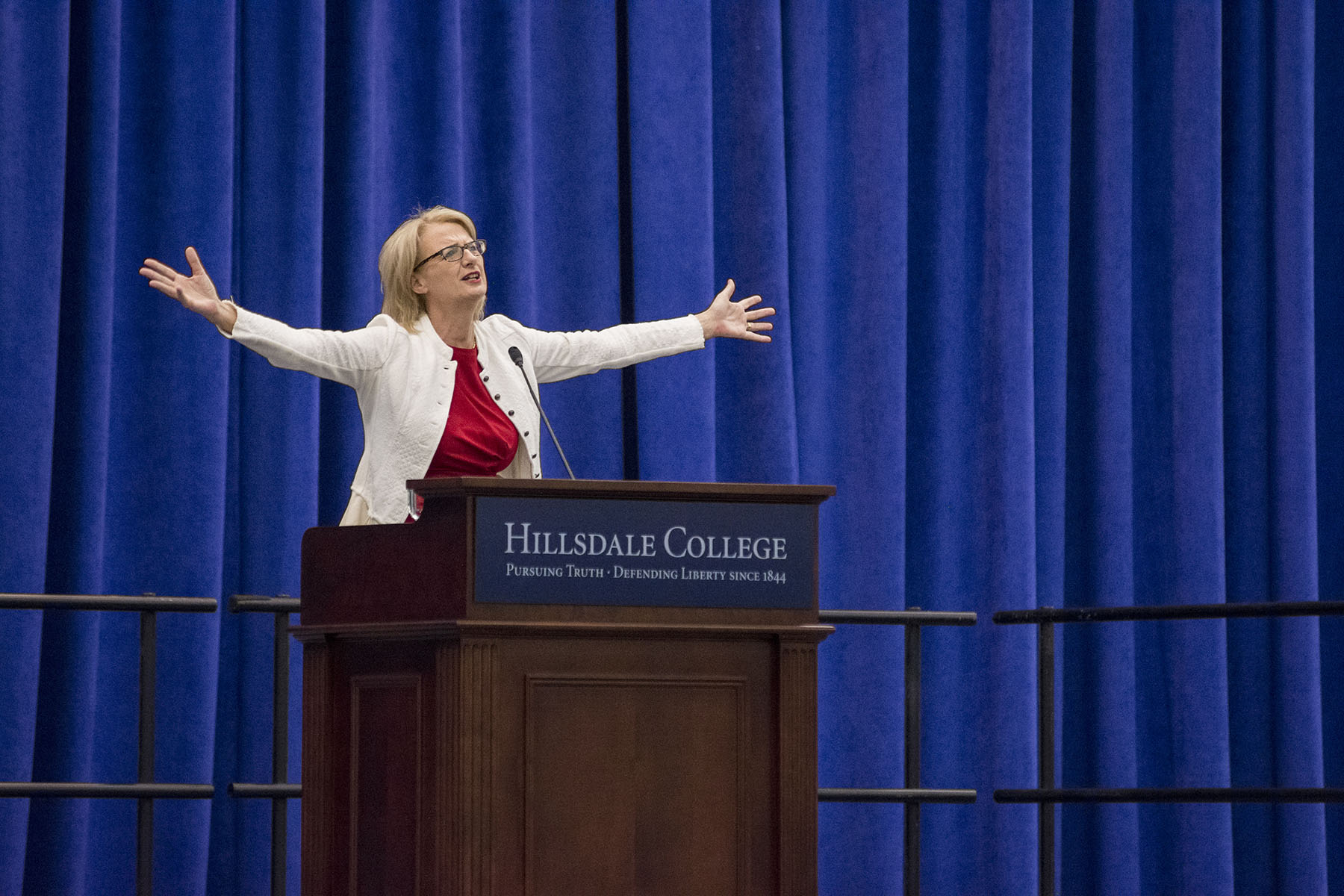
Sunday night, journalist and documentary filmmaker Ann McElhinney spoke at the Center for Constructive Alternatives seminar on Energy: Issues & Controversies to an audience that came away with very mixed reactions. The topic of her speech, “To Frack or Not to Frack,” focused on the highly disputed practice of fracking and why the process should be embraced rather than shunned.
Hydraulic fracturing, or “fracking,” is the process by which natural gas and oil are retrieved using high pressure injections of “fracking fluid” into the ground. Fracking fluid is a mixture of water, sand, and chemicals, pumped into the ground to fracture surrounding shale rock and force gas and oil to flow into a well.
The process has been employed for more than 60 years, according to the Global Energy Initiative, but some worry that fracking can contaminate nearby groundwater consumed in residential or urban areas by leaching chemicals into the ground.
McElhinney’s speech addressed these concerns. By focusing on other sources of energy, such as renewable forms of solar and wind power, McElhinney attempted to show why fracking is the best option currently available to obtain energy. While most students agreed with her conclusion, McElhinney’s approach appeared to be as controversial as her topic.
“I thought she made a lot of good points, but I think that her opinion was very polarized,” junior Colin Wilson said. “That, in my mind, takes away from some of the arguments that she made. I think most of the CCA people are gung-ho conservatives…I think they don’t take the arguments against things quite as seriously as they should, and because of that, if they were in a debate, I don’t think they’d be making very convincing arguments. That mindset only works in a vacuum.”
McElhinney said that although fracking has been in use for so many years, “environmentalists” discredit it because they are entrenched in a certain way of thinking. McElhinney urged the audience to see what she referred to as “despicable liberal hypocrisy” and to realize that fracking is “a miracle. It’s a game changer.”
“I think that anyone who was looking for a scientific defense of fracking would be disappointed,” senior Phil Wegmann said. “But I think we need to keep in mind that this woman first and foremost is an entertainer and an investigative journalist, and she wants to be bombastic to get people’s attention. And she did a fantastic job of that…and I think for her, that’s a win. She wants individuals to take interest in this and instead of using boring charts and graphs she used colorful language and extreme examples.”
Others agreed that while McElhinney’s somewhat-exaggerated approach may have been unnecessary, her points were important and well-communicated.
“Sans hyperbolic rhetoric, her argument was basically that all forms of energy, even wind and solar, have significant consequences, and that fracking, while not perfect, has one of the best cost-to-benefit ratios of any energy source today,” junior Aaron Schreck said. “That’s something I can get behind.”
