
This May, the college will begin building the Searle Center.
This new construction will expand both Curtiss Memorial Dining Hall and Phillips Auditorium while improving the look of the building. This will create space for large campus events and update a complex that has been in place since the 1950s.
“We have been planning to do this, and we have had a very generous donor gift,” Chief Administrative Officer Rich Péwé said.
The construction will take place in two phases. The first phase, beginning in May, will focus on the expansion and renovation of Curtiss and its lobby, giving more than 800 people room to dine. The second step will add on to Phillips, but no date has been set, as the college is still raising money.
The plans were announced at the Rebirth of Liberty and Learning Campaign in October 2013. In order to increase the size and improve functionalty, crews will remove the roof of Curtiss, replacing it with a higher, more acoustically-effective ceiling with new lighting fixtures for the larger space. The floors and other furnishings will also change.
Along with the renovations to the dining area, the lobby will undergo some serious changes.
“We’ll take the existing lobby and blow the roof off that, put an escalator in, an elevator, and stairs that go down to the left,” Péwé said. “That lobby will extend out almost to the road, and there will be a porte-cochère for dropping off stuff. The idea is to make an easy flow between the dining space and the expanded Phillips.”
Likewise, Phillips will almost double in size, reaching to the road with a rebuilt roof and balcony and approximately 800 or more new seats in the auditorium.
The current building has a long, complex history. After World War II, changes in higher education across the country left Hillsdale in dire economic straits. While the college’s endowment fell, students began to demand new buildings to replace the aging, 19th-century structures still in daily use. The college’s Board of Trustees began aggressively campaigning for alumni and other benefactors to support the school.
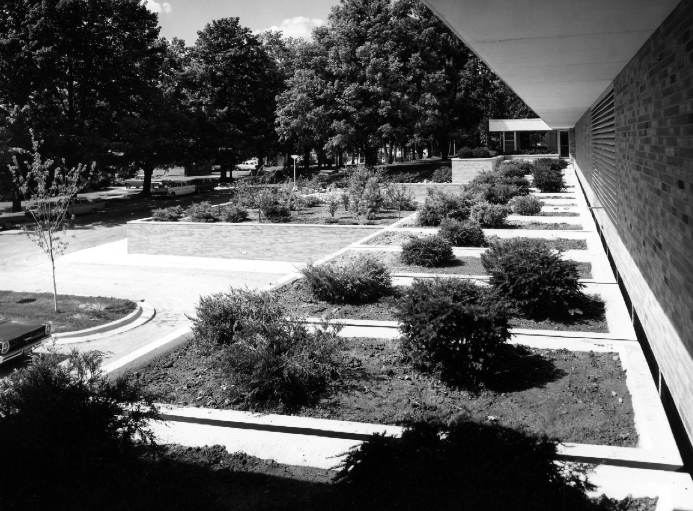
By the late 1950s, the college was ready to build. Koon Residence was completed in 1958, and plans for a large dining hall/student union/conference center were under consideration by the Board of Trustees. The groundbreaking ceremony for Curtiss Memorial Dining Hall, the first building constructed, took place at Homecoming of the same year.
Alden Dow Associates, the architectural firm of Alden B. Dow, student of Frank Lloyd Wright and son of Herbert Henry Dow, founder of Dow Chemical Company in Midland, Mich., designed the building and the subsequent adjoining student union and conference center.
Saga Inc. moved to the new building from East Hall in the spring of 1959, and a dedication was held as part of that year’s commencement ceremonies.
In the years following the war, campus resumed normal operation. As students returned, they began to demand a recreational facility, tired of having to go to off-campus restaurants to be social with classmates. The administration responded by renovating the almost-defunct Dickerson Gymnasium, which had fallen out of regular use after the new fieldhouse (later expanded several times into the Roche Sports Complex) was constructed in 1928.
The barn-like Dickerson Union was very popular with students, with space for dancing, lounging, a snack bar, a soda fountain, a new pool table, and television tearing students from their books. It was always a temporary solution, though, and by the late 1950s students were clamoring for a more up-to-date facility.
The Knorr Student Center was built in 1963 after extensive student fundraising and petitioning. Students visited other schools around the area with modern student unions and were frustrated for years by financial difficulties keeping any plans from moving forward.
Eventually, the family of the late Fred Knorr, donated $27,628 toward the fund. Knorr had graduated from Hillsdale in 1937 and died in December 1960. Knorr was part owner of the Detroit Tigers, and the newly founded Knorr Foundation received half of the proceeds from a memorial Detroit Tigers–Los Angeles Angels ballgame. These funds, along with a vigorous fund-raising campaign by the students and a loan, were enough to construct the new building.
College President Donald Phillips presented a new plan for expansion to the Board of Trustees in 1960. The slogan “Preparation for Leadership through Learning and Experience” pervaded the Phillips era, and, as the college slowly came out of the financial straits in which the preceding decades had left it, new plans for campus improvements were possible.
Phillips proposed a leadership development center as the next step in the college’s mission.
In 1961, the Herbert H. and Grace A. Dow Foundation of Midland, Mich., donated $1 million for the construction of the center. Ground was broken in 1963, and construction was complete in August 1964.
The Dow Center has served the college for 50 years, hosting visitors and conferences to further the mission of the college. With the introduction of the Rebirth of Liberty and Learning Campaign, the college has raised funds to bring the center a new life.
“What you saw at the gala was the Searle Center, which is the Curtiss–Phillips plan, and that is still in the works,” Péwé said. “We’re working on documents that will make us ready for construction.”
