
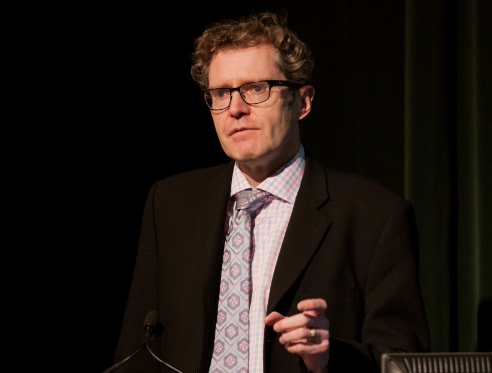
Ross King received his Ph.D. from York University in Toronto in 1992, and now lectures on art and history throughout Europe and North America. He has written on Brunelleschi, Machiavelli, Michelangelo, and, in his most recent book, Leonardo da Vinci. His books have been nominated for a National Book Critics’ Circle Award, the Charles Taylor Prize, and the National Award for Arts Writing.He has won BookSense Non-Fiction Book of the Year in the United States for “Brunelleschi’s Dome,” as well as the Governor General’s Award in Canada for “The Judgement of Paris.” Born in Canada, King now lives near Oxford, England with his wife Melanie.
When did you become interested in history?
When I was around 11 or 12, my mother took me to the public library. I would come away with my little stack of books. My favorite books when I was about 10 were usually about a boy and his dog, and the adventures they faced on the frontier. I gradually got interested in history during adolescence. I was interested in historical periods and the history of place I lived in, but I was also very interested in Leonardo da Vinci. I knew who he was when I was about 7 or 8 years old. I just sort of always had him in my imagination — partially because he was left-handed and a painter, and I was interested in painting.
Are there any misconceptions that people commonly have about da Vinci?
There are lots of misconceptions about da Vinci. For a while, it never occurred to me that he could fail. He is often considered the person with the highest IQ in history, an all-concrete genius. I was fascinated to discover that in 1490, he tried to get a job casting bronze doors in Piacenza, and he didn’t get it. It almost boggles your mind to think that there’s a hiring committee in Piacenza, and Leonardo’s CV comes across their desk, and they say, “No, no. He’s not the man for the job.” The other thing that I discovered was that he was really well in his forties before he did the work that we now know him for. Had he died in 1494 at the age of 42, which is when he started “The Last Supper,” he would really just be a footnote in history. partly because the paintings that survived that he did before that, the main one being the “Virgin of the Rocks,” which is in the Louvre, might have disappeared unless it had the fame of Leonardo attached to it. If Leonardo was just obscure, that painting may have not survived. And so, I guess it’s heartening in a way, going through all of my projects, the Brunelleschi one, Michaleangeo, Machiavelli, Leonardo, these people being undeniably brilliant, having huge achievements, and deservedly enormous repretations. In some way it’s heartening to think that they were human as well, and to know that they were plagued with self-doubts. I mean Leonardo, it’s very poignant to consider of him at the end of his life, and saying that he had not done enough. What hope there is for the rest of us, if Leonardo didn’t make full use of his talents. Arguably, he didn’t because he was trying to do so much. He wasn’t good at just one think. He was good at 50 things, and couldn’t concentrate all of his effort on just one thing, whether it was painting, sculpting, or anatomy. I think there are lessons there for us. If Leonardo da Vinci can fail, so can we. And we can succeed, as he did, in a more modest way.
I noticed that you edited a collection of da Vinci’s fables, jokes, and riddles. Can you tell me a little bit about those?
That’s something that few people know about. We know him as an architect, a painter, a would-be sculptor, and an inventor. All these things have entered the public consciousness. One of the things that didn’t is the fact that he wrote. Through that book, I wanted to give a portrait of him in the court of Milan. He was a very successful courtier. He was an entertainer. It was almost as if he was a jester. Milan had a very sophisticated court. That’s one of the reasons why he tried to learn Latin. When you have a group of very intelligent people exchanging ideas, and everyone’s trying to one-up each other and competition. They would tell puns and jokes and witticisms to one another. Leonardo excelled at that. Besides being brilliant, he was also very funny and witty.
Do you think that da Vinci would see a place for a multi-faceted renaissance knowledge in this world today?
I’m sure he’d say, “yes” resoundingly. He wasn’t about specialization because he dove very, very deeply into things. The quote that I love from him is, “Study the art of science. Study the science of art.” I think Leonardo was one of the first interdisciplinary thinkers, or he was the first one who took it to the extreme. Much of medieval education was very good at making those connections, but Leonardo took it to the next level, where he tried to find connections between and among the disciplines. Yes, he would be very much in favor of a deep, but very broad, education.
What is your favorite quirk or idiosyncrasy of da Vinci?
He was a very snappy dresser. He probably owed a lot of money to his tailor. He lived the good life. It took a lot of money to be Leonardo da Vinci. To compare him to Michelangelo, Michelangelo was grimy, dirty, he kept his dog skin boots on when he slept. When he took off his boots after two months, his skin would come off with it. It was really disgusting. Leonardo was very elegant and he wore nice clothing, lived in beautiful surroundings, and had music playing all the time. You’d much rather be a house guest with Leonardo than with Michelangelo.
