
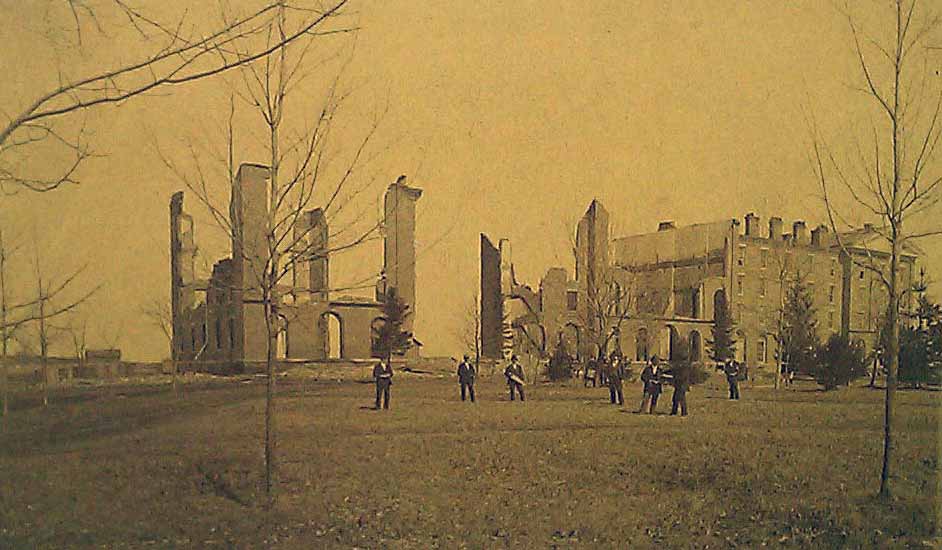
Proudly gazing down Manning Street, majestic Central Hall embodies the phoenix, attesting to the powerful resurrection of the college from the ashes of destruction.
Hillsdale College was originally comprised one grand building – a ‘central’ building connected by hallways to east and west wings. The west wing had class rooms, laboratories, and rooms for the male students, while the east wing held two ladies’ societies, music rooms, and rooms for the female students.
The central portion of the building housed the college’s seat of power. The lower floors contained the college president, school administration, and rooms for professors. On the top floor was the chapel, which boasted its own organ. Just like the dome of Central Hall today, the majestic domed cupola of the central building towered as a visible representation of the college. Many of the Hillsdale city fathers lived on Manning Street and enjoyed terrific views of the college.
At 1 a.m. on March 6, 1874, intense heat woke two male students asleep in the west wing. Seeing flames, they alerted everyone inside the building, then quickly ran to the college bell, frantically ringing it to alert the city of the blaze. Despite heroic efforts made by firemen, college men, professors, and residents of the town, the fire burned on. Two hours after it began, two-thirds of the college was destroyed, leaving only the east wing. While many men valiantly fought the flames, some merely looked on, smoking cigars and meerschaums.
In contrast to most contemporary western colleges, which would cease to exist after suffering a major fire of that magnitude, Hillsdale College rose again. Building on the foundation of the original building’s ‘central’ portion, Central Hall rose as the focal point of Hillsdale’s new buildings.
-Compiled by Evan Carter based off an article by JoAnne Miller from the Hillsdale Historical Society
