
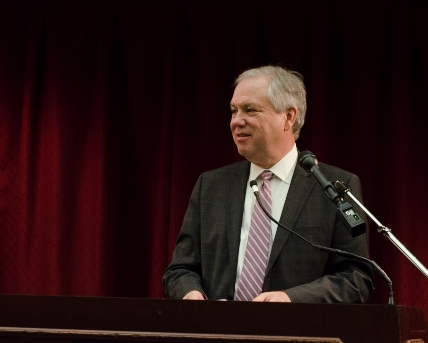
Kim Holmes, Ph.D., is a distinguished fellow at The Heritage Foundation in Washington, D.C., and directs the think tank’s foreign policy and defense team. From 2002-05, Holmes served as Assistant Secretary of State of International Organization Affairs under Secretary of State Colin Powell. Interview compiled by Taylor Knopf.
In your new book, “Rebound: Getting America Back to Great,” you make the claim that America is not as great as it used to be. What needs to happen for the U.S. to rebound?
What I talk about mainly in the book is what’s happened over the last 50 years. It is different, and the changes came about for three reasons. On the political side, it was the expansion of government programs. Counterculture of the 1960s changed the traditional idea of freedom as something mainly about what the individual has from government in exchange for them being morally restrained in their personal lives. It changed the cultural definition of personal responsibility and freedom. The third was an intellectual movement that occurred in the `50s and the `60s that changed American liberalism. It was a rise of the New Left, an intellectual movement that focused mainly on cultural, gender, and personal identity issues. These three things came together and basically eliminated the natural sort of built-in break that the culture had on letting the government do everything for you — big or small.
What can the young generation of politically-minded people do to help America meet the goals you present for us in your book?
The young people must figure out the essence, the universal notion, of being personally responsible for themselves and their lives with their families and communities, then figure out how to manifest that through all aspects of life, and to do what the New Left did in the `50s and `60s. They marched through the institutions, they dominate every major university today – not this one, but most. They control Hollywood. They’re the dominant ruling class even in Manhattan among the wealthy Wall Street people. It’s taken 50 years to happen. You’re going to have to figure out how to undo it. This means engaging the culture. It doesn’t just mean politics. It means figuring out how to have artists who make movies that are not just the best movies possible but have a narrative that’s counter to the kind of free and easy liberation model that you get from Hollywood. But I do think that you can figure out a way to do it, in a way that’s popular and meaningful, but keeps the core values.
You were right in the midst of the decision to go to Iraq. So now that we’re pulling out of the Middle East, quite a few years later, what is your opinion now of that decision looking back?
It was about the WMD and the war on terrorism. It was about the fact that 9/11 was still fresh in our memory. Also we were not going to tolerate the things that Saddam Hussein had done before. But since then, it’s become interpreted as being all about trying to spread freedom to the Middle East. I’m sure that there were some people in the administration who thought that, but that’s not what we discussed and brought to the U.N. Security Council. It was this very specific question of whether or not Saddam Hussein was complying with U.N. resolutions to cooperate with arms inspectors. So President Bush pressed the issue, and that’s what led to the war. I think that in hindsight the biggest mistake was that I don’t think that we adequately understood what it meant to intervene, and there weren’t adequate preparations for it after the initial stages of combat. My boss, Colin Powell, made the argument that if you break it, you own it. We should have paid more attention to that and prepared more than we did. We invested an awful lot in that place. I wish that President Obama had done a better job of negotiating an agreement with them and not completely cut ties so we could have stayed there and had more influence than we do now. It seems to be a pity after the price we paid.
Many have compared the Iraq conflict with the recent Syria conflict. Would you draw any comparisons between the two? And how much should a humanitarian motive play in our foreign policy and decision to intervene?
It’s always a factor, but it should not be the sole factor. There are plenty of humanitarian crises all over the world, and we don’t intervene in them because we simply cannot police the world like that. The difference between Syria and Iraq is that I don’t see intervention in Syria being necessary for our national security interests. Assad has been there for years, and we tolerated him. He’s doing horrible things now on the humanitarian side with the civil war, but it is not as influential as Iraq was in the Middle East. Also, I just can’t see an intervention of any kind working. Whatever you say about Iraq, it initially worked. They got rid of the regime very quickly. The problem began with the occupation. We don’t necessarily have to define ourselves by military interventions, but if we do intervene we have to be very careful about the circumstances. If we do it, we need to prepare for it and win it.
