
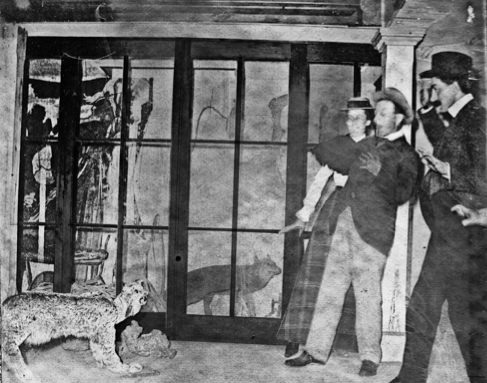
Hillsdale College once had one of the best natural history museums of any college in the country.
But two fires and almost 100 years of neglect, punctuated with theft, left the remnants of the Daniel M. Fisk Museum of Natural History’s former glory scattered across campus in boxes and drawers.
After 13 years of work, professor of biology Tony Swinehart reopened the museum in 2011. Thanks to a recent grant from the Student Federation, Swinehart will be able to continue his renovation project with new carpet today and new display cases sometime in the near future.
Professor of Science Daniel Fisk founded the Museum in 1872. But the 1874 fire that destroyed the main campus building incinerated much of what Fisk had started.
“Rumor has it that the fire started in the museum, but it wasn’t the museum’s fault,” Swinehart said. “The college was putting up plaster and lit a fire to dry it.”
Swinehart reopened the doors to the museum in the Strosacker Science Center on March 7, 2011, exactly 137 years after Fisk began digging through the ashes to find surviving specimens. The destructive fire cemented Fisk’s determination to continue expanding the museum. When the college built Knowlton Hall to replace the classrooms destroyed in the fire, Fiske established the museum on its first floor.
From 1874 to 1910, the museum blossomed, drawing visitors from across the Midwest and donations from across the world. Former Hillsdale president Ransom Dunn even indicated in a letter that, as he rode across the country raising money for the college, he collected specimens for the museum.
“There were literally thousands of specimens,” Swinehart said. “It was a campus icon. People wrote poems and short stories in the Collegian about the museum.”
The Hillsdale Herald reported on Oct. 24, 1878, that: “The College museum grows as ever. Two Cobra de Capellos crawled all the way from Richard Lawrences in India, to Prof. Haynes’ for the benefit of science. The mummy’s head, now the property of the museum is the gift of Mr. Baggerly, of Quincy, as is also the complete skeleton of a Chinaman.”
The college cosponsored an expedition to South America with the Smithsonian Institution and Albion College in 1880. The college received a letter from then U.S. Secretary of State William M. Evarts hoping that the trip would encourage diplomatic relations between the U.S. and South American countries.
But in 1910, Knowlton Hall burned. Though the exterior survived, the interior was scorched and the ceiling in the museum collapsed. Though most items remained intact, Swinehart said, the specimens were moved into boxes and scattered across campus. Many irreplaceable items were stolen or lost.
“For some time the specimens lay strewn about the campus unprotected. By the time they were removed many articles of small intrinsic value, yet of immeasurable value to Hillsdale’s museum had been taken away,” the Hillsdale Collegian reported on May 7, 1914. “Ever since that time people have at various times gained access to the hall and “helped themselves.”
In 1934, for example the Egyptian mummy was found in the basement of the Mossey Library, Swinehart said. Since then, it has disappeared like so many of the items the Collegian archives describe.
But in 1914, DeLapp `14 spearheaded a movement to restore the museum. Swinehart only recently discovered his role in the museum. Because of Albert DeLapp’s dedication to managing and superintending the “enormous task,” the Collegian reported, the class of 1914 rebuilt the museum on the third floor of Knowlton.
“If he had not done what he did, everything would have been lost,” Swinehart said. “We only have five percent of what we used to have left. But without Albert DeLapp, we would have had nothing.”
DeLapp started a legacy on campus as many of his descendants attended Hillsdale. Currently, six of his granddaughters attend Hillsdale: senior Elizabeth Viviano, juniors Julia DeLapp and Mary Kate Kibbe, and freshmen Bridget DeLapp and Rebecca Viviano.
“He never really talked about his accomplishments. He was just one of those men that felt you had to be involved,” Albert DeLapps’ grandson Dennis DeLapp `82 said. “This recent discovery of what he did with the museum was the first I had heard of it. But it doesn’t surprise me.”
In the 1960s, the sciences moved out of Knowlton Hall to Strosacker. And yet again, the museum neared extinction. Faculty were told to select the specimens they wanted from the museum, Swinehart said. Students picked next and the remains were dumped.
To this day, Swinehart finds remnants of the museum scattered across campus. In 2004, Swinehart found a lump of lava brought to Hillsdale in the 1870s from the Sandwich Islands – now known as Hawaii – used as a doorstop in Central Hall for 25 years.
In 1999, just days before Knowlton was torn down, Swinehart and former professor of biology Donald Toczek searched for discarded remnants of the museum. The men saw a tiny door near the ceiling of the former theater prop room. In it, the men found multiple cobra skins, a candle-powered incubator, and an old wooden crate full of one of the most complete collections of American freshwater clams.
Since then, Swinehart has dedicated hours of time and energy into continuing the legacy Fisk and Albert DeLapp began.
“Over the past two years I’ve worked for Dr. Swinehart in the museum. His admiration for history and appreciation for natural sciences have shaped the museum into what it is today and provide a foundation to where it will progress in the future,” junior Greyson King said. “Dr. Swinehart is one of, if not the biggest source of progress in the restoration of the museum.
Though less than five percent of the museum’s original specimens remain, the museum still showcases irreplaceable relics of local, national, and global history. The stuffed armadillo on display, for example, was carried by boat from South America to Washington, D.C. From the Smithsonian, it traveled by train the horse and buggy to be displayed in the musuem.
“You just can’t replace that history,” Swinehart said.
