
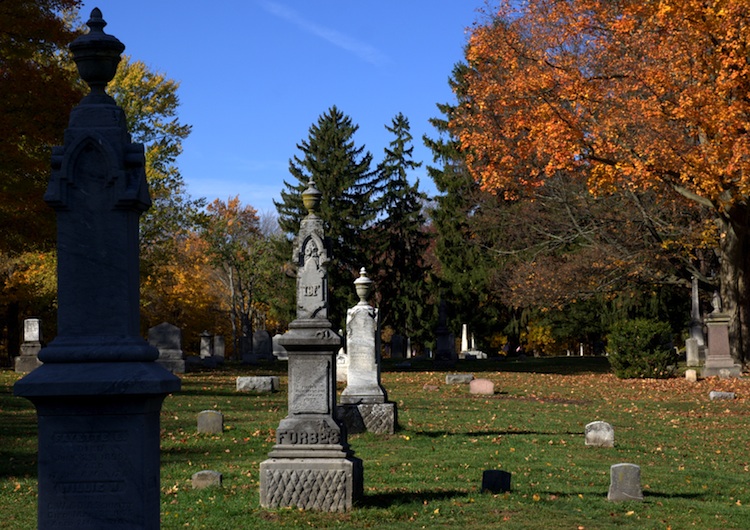
At the edge of Hillsdale, where the town meets the woods, lies Oak Grove Cemetery. It is a peaceful spot, settled on rolling hills beneath oak trees that litter the ground with orange leaves in the fall and gave the cemetery its name.
Oak Grove is an amalgamation of graves. Some are over a century old with faded names and crumbling pedestals. Others have only been around for a matter of months, all shining granite and crisp verses in modern fonts. Flowers, American flags, and an occasional wind chime reveal the presence of the friends and family who visit to pay their respects.
Oak Grove is a centerpiece of Hillsdale’s heritage. According to historian and former Hillsdale professor Arlan Gilbert, four Hillsdale professors originally established the graveyard in 1859. It was never a college-owned cemetery, but because so many of Hillsdale’s founders, supporters, and staff lay buried there, the cemetery has always been closely associated with the school.
Professor of History Brad Birzer has lived across the street from Oak Grove Cemetery since 2007.
“It’s an extremely important spot for the community and the college — not just because of its beauty in design, but also because of how many prominent persons are buried there,” Birzer says. “Each stone, of course, tells a story, and each person buried there – prominent or not – represents something unique never to be seen again in this world.”
According to Birzer, there are close to 300 Civil War veterans buried in the cemetery. Near the center of the graveyard stands a Civil War statue of a soldier on a pedestal engraved with the words “in memory of our comrades.” It is dedicated to the Free Masons. Encircling the figure in the traditional Mason burial pattern are a number of veteran graves and, rumor has it, a loyal Civil War horse.
Among the veterans lies Richmond W. Melendy, a judge-turned-pauper whose millionaire friends buried him in Oak Grove. Gilbert writes of Melendy in his book “Historic Hillsdale College,” saying, “Just before Melendy’s body was lowered into the grave, a crippled veteran stepped forward and asked to see the face of his beloved officer one more time. The request for a moving silent interview of the living and the dead was granted.”
Gilbert’s words speak to the great significance of the cemetery. He points out, “Back then [mid-1800s], death came early. Suffering and death were prominent on the frontier…the attitude towards death was that it was part of God’s plan and it was inevitable. The beautiful cemetery recognizes that. It is almost poetic.”
Gilbert says that after reading hundreds of personal documents and diaries “you get a feeling for the poor souls who are lying there.” He shows one section of the cemetery where a mother, father, and their children lay buried. They died within two weeks of each other, probably from small pox.
As Gilbert points out, the modern world often fears and attempts to hide the reality of death. In establishing a graveyard associated with the college the founders recognized the eventuality of death, not as something to be feared but as something to be faced with fortitude.
“It was a part of life,” says Gilbert. “Birth, life, and death. I do think that there was a greater reality about death back then.”
The graveyard is now seen as a symbol of life’s tragedy; yet, its monoliths and monuments pointing to the sky serve as a comforting reminder of the promise of life to come. As Birzer says, “it’s laid out to be a place of contemplation and hope.”
The cemetery plays an integral role in student and faculty life. According to Birzer, students sometimes visit Oak Grove. He has taken his own classes to the cemetery in the past.
“I’ve led several excursions through the cemetery,” he says. “Students always respond well. The cemetery, dating back about 160 years, is a pretty perfect 19th century cemetery.”
Oak Grove played an even bigger role in campus life during the 19th century. Gilbert says that after the Civil War, once a year students and faculty lined up and marched down to the cemetery. There, they held a celebration to honor the young men who died in the war. This tradition continued up until the 20th century.
Today, students are more cavalier.
“People have told me it’s a good place to study, visit, and just hang out,” says senior Emily Whitaker.
Several decades ago, the pond in the middle of the cemetery was filled in to prevent students from holding “baptism” parties there.
A number of campus faculty visit the cemetery regularly.
“Professor of History and Politics Paul Rahe and his family walk through the cemetery almost every Sunday; retired education professor Walt Lewke walks his dog there almost every day; and Professor of English John Somerville runs through the graveyard several times a week,” Birzer said.
Of course, every cemetery has its fair share of ghost stories. Gilbert says the ghost of a Civil War horse has been rumored to appear on occasion. Birzer and his wife say they’ve had several odd encounters living near the cemetery.
“We’ve had some weird experiences,” he says, “seen some strange lights, heard some strange noises, and thought we’ve seen some ghostly things crossing our property.”
“I’ve only been there once,” says senior Joshua Koczman. “My friend and I bought McDonalds and went at night. We got nervous and left when the pit in the cemetery started filling with mist.”
According to the City of Hillsdale, Oak Grove is approximately 40 acres and contains over 9,000 gravesites, adding an average of 60 burials per year. Eugene Goodlock serves as the graveyard’s sexton, but was unavailable for questions due to medical leave.
