
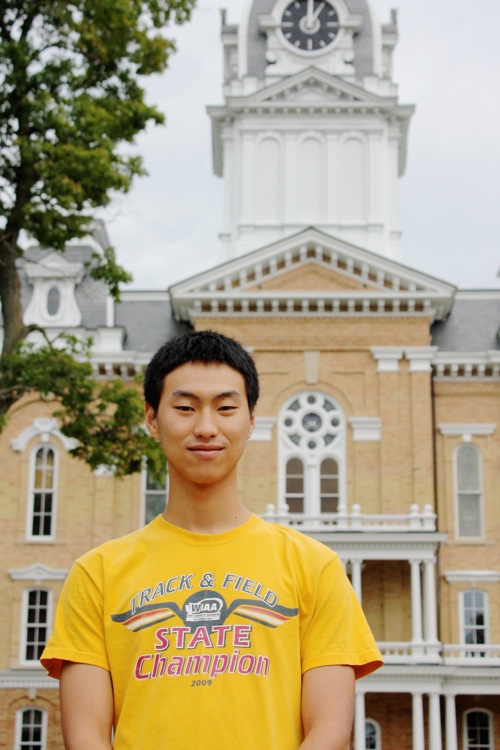
In South Korea, it is a national mandate that all able-bodied men between the ages of 18 and 30 must serve two years in the military. Any objectors are thrown in prison. So, for most, the choice is a simple one.
When sophomore Sang Jun “Jay” Lee considered colleges four years ago, he had limited options due to the high price of out-of-state tuition costs found in most American universities. He received substantial scholarships from two liberal arts schools: Seattle Pacific University and Hillsdale College.
Due to his summer plans, his financial dilemmas were not resolved.
“I know that I would be serving sometimes after freshman summer or sophomore summer for mandatory service in South Korea,” said Lee.
Seattle Pacific University offered Lee a scholarship for eight consecutive semesters while Hillsdale offered him a scholarship for eight academic semesters. In addition to his appreciation for Hillsdale’s academics, the college’s financial flexibility solidified his attendance that fall.
“A lot of Koreans go [into mandatory service] while they’re in college. Early is better,” Lee said. “In the Korean culture, the older you are the more respect you receive, so you don’t want to be old in young rank.”
Senior Micah Speers lived across from Lee three years ago in Galloway Residence Hall. Through “feast,” Frisbee club, the annual Zombie Romp on Halloween, and late nights working on homework, Speers said that he and Lee hit it right off.
“It was one of those friendships during freshman year that laid the foundation that shapes your college experience,” Speers said. “I’m super excited that he’s here now.”
After taking his spring semester finals at Hillsdale, Lee set off to South Korea to begin his mandatory service in hopes of being a translator. But after weeks of rigorous studying for his college finals, studying for a translator exam did not appeal to Lee. He thought he would trust his luck and take the test blind.
“I was five points short of passing,” Lee said. “I probably would have gotten it if I had prepared, I just didn’t want to study.”
In South Korea, Lee was stationed in Gangwon-do, infamous for its cold mountains and desolate surroundings. For a month and a half every year, Lee and his battery would patrol in negative 20 degrees Fahrenheit for 14 hours a day in thin uniform jackets. Lee said Gangwon-do is one of the worst regions in South Korea to serve.
“If you’re near a city, you can hang out on your vacation time, but I didn’t have that chance,” he said.
Upon his arrival, Lee was assigned to work in the artillery as a Fire Direction Center Agent. His job required him to calculate the distance and angle at which his battery shot its canons from the control room. This job, however, was not a politics major’s position of choice.
“The only reason I was selected to do this job was because one, I looked like the guy who had just left the position, and two, they knew I was educated in the United States and assumed I could do the work,” Lee said.
Speers remembered that the choice to leave for South Korea was not an easy decision for Lee. He was impressed that Lee returned after two years of delayed study and friendships.
“It speaks a lot about his character that he’s willing to follow through,” Speers said. “Coming back as your friends are seniors and you’re a sophomore . . . it’s not as easy as he makes it look.”
Dr. John Somerville met Lee at College Baptist Church during Lee’s freshman year. Whether he approached Lee or was introduced, Somerville doesn’t remember, but a relationship quickly developed between the two. Somerville grew up in South Korea and attended a school for missionary children through his high school years.
“When Jay went back [to South Korea] I wondered if he would return,” Somerville said. “It’s a real change in your life to be a college student and then serve in the South Korean Army.” Currently, North Korea is the most militarized nation in the world while South Korea holds the sixth largest amount of troops.
“The ROK [Republic of Korea armed forces] has a reputation, internationally, for being a crack military,” Somerville said. “They are really fierce fighters.”
During his service in Gangwon-do, Hillsdale was frequently on Lee’s mind. He missed his studies, his friends, and the freedoms of being a student in the United States.
“At Hillsdale, I get to study what I want to study,” Lee said. “But I don’t regret going in. I wouldn’t trade it for any experience.”
Speers was pleased when he received news that Lee would return for the fall of 2012.
“There was stuff missing when he left Hillsdale College,” Speers said.
Even after two years of living in difficult conditions away from home, Speers said that nothing about Lee had changed.
“He’s the same ol’ Jay,” Speers said. “Just right.”
