
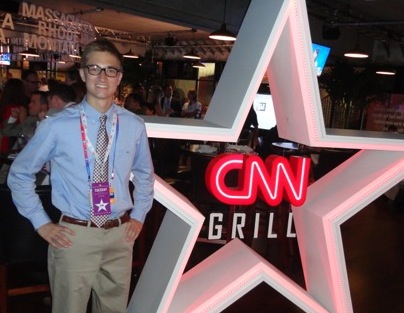
A forty-five second video entry in a sweepstakes won me a ticket to cover the 2012 Republican National Con-
vention with CNN. I quickly found myself in a whirlwind — not Hurricane Isaac, but the crazed, fast-paced world of TV news. I’d always been skeptical of the existence of media bias, but not after this week in Tampa.
As a “student iReporter,” I was assigned to capture the sights and sounds of the RNC and communicate them through various social net- works including Instagram, Twitter, and Face- book. But I learned more than just how to use social media effectively. I soon began to notice that CNN’s coverage was impacting not only the convention, but also the election as a whole.
There’s a bias attached to CNN. On a spec- trum of media outlets, CNN would tend to lean closer to MSNBC than it would to Fox News, but it’s typically rated as more neutral than both. While working closely with the CNN Team, including producers and marketers, I experienced how a network packages, brands, and relays a message to its viewers. I was immediately con- cerned. Why does a 24-hour news network have to brand its messages before it reports them?
I became frustrated with the media’s incom- plete coverage of the event. Instead of broadcasting the speeches in their entirety, the programming was interrupted by commentators. This made me wonder: Why is the commen- tary of Wolf Blitzer, Diane Sawyer, and Sean Hannity more important than the speeches of Sen. Marco Rubio, Gov.
Chris Christie, and Secretary of State Condelezza Rice? It seems that honest reporting has taken a backseat to constant chatter from uniformed, self- important commentators.
According to a recent Pew Research Poll, Americans receive 68% of political news from local and cable networks. In a society in which the public depends on television as its source of news, the viewer should be able to experience the news without the filter of a commentator or pro- ducer. Even worse is the media’s unwillingness to admit such a filter exists.
Pundits keep complaining that Mitt Romney lacked a personal and compassionate connection to voters. Fair coverage of the event would have shattered this notion. Where was the media dur- ing Pamela Finlayson’s speech at the convention?
Finlayson, a family friend of the Romneys, spoke out in support of Romney’s leadership throughout her local community and church. She specifically referenced a time when Romney comforted her and her family during her daugh- ter’s premature birth saying, “I will never forget that when he looked down tenderly at my daugh- ter, his eyes filled with tears, and he reached out gently and stroked her tiny back.”
She touched everyone in the convention hall when she spoke. But viewers missed the moment as cable networks barely covered or mentioned the story. Instead, the networks substituted im- portant convention speeches with on-air pundit panels. A poignant moment replaced by talking heads. Commentary news reporting has created an environment in which the media is telling people what to think. Romney has a rough road ahead competing in such a staged media environ- ment.
On Thursday evening, the night of Romney’s acceptance speech, a few CNN employees and I went to a restaurant in a Marriott hotel for dinner. We asked the sports bar to change the TV channel from Fox News to CNN. The manager obliged, and instead of watching speeches, we were now watching anchors. Other patrons protested loudly. Watching this happen, I couldn’t doubt media bias anymore.
