
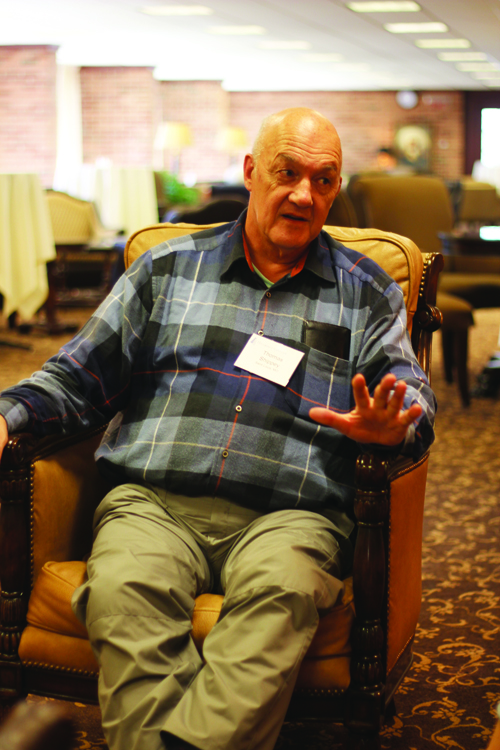
Tom Shippey, a medieval literature scholar, spoke at this weeek’s Center for Constructive Alternatives on “How to Think About Science Fiction.” Shippey has taught at the University of Oxford, the University of Leeds, and St. Louis University.
Shippey is a leading expect on British author J.R.R. Tolkien. He spoke to The Collegian about the author of “The Lord of The Rings,” the appeal of fantasy and science fiction, and Tolkien and C.S. Lewis’ popularity at Oxford University.
How does academia generally view J.R.R. Tolkien?
It’s a very combative area. Every time there was a reader’s poll of the most popular book of the century, Tolkien always won. Except once, when actually you were allowed to nominate the Bible. So he got beaten by the Bible. Well, fair enough.
The reaction to this by the self-appointed scholars and critics was terribly hostile. I’d have people say to me, “You can’t read Tolkien. The man can’t write. He just can’t write sentences.” And I thought, “That’s just stupid. It’s particularly stupid because Tolkien was a professor of the English language, so he could have told anybody anything they wanted to know about the construction of sentences, or the proper use of non-finite verbs, or anything like that, without thinking twice. And he was being criticized by people who didn’t know anything about that at all. In a way it was kind of insane.
My second book on Tolkien was called “Tolkien: Author of the Century,” and that was just me being provocative. And I thought, you know, if this is a fight, let’s get on with it. So that’s the polemic side of it.
You studied and taught Old English, as well as learning Old Norse, German, and Latin. What do you value in studying languages, and how do you feel it helped you understand Tolkien better?
I think language opens up whole new areas of human experience, so I think studying languages is just good in itself. As for Tolkien, he himself was something of a linguistic freak. You know, you have musical freaks and mathematical freaks, and he was really a bit of a language freak. Tolkien was the only person I know — apart from me, maybe — who could actually really take genuine enjoyment from reading the telephone book. He read the telephone book because he liked names. And he liked names because he liked to figure out what their etymology was, you know, what they derived from, at which he was very good. And I think that sense of the way that languages change and the kind of rootedness of them was a very big part of “The Lord of the Rings” and indeed of “The Hobbit.”
How would you describe Tolkien’s personality, for those who have dreamed of meeting him?
I’d say he was a nice old guy. He was very gentlemanly and courteous. But when I knew him, he’d been shot over a bit too much. I mean, he’d been interviewed so many times that he got wary and cautious, and he’d gotten a bit tired of answering the same questions, I guess. So I was very careful not to ask them and talk to him about something else, which I think he took as a great sort of relief. Everybody else was trying to dig something out of him, and I — well, I would have liked to do it — but I thought it was rude, so I didn’t. We talked about other things.
Were you involved with the “Making of Lord of the Rings” documentaries?
Yes, the back-up DVDs for the movies have me all over them like a nasty rash, and of course, I also had quite a lot of video interviews and things like that for the documentaries. Lots of them. More than I can remember.
You also had personal experience with C. S. Lewis, correct?
I suppose I could claim to be one of Lewis’ very last students. I went to his very last set of lectures at Cambridge University, which would have been early 1963, I think. He was one of the two best lecturers I ever heard. He was very informative. He was also extremely clear and well-organized; he talked slowly, and he gave you references, which you could write down so that you could look things up for yourself. The course of the lectures I heard was eventually published from his notes. Somebody wrote his notes up into a book. You could have written the book from my notes. It was, in a way, the most useful set of lectures I ever went to. He lectured on Edmund Spenser, the 16th-century poet. Somebody about whom I knew nothing. I’d read him, but I found him baffling and bewildering. I listened to Lewis, and I thought, “Well, I’m beginning to catch on now.”
Weren’t both Lewis and Tolkien unpopular with the Oxford University English department?
The accusation against Tolkien was that he was lazy, that he did not do his job. That wasn’t true, but it was true that his mind was often elsewhere. I should think he was the guy who would turn up at the faculty meeting and forget what they were talking about. I wouldn’t be surprised.
Lewis, on the other hand, was the kind of guy who, if he thought of something funny to say, no matter how wounding it was, he would say it. He started trouble just for fun. Many of his little jokes were remembered bitterly by people who had been the objects of them.
Why would you recommend reading science fiction or fantasy to the average person? What do you think can be gleaned from it?
Well, there are kind of two different categories. I’d recommend fantasy first because it’s fun. Second, because the theme which animates much modern fantasy is the nature of evil. Every major author of fantasy in the last 50 years or so has had a different idea about it. Strangely, they really are all different because they’re trying to understand a phenomenon for which there is no accepted explanation. So that’s why I’d do that. I think you’ve got to read science fiction actually to have some idea of what has been going on, is going on, and what might — well, we know something is going to happen in the future, we don’t know what it is — but at least you should read science fiction because it makes you psychologically prepared for inevitable change.
