
Researching Celiac Disease
Last summer, senior Amanda Konarske conducted her research on Celiac disease, a form of gluten intolerance and an autoimmune disease that affects the digestive system.
Assistant Professor of Chemistry Christopher Hamilton, mentored Konarske, in her work on the project he started in 2008 when he discovered the prevalence of the disease. One percent of the population currently suffers from Celiac disease, and on Hillsdale College’s campus, some 20 people deal with the disease every day, Hamilton estimated.
That is “something significant,” Hamilton said, and he wanted “to find out if there is something we can do to help people.”
Since 2008, this research has become the most popular project in the science department.
“The end goal would be to eventually create an oral supplement or the like that people with gluten allergies could take and then be able to eat gluten,” Konarske said.
Gluten is hard on the human digestive system because the body does not naturally contain enzymes that effectively dissolve the gluten. This can build up in the small intestine.
“People with Celiac have reactions to the gluten that gets built up, which then causes inflammation of the intestine wall, damaging villi,” Konarske said. “The long-term effect is that your intestine won’t be able to absorb all of the nutrients that the body needs, and you become malnourished.”
When the body cannot break down the gluten, the the peptides build up in the small intestine. Antibodies are then released to stop the buildup, breaking down the villi in the small intestine. This causes the body’s negative reaction to gluten.
While the human body cannot break down gluten easily, other organisms possess enzymes that can. Konarske said her research focused on isolating an enzyme, prolyl endopeptidase (PEP) from a strain of bacteria, and then testing the enzyme’s activity.
Konarske’s research included extracting DNA from the enzyme and then reproducing it for the rest of the research.
“I think if someone picked up where I left off, they would be able to complete what I did in six weeks in three or four days, and be able to really figure things out,” she said.
Konarske said her research wasn’t especially successful, but other students plan to continue working on the project.
Their stories: gluten intolerance gives students a unique college experience
Rebecca Schoon
Senior Rebecca Schoon has been gluten-free for over two years. One of the first signs that Schoon was gluten intolerant was in high school when her hair started falling out in “big clumps.”
“It kind of freaked me out,” Schoon said.
After switching to a gluten-free diet, Schoon lost 20 pounds, and her hair stopped falling out.
“I’m not incapacitated all day,” she said.
To maintain her health, Schoon is on the GAPS diet, which restricts all food to raw milk, fruit, vegetables, and meat.
“I’ve just become the crunchiest person,” Schoon said, and called herself a “dietary hipster.” She says she tries not to judge her friends for downing pizza and brownies, but just wants everyone to be healthy.
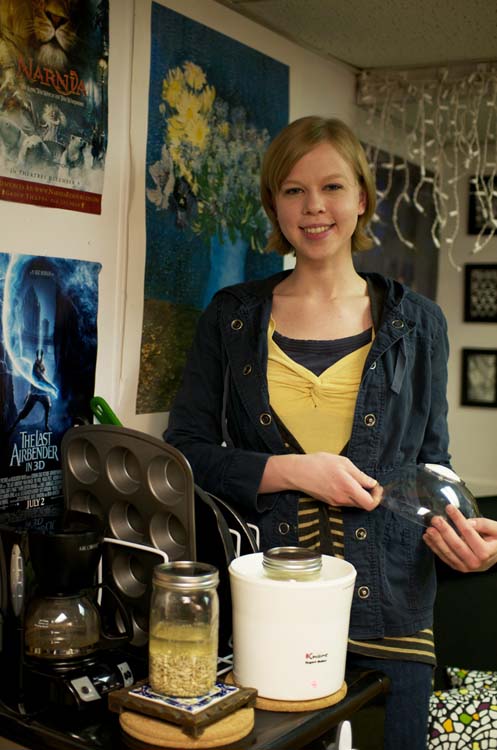
Schoon accommodates her dietary needs by making yogurt with raw milk and cooking eggs, sometimes five at a time.
When she feels a cold coming on, she eats garlic, which she says is “antibacterial, anti-fungal, anti-viral… and then you just have to brush your teeth.”
Margaret Freeland
Margaret Freeland, a junior at Hillsdale, said her gluten-free diet not only gives her more energy and makes her feel more healthy, but also provides an outlet for her natural cooking creativity.
She found out she had a gluten intolerance about two years ago when she was experiencing digestive problems. She said God gave her the grace to give it up, and ever since she has been discovering the beauty in the alternative forms of grain available. Among the alternatives are teff, quinoa, millet, and rice.
“All those gluten-free flours, they not only have their own properties but they have their own tastes. You can really learn to play off of them and have fun with them,” she said.
Freeland said the gluten-free diet is challenging but worthwhile.
“I still have people look at me and say, ‘You look so bright, you have so much more energy.’”
Jesse Losli
Freshman Jesse Losli never thought it was gluten intolerance that caused the knife-like abdominal pain she experienced in high school.
Losli played basketball in high school, and was not progressing despite rigorous training. “I should have been getting better, but I was just getting sicker,” Losli said. During basketball practice as a sophomore and junior, her face would become “ghost white,” and her coach would make her sit down.
When Losli ate anything, she experienced “horrible pain” in her stomach.
A medical test showed her gallbladder to be inflamed, and a following series of tests included an abdominal ultrasound, three biopsies, and an endoscopy. When they didn’t find anything, Losli was put on a waiting list to have her gallbladder removed.
“I was only 16 at the time. You shouldn’t be having organs removed.”
A naturopath and another series of tests revealed that Losli was hypoglycemic and had a gluten allergy. She cut the gluten out of her diet, and has been eating gluten-free for over a year.
“I feel tons better,” Losli said. “I didn’t know what it was like for your body to really feel good after you eat.”
Natalie Knudsen
Senior Natalie Knudsen had been experiencing what she called “horrible immune system problems,” and discovered through a series of blood tests that she had Celiac disease.
Knudsen is also anemic, which means she has to keep a store of high-protein foods in her closet along with all her gluten-free things.
“My roommates make fun of me, because [they think] all the food on my side of the pantry is inedible,” she said with a laugh.
Knudsen misses sourdough bread, and says that a lot of gluten-free bread is terrible.
“Seriously,” she said, “rip out a piece of drywall and eat that.”
However, Knudsen testifies that she feels better after changing to a gluten-free diet. Despite the challenges, she says her diet is “rewarding.”
Her advice for those with similar health problems?
“Just eat like Adam and Eve.”
Saga, Inc. makes changes
Saga, Inc. helped students with gluten allergies by adding a line of gluten-free foods last semester.
Kevin Kirwan, general manager of Saga, said they started serving gluten-free foods such as pasta, cupcakes, tortillas, waffles, cookies, and, on Friday nights, pizza dough.
“In the seven years I’ve been here I’ve seen an increase of students who are on or have a need to be on a gluten-free diet,” Kirwan said.
The gluten-free options are available by request.
Dale Curtis, Saga production manager, is in charge of making the meals for students on special diets. He said most of the students he cooks for have Celiac disease.
There are at least 20 students who require a special gluten-free diet, he said, and the number is growing.
“In the last couple weeks I’ve had four or five new people come.”
To accommodate them, Dale says he makes “a lot of grilled chicken and brown rice,” beef, sautés, and tries to make a gluten-free version of the day’s vegetarian dish. His gluten-free pasta of choice is pad thai, a rice noodle. In addition, he cooks with olive oil instead of soy sauce or teriyaki sauce, both of which contain wheat.
“Dale is very sweet,” junior Bridget Ervin said, who is trying out a gluten-free diet for digestive reasons.
“After experiencing severe dietary issues at the end of last year and trying a variety of things and talking with health professionals over the summer, I am trying a gluten-free diet to create an hospitable environment for happy bacteria,” Ervin said.
