
Whether using a Canon or a Kodak, the elements of photography relatively stay the same. Introduce the question, “Film or digital?” into the equation, and differences of opinion emerge.
The two mediums achieve a print using two entirely — and highly debated — methods.
Ever since the ‘90s, when Kodak, Sony and others began marketing consumer-level digital cameras, film enthusiasts decreed digital as a lesser art.
“There tends to be people who say ‘digital isn’t real’ and that film is more of an art. That’s nonsense,” said Douglas Coon, lecturer in art and staff photographer. “The camera’s just a camera.”
Digital photography picked up speed in the early 2000s as quality images became achievable. After starting film photography in college, Coon shifted from film to digital about five years ago.
“The biggest change with digital is the quality of the system,” said Coon. “The quality now surpasses film.”
Though Coon has entirely switched to digital, he still says there are some things he likes about film.
“Film handles highlights really well,” he said.
Freshman Phillip Wegmann, however, shoots almost exclusively with film. His passion for film photography began when, inspired by his father’s work, he enrolled in a film photography class at the University of St. Francis.
“Photography doesn’t deserve the respect it gets because, today, people think of it as nothing more than a click,” he said. “With black and white film photography, you’re either really lucky or you work incredibly hard to get the right moment.”
However, Wegmann never wants to downplay digital photographers who practice serious art.
“I know several very talented digital photographers on campus,” he said. “They don’t point and shoot. They wait for that perfect moment.”
As the final project for his film photography class, Wegmann spent a day photographing 73-year-old, friend-of-a-friend Kenny Bontrager.
“There are two things he refused to put up with: laziness and self-pity,” said Wegmann. “As a food truck driver, he did work younger men would shrink at.”
Wegmann was forced to capture the “decisive moment” when photographing Kenny Bontrager’s friend “Amish Ed.” Bontrager’s coworker initially refused Wegmann’s request but finally agreed to allow one photograph.
“I waited till the end of the day to get the picture. They were both waiting til they could clock out and were just staring at the clock,” Wegmann said. “Originally, there wasn’t enough light. The negative was very dark. I had to tease the whites out with filter also save the blacks with other filters.”
The image required careful dodging – or increasing the exposure of specific areas of the image — and burning — or decreasing the exposure of certain sections.
“With digital photography, it takes a second to take a single frame,” he said. “ With film photography, it takes two to three hours to make sure there is no dust or scratches on the negative. It’s evident that you spend a lot of time with many steps between closing the shutter and the final print.”
Coon said that the idea of film requiring more of a “decisive moment” than with digital is a misconception because both require hours of post-processing.
“With film, you have to match film, the chemicals in the dark room, the paper and the filters in the enlarger,” said Coon. “You get the same results in different ways.”
Coon said that, though many people think manipulation of images began with digital photography, film photographers can edit photos more than many people know. Film photographers are perfectly capable of adding and removing elements of photos by using layers of masks.
“It was just harder with film,” he said. “There is what I consider a false perception that film is truer.”
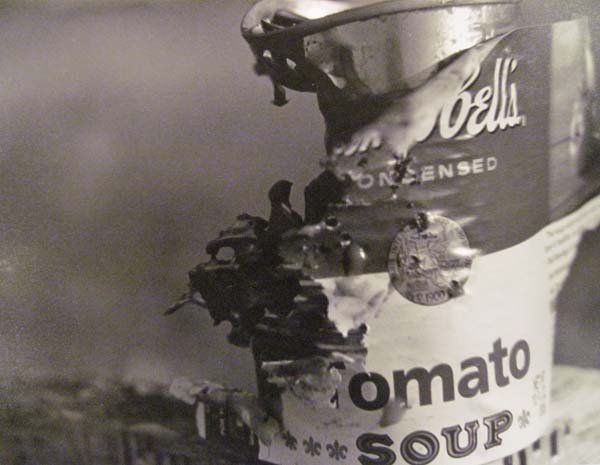
Wegmann uses film to capture greater truths. For an assignment on re-imagining art, he critiqued Andy Warhol’s subjectivistic perspective on art.
“I wanted to critique [Warhol’s] prostitution of art — this idea of anything as art,” he said.
He did so through a serious of photos playing off of Warhol’s work, from the wildly famous Campbell’s soup can to the painting of the banana that The Velvet Underground picked up.
Since he has stopped taking photography classes the University of St. Francis, Wegmann would love to see a dark room in Sage once again. However, as Coon explained, the cost of film and processing equipment makes it impractical for most students.
“It’s hard to find film anymore. Motion pictures are saving film because they use miles of it for movies. It keeps plants producing it,” he said.
snelson1@hillsdale.edu
