
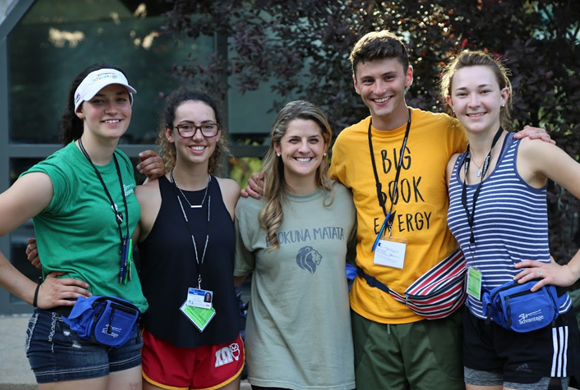
If anything is enigmatic to late-stage capitalism, it’s probably a door-to-door sales company that sells books in the age of the internet. College-age interns who work there typically gross $10,000 a summer.
This is Southwestern Advantage, “America’s oldest entrepreneurial program for university students.” Established in 1855, Southwestern markets itself as a company that gives students the ability to afford their college degrees and earn transferrable skills for life after graduation.
“Southwestern Advantage is the original company of what is now Southwestern Family of Companies — 29 brands that serve a range of industries around the world,” Sales and Marketing Associate Morgan Millikin wrote in an email. “Interns are trained in performing consultative sales, marketing educational products to families in communities throughout the country.”
Essentially, interns sell educational materials — think Princeton Review and National Geographic — door-to-door in neighborhoods across the United States. Four Hillsdale students, among them junior Karinne Houser and senior Ian Brown, interned with Southwestern and plan to return this summer.
Houser heard about Southwestern when she filled out a summer work interest survey in her senior year of high school. From there, she attended an informational meeting, earned an interview, and was selected as an intern.
“It sounded like the hardest thing that I could do with my summer,” Houser said. “If I did the work, the company was old enough where I could trust that I would make the amount of money the average first year makes. And if I didn’t, that would be on me, and that scared me.”
Houser said she also interned to build her resume.
“On my resume I could be relocated, was able to learn how to prospect, approach, and have a sales conversation with over 3,000 families of all different socioeconomic backgrounds, and then did my own facilitating of all the product, close the sale, and deliver to this amount of customers,” Houser said. “So, it was a lot of growth condensed into three months.”
Houser made $6,500 dollars in profit her first summer. Since then, she profited $13,000 and $25,000 dollars from her second and third summers, respectively. She plans on completing a fourth internship with Southwestern after this semester.
Brown heard about Southwestern through his cousin, who had made $13,000. Brown’s parents told him he was on his own for college, so he saw the internship as a way to help pay for tuition.
“Honestly, it was because of the money aspect,” Brown said. “I didn’t want to graduate with a ton of student debt. I wanted to be able to buy a car, so when I understood that I could actually make a lot of money, it was kind of just like the immediate need of school. So that was really the reason why I got into it. Then I was like, okay, these people seem cool.”
Brown made $9,000, $21,000, and $24,000 his first, second, and third summers, respectively. He now recruits and trains students as a Southwestern student manager himself.
“In the spring training, we meet with interns once a week and we cover all kinds of stuff — basically the A-Z of selling,” Brown said. “So we walk through, like, ‘What’s the cycle of a sale?’ And, ‘What are the objections, blah, blah, blah.’ Then we also do sales talk practice. We practice going through our sales talks, because the more you have that memorized, the more you can jump in and out of it. It’s improv, essentially. For example, a mom is talking to you and they ask you a question. And you’re like, ‘Oh, I don’t know what’s next in my sales talk.’ You can’t be a robot, you have to understand how to come in and out. The sales talk is so that you don’t have to be thinking about what you’re saying. It just comes out like second nature.”
Brown said that being able to come in and out of the sales script is essential to connecting with a potential customer, as the conversation should be as genuine as possible.
“If a family doesn’t trust you, they’re not going to buy what you have no matter what it is, even if it’s the best deal ever. And so the first goal is always to get them to trust you by being human, because people trust people who are being real and being themselves,” Brown said. “That’s also why the first three weeks you don’t focus on how much you sell. You focus on how many people you’re talking to and how much practice you’re getting, because if you do the reps, you’re going to get better at it.”
Credibility is a vital component for every Southwestern intern. As Houser said, each intern is assigned to a school district. They make a Facebook business page, obtain a permit, and check in with the police.
“Most people in that community know who we are and what we’re doing from the Facebook page, but if they don’t, you just have to say you’re the book girl or guy for that area,” Houser said. “So you build your business for that summer in the one area, so it’s not like a group thing. Other interns don’t come into your area. They have their own.”
Although a seemingly solo effort and enterprise — interns make 40% commission on everything they sell — community still defines the experience.
Interns live with each other and stay with host families — usually Southwestern alumni. Every Sunday, the entire Southwestern contingent for their area meets up, and everyone checks in with each other and participates in bonding activities.
“So you’re able to get your questions answered and first years who are going through it for the first time get to talk about whatever emotions they experienced through the week to a manager,” Houser said.
After completing their first summer internships with Southwestern, both Houser and Brown knew they were going to return. But this time, it wasn’t for the money.
“It’s after you get past the money aspect, that’s the next reason why people like it. It comes from the idea of, ‘How far can I actually push myself?’” Brown said. “Doing door to door sales is really hard. My family never opened the door. For example, my parents were like, ‘Why are you doing that? We never open the door when somebody knocks.’”
Houser said if money was the motivating goal, most people would quit Southwestern after their first internship.
“It’s the mission of our company to help young people develop the skills and character they need to achieve their goals in life. And it gets super touchy-feely, but it’s literally my job as a manager now,” Houser said. “I come back and talk with people about what their goals are. If Southwestern lines up with that, and they are willing to trust me, and I can trust them to be honest, my job is literally to help these people realize their potential. So I would say that’s the biggest motivator.”
Brown also stressed the mission of the company.
“It’s really, really centered on helping us,” he said. “It’s not necessarily about sales skills, what we really emphasize is you’re learning how to communicate with people, you’re learning how to sell an idea, which are really important skills to have. But there’s also the character of how you run a business over the summer. In general, how you run a business says a lot about you, what your core values are, and what your principles are. Even if you run it poorly or unethically, that’s on you. Southwestern empowers college students to run their own business.”
Through their internships, both Brown and Houser received skills they will use for the rest of their lives. But they are not done. They plan to spend a fourth summer selling books door-to-door.
Perhaps late-stage capitalism doesn’t account for personal growth and achievement.
