
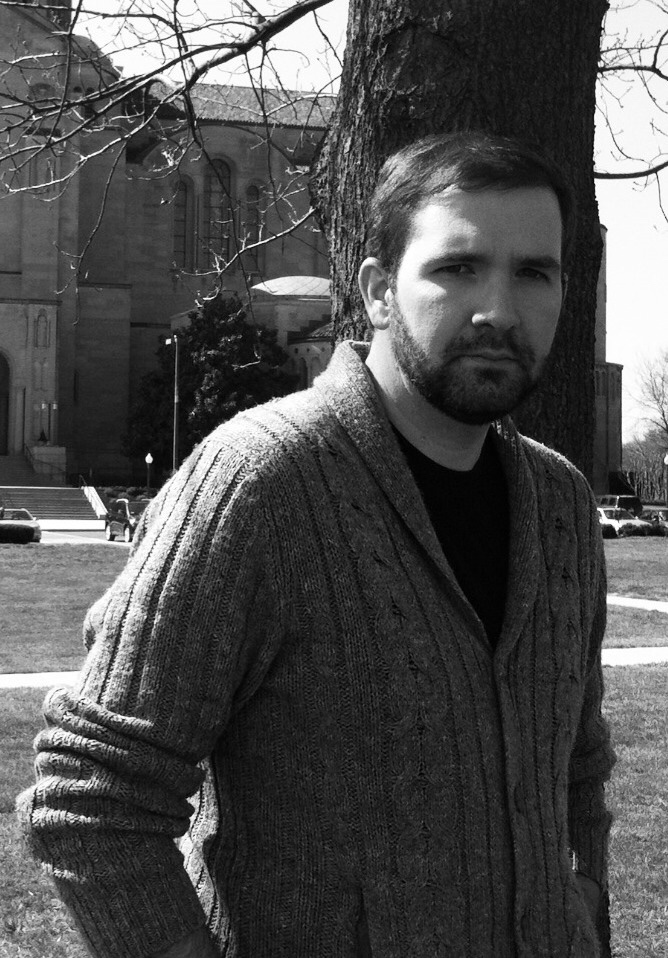
Ryan Wilson is a poet and the current editor of Literary Matters, an online literary journal. Wilson’s first book of poems, “The Stranger World,” won the 2017 Donald Justice Poetry Prize, and his poems, translations, and criticism appear widely in periodicals such as First Things, Five Points, The Hopkins Review,
The New Criterion, The Sewanee Review, and The Yale Review. Wilson is visiting campus Jan. 24-25 to teach a poetry workshop, and will be giving a poetry reading.
How long have you been writing poetry? What inspired you to begin?
I started playing with words and making little rhymes almost as soon as I learned to talk, and I was always writing little things, but I didn’t commit myself to writing poetry seriously until I read T.S. Eliot’s “The Love Song of J. Alfred Prufrock” during my Freshman year of college, almost twenty years ago. That poem struck me like a lightning-bolt.
Do you find literary critique to be a completely different skill from poetry, or do the two play off of each other?
The two go hand-in-hand. If one wants to be a great musician, one listens—and listens critically—to a lot of music. If one wants to be a great basketball player, one watches—and watches critically—a lot of basketball games. Similarly, reading lots of poetry—and reading it critically—helps one to develop one’s own craft.
What — or who — inspires your work today?
I’m a poet mostly of farm country and woodlands. The beauty of creation delights me to no end.
Modern poetry has a tendency to be free form, and often dark: is this a tendency that you have embraced, or have you tried to introduce a different tone with your work?
I’m not sure that “free form” is exactly accurate. The greatest poet of American Modernism, T.S. Eliot, who is often considered a pioneer of so-called “free verse” — “orvers libre” — writes, “Vers libre does not exist,” and goes on to add that “there is no freedom in art.” What he means is that all art is based on patterning. While much modern poetry modifies traditional patterning, or invents new kinds of patterning, it’s not quite “free form.” Indeed, William Carlos Williams—who is often taken to stand in polar opposition to Eliot—writes similarly, “There is no such thing as free verse.”
Very often, the illusion of an absence of patterning is created by the poet’s using more recondite patterning. As W.B. Yeats writes in “Adam’s Curse”: “A line may take us hours, maybe;/Yet if it does not seem a moment’s thought,/Our stitching and unstitching has been naught.” That is to say that the modern poets tend to follow Ovid’s claim from The Art of Love: Ars est celare artem, “The art is to hide the art.” One wants a poem to seem like spontaneous speech, the way a magician wants a long-practiced trick to look easy.
As for modern poems often being “dark,” I suppose that’s so, although there’s a great deal of light in masterful poets like Marianne Moore, W.H. Auden, Elizabeth Bishop, James Merrill, Richard Wilbur, Derek Walcott, and John Ashbery, as well as in some of our more brilliant living contemporaries like Mary Jo Salter, Brad Leithauser, and A.E. Stallings. Personally, I’m interested in utilizing a wide variety of patterns and in poems that wrestle with the angel as Jacob did.
With the younger generation increasingly encouraged to pursue careers in STEM, business, or medical fields, because of their greater perceived usefulness in the modern world, what defense would you make for writing poetry? How would you respond to those who suggest that poetry is not a viable occupation, or that it is not useful enough?
First, writing poetry and working in medicine or business are not mutually exclusive. William Carlos Williams was a physician, as is the fine contemporary poet C. Dale Young. The modern master, Wallace Stevens, was Vice President of the Hartford Insurance Company, and the wonderful contemporary, Dana Gioia, was a Vice President of the Kraft Food Company. The poet doesn’t have to be a bohemian, although some poets choose to be bohemians because they find bourgeois stability a bit stifling.
While poetry can’t stop a tank, as the Nobel Laureate Seamus Heaney once quipped, neither can virtue, yet we tend not to question the value of virtue. Without delving into theology, we might mention Aristotle’s concept of the “hexis,” which Aquinas translates “habitus.” The “hexis,” or “habitus,” of virtue is “the good seeking the good,” and the habit of virtue is, for Aristotle, its own reward. Similarly, the pursuit of beauty is, on a basic level, its own reward: there is pleasure in encountering beauty, and there is pleasure in making one’s life as beautiful as possible. (The Platonist would see the habit of virtue and the habit of beauty as inseparable.) I hope that we haven’t become so abstracted that we disdain the pleasure of beauty.
Moreover, people have an innate need for language with which to understand and to express themselves: the best poetry is nothing less than the greatest language recorded in human history. It affords us not only the pleasure of encountering beauty but also the opportunity to know ourselves and our world more fully, more intimately, not as ideas but as particulars. The imagination is not an escape from reality but an entrance into the body of it.
While poetry may not seem as immediately useful as learning to perform life-saving surgery, self-knowledge and the love of beauty and the human community promoted by poetry are important parts of why we want to stay alive at all. In “Asphodel, That Greeny Flower,” Dr. Williams writes: “It is difficult/to get the news from poems,/yet men die miserably every day/ for lack/of what is found there.”
What advice would you offer to young artists, whether writers, poets, or otherwise?
Don’t sell yourself short by taking shortcuts or avoiding the difficult. Believe in yourself so deeply that you can be as exacting and meticulous in the practice of your craft as the greatest masters were. Shakespeare and Emily Dickinson and Langston Hughes and Michelangelo and Bach were people, just like you.
