
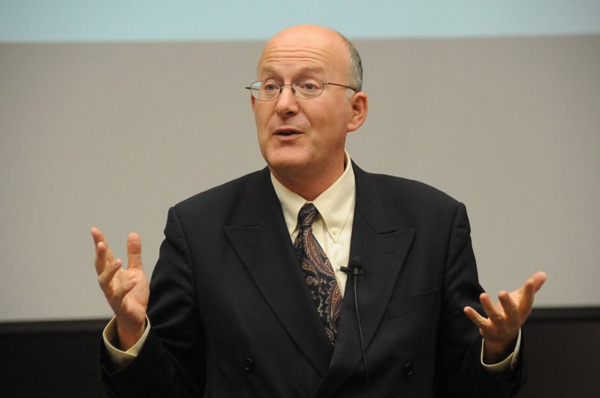
The best way to be effective in war is to be familiar with your opponent’s geopolitics, according to Jeremy Black, author and professor of history at the University of Exeter.
In his lecture, “Geopolitics and Revolution: America’s War for Independence,” on March 10, Black argued that military and foreign affairs are a primary concern for the citizen, so citizens ought to understand military affairs.
“In essence, the use of power is to try to direct a change in other people’s attitudes, essentially to make them compliant to yours,” said Black, who is also a distinguished fellow in Hillsdale’s Center for Military History and Strategy. “And it is very difficult to do that if you do not understand how those societies work.”
Black is an expert in early modern to modern war and geopolitics, according to Jason Gehrke, assistant professor of history and associate director of the center.
“Dr. Black is known as one of the most prolific living military historians,” Gehrke said.
Black spoke to about 150 people in the Searle Center.
He argued that because of ever-changing technological advancements, people need to observe the past and the present in order to engage with the future of military warfare.
“If you are thinking about the future, you have to think about the data set of the present and the past, and you should do that if you’re looking at military history,” Black said. “Because you want to work out how people in the past confronted and sought to mold to their advantage change, and how they did so in order to create relative capability advantages and successful outcomes.”
Actors in history have to live history forward, while contemporary people have the benefit of hindsight, Black argued.
A country has a wide range of factors that influence how it responds, Black said. If one country acts, it does not mean that another country will respond.
“I think the central claim was that every power involved in a war has a distinctive range of political and military concerns, which result from its distinctive history, its distinctive politics, and its specific strategic geography,” Gehrke said.
The American attack on the British in 1775 was poorly timed, even though the British had a small army in North America, according to Black.
“It wasn’t a brilliant year to start a war,” Black said. “The Americans were extraordinarily foolish, because 1775, 1776, 1777, and the first part of 1778 were unusual in British history. The British weren’t fighting anybody else.”
The commander-in-chief ought to lead well and have extensive geopolitical knowledge, according to Black.
“The United States is the most powerful state in the world,” Black said. “It is a state with commitments all around the world, which have a habit of biting it, given that it has global economic, financial, geopolitical, and military issues and interests. It is absolutely crucial to win the element that ensures that you are well led and well taught militarily.”
The audience received Black’s talk well, according to Gehrke.
“My sense is that everyone enjoyed it and learned a great deal,” Gehrke said. “It is a rare thing, but he is an utterly non-dogmatic thinker. He is not pushing any kind of ideological point. He is just helping you think well about this thing about which he is an expert.”
Black also taught a one-credit course for the third year as a fellow at Hillsdale College. This year’s course, titled “The American Way of War,” studied the American Revolution, Civil War, World War II, and the Korean War.
“If you want to think about history, take his class,” freshman John Armani said. “If you want someone smart to tell you what to think, don’t take that class.”
