
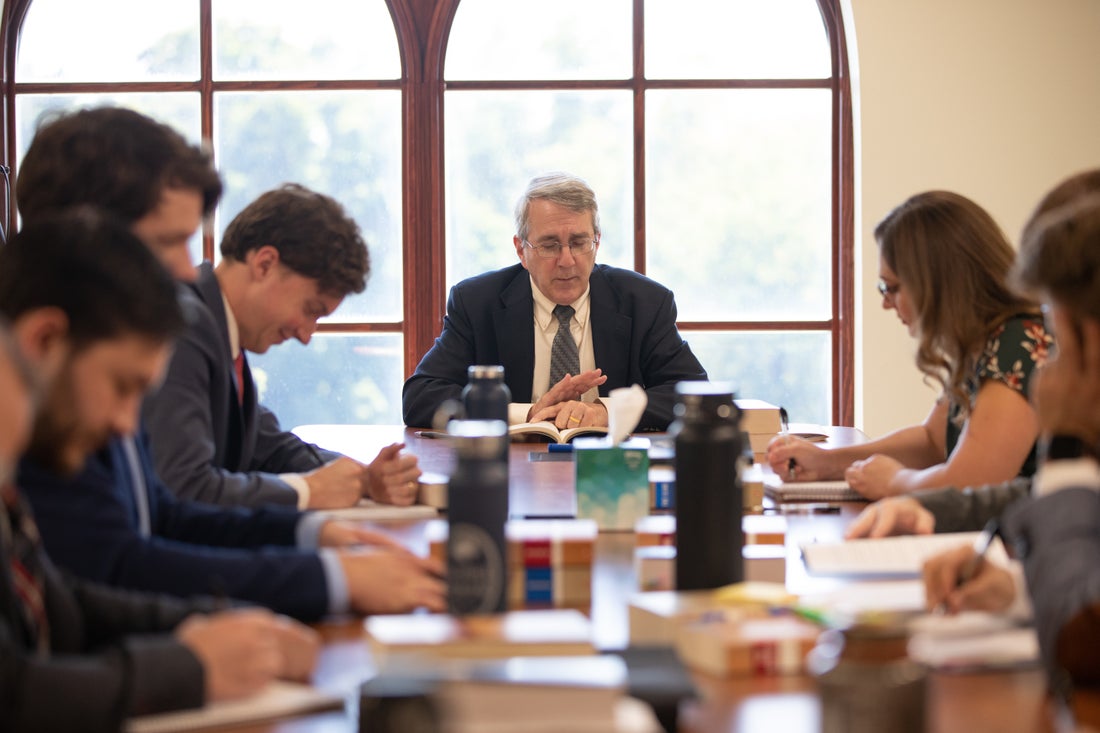
Future Hillsdale students might be required to take a comprehensive core exam, according to members and advisors of the core curriculum review committee.
The committee began its review of the core curriculum in November and will have its final meeting of the semester in April. Afterwards, it may propose specific changes to the core, Hillsdale’s set of courses in humanities, sciences, and more that all students are required to take. The entire faculty would then vote on the changes recommended by the committee. If adopted, the changes would not affect students currently enrolled at Hillsdale.
“The biggest ticket items are still on the table for meeting six: the comprehensive exam idea, the structure of the capstone, and this question of how we evaluate core scholarly skills,” said Samuel Negus, director of program review and accreditation and the non-voting secretary of the committee. “I couldn’t tell you which way they’ll go on those, even if I wanted to, because they haven’t decided.”
Changes will largely focus on areas of the core altered by the last review committee, which met about 15 years ago.
“What we’re hoping to do is take the core that we have and make it stronger,” said Associate Provost Mark Maier, a non-voting member of the committee.
According to Maier, the most radical change to come from the review could be changes to the senior capstone and College President Larry Arnn’s idea for a comprehensive core exam, though the committee has not discussed the specifics of either yet.
“We wanted to get rid of the idea that the core was just something that you just get out of the way and then move on to your major, and that’s what is most important,” Maier said.
The comprehensive exam might incentivize students to retain that information, Maier said.
“We also wanted the core to be the sort of thing that students carried on from here — what they learned in the core was something that they took out into their lives,” Maier said.
The comprehensive exam could possibly be located within the senior capstone requirement, according to Negus.
“The committee might decide to do something different, but that is one very obvious practical possibility to take care of both the core exam and capstone at the same time,” Negus said.
The committee has discussed the logistics that go into choosing core classes, including the different requirements for Bachelor of Arts and Bachelor of Science students, Maier said.
“What would the ideal first-semester freshman schedule look like? What would the ideal second-semester schedule look like?” Maier said. “That’s been the focus of a lot of the conversations.”
Associate Professor of English Lorraine Murphy, a voting member of the review committee, said the committee’s role is not to enact changes, but to make recommendations that the entire faculty will vote on.
“We’ve considered a range of options, from streamlining the core curriculum to expanding it, and we’ve spent quite a bit of time considering whether a more structured or ‘sequenced’ path through the core would be helpful to students,” Murphy said.
Maier joined the provost’s office in 2011 and had a hand in implementing the changes of the last core curriculum revision.
“One of the big changes that happened in 2008 was the decoupling of the Great Books and the Heritage classes,” Maier said. “There’s always been this goal of having a common experience for students — that the students are largely going through the core at a similar pace, exploring the same ideas.”
With the exception of Western Heritage, students haven’t had much direction in the sequencing of the core, Maier said.
“We’ve spent a lot of time talking about what are the sort of classes that are better experienced early in the college career, as opposed to those that can wait till later,” Maier said. “We discovered that there are a lot of students that take a good chunk of the core at the end of their college careers. And there’s a lot of different reasons for that.”
The committee is also considering whether the core adequately cultivates and develops students’ scholarly abilities, according to Negus.
“What do students need to do college-level undergraduate work within the range of what Hillsdale College deems acceptable?” Negus said. “Are our students actually coming in with those things? Are they getting developed in the core? Are they getting developed consistently? We’ve looked at that question, and we’ll consider some recommendations for what we can do there.”
Another possible change would be to alter or eliminate the Physical Wellness Dynamics class, Maier said.
“Up until fairly recently, it used to be that everybody would take activities courses to satisfy that particular part of the core,” Maier said. “We talked about whether or not we need to go back to that. We talked about whether or not we need to change the course as it exists and streamline it and make it more geared toward practical application. Should there be a requirement that students have to do this, but it not be a credit bearing class?”
The committee also discussed the Great Principles introductory science courses, physical wellness, and the requirement to take philosophy and religion.
“In 2008, the last core revision was a structural redesign,” Maier said. “What we’re doing now is not a redesign, it’s more of a tweaking and refining.”
Negus said the committee has focused on areas of the core introduced or altered with the last core revision in the late 2000s.
“This fall will be a full 10-year cycle since the first freshman class to take revised curriculum came on board, and it’ll be about 15 years since the initial recommendations were made, and so that just seemed like a good period of time to revisit those changes,” Negus said.
Maier emphasized that the committee has not decided anything.
“This is all just a matter of putting together the information that we have and talking to people and hearing ideas,” Maier said. “This semester, we’re going to formalize a list of recommendations for the faculty, and then that’ll probably be presented to the faculty for their vote in the fall next year.”
For the most part, Maier said, whatever changes are approved will only apply to the freshman class the following year, allowing students already enrolled to continue the core that was established when they arrived at Hillsdale.
“The changes are going to be mostly modest,” Maier said. “If I were a betting man, I would say that you’re gonna see some fine tuning, but not a major overhaul.”
After the April meeting, Negus said the committee will draft a report summarizing their discussions and recommendations, and will send the final draft to the entire faculty for discussion and a vote in the fall of 2026.
“It’ll be sometime before Thanksgiving when we should have a set of recommendations that the faculty has formally adopted,” Negus said. “Then it would go to the president and to the board of trustees, probably in the spring meeting of the next academic year.”
