
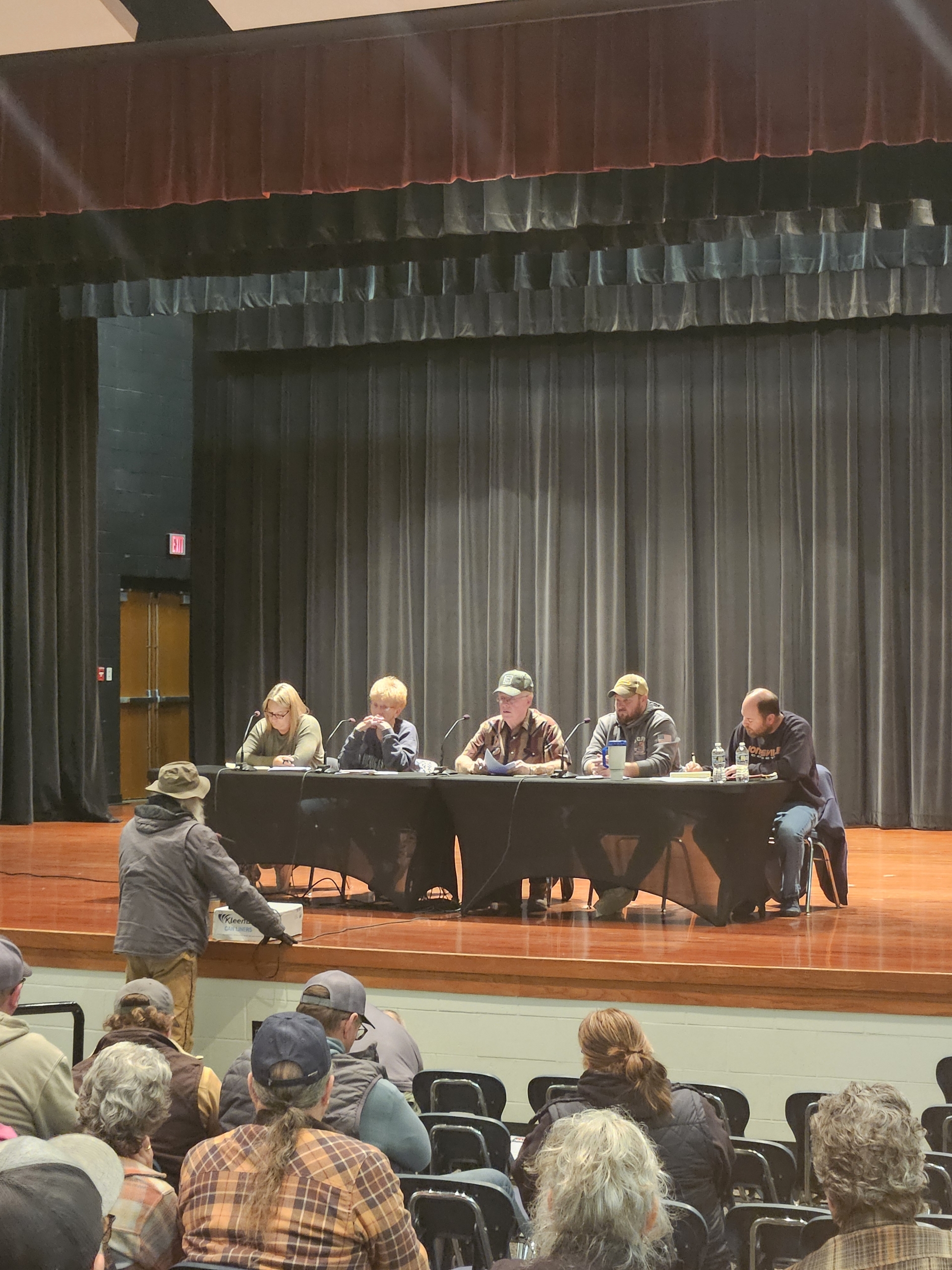
A resident speaks at a Fayette Township board meeting Jan. 12. Christina Lewis | Collegian
While the state of Michigan races toward a mandate of 100% clean energy by 2040, Fayette Township in Hillsdale County is weighing whether to allot 1,350 acres of farmland to construct a solar farm.
Ranger Power, a Chicago-based solar energy company, plans to build the Heartwood II solar project on the east side of the township just north of the City of Hillsdale, along U.S. 12 and White Road. In 2022, the township approved the Heartwood I solar project, converting roughly 900 acres of land into a solar farm in the western part of the township.
The board of Fayette Township hosted a packed meeting Jan. 12 at Jonesville High School. Roughly 200 people attended the meeting, including residents of Fayette Township and the City of Hillsdale, Rep. Jennifer Wortz, and candidates for governor.
The public comment section lasted for 90 minutes, with a three-minute time limit per person. Roughly 30 people spoke at the meeting, and all opposed the project. People voiced their concerns that solar panels would change the way of life in Michigan, and that they would negatively affect people’s health.
“I think one of the main things to point to is just how this is going to change the character of our country and Hillsdale County,” Ward 4 Councilman Joshua Paladino said. “It’s been an agricultural area for 180 years, whenever it was first settled. And are we just going to give that up and allow it to be a series of stagnant solar fields?”
Wortz, a Republican who represents Hillsdale and Branch counties, said the solar project is part of the state’s Green Energy Initiative. In 2023, with a Democrat-controlled House, Senate, and a Democrat governor, the state passed the Clean Energy & Jobs Act, which set a mandate for 100% clean energy by 2040.
“When I was elected and took office the first of January last year, one of the first things we passed were House Bills 4027 and 4028, which gives the power back to the local control to set the guidance and to approve or allow for — whether it’s solar, whether it’s battery — to be decided on at the local level,” Wortz said. “The problem is the Senate has not taken up those bills, and so we’re in a holding pattern until hopefully we elect a conservative governor and a conservative Senate, and maintain a highly conservative House, and we can repeal this green energy Michigan Healthy Climate Plan, as they call it, altogether.”
Wortz said she encourages landowners to reach out to the Senate Majority Leader Winnie Brink’s office and ask that she take up the House bills. One way the township can fight this is by using the clause in the 2023 act that states that “an unreasonable amount” of farm ground cannot be used, according to Wortz.
“The question is, what does an unreasonable amount mean? Is an unreasonable amount more than 10%? Is it more than 20%? In this case, my understanding is that if this project goes forward, more than 20% of the farm ground in Fayette Township would be covered in solar,” Wortz said. “That seems pretty unreasonable to me.”
Wortz said the Jan. 5 Fayette Township planning commission meeting was rescheduled to Jan. 19 because the township hall did not have enough space to accommodate all the people who showed up to speak against the project, violating the Open Meetings Act, which requires the township ensure enough space for anyone who wants to attend the meeting.
“If you have that many people showing up at a meeting to say they don’t want this in their community, then I think that the solar company and the energy companies need to honor their word and respect that and go find another location,” Wortz said.
She said there is a “time and place” for solar panels, and that people must be wise on where to put them.
“There’s a great example in the City of Coldwater, where there was a brownfield — a toxic waste area from a factory years ago,” Wortz said. “They filled these large containers with cement and put the solar panel posts in these cement containers, and that whole brownfield within the city is covered in solar panels. That’s a great idea. That’s a great place for them. It’s not disrupting fertile farm ground or natural resource grounds of forest fields or wetlands.”
Ward 1 Councilman Jacob Bruns said that although this issue deals with Fayette Township, he has heard “entirely negative feedback” from his constituents in Ward 1.
“Not one positive thing have I heard mentioned yet,” Bruns said. “That doesn’t mean there aren’t people out there who might be in support, but, by and large, it seems like a huge majority of the population opposes this.”
Janice McNair said she lives on a hill and can see all the solar panels from the Heartwood I project despite the trees planted by the solar company in an effort to prevent that.
“I used to have a beautiful view for over 30 years, and now all I get to look at is solar panels,” McNair said at the meeting. “It’s ruined my property value and it’s terrible. I have a huge dining room and a living room window, and I sit there and look out at that. And what do I get to see? Solar panels. It’s not right. Nobody asked me, ‘Do you want to look at solar panels?’ They just put them in and now we’re stuck with them. I want to move, and you’re going to see people move because they don’t want to look at solar panels.”
Realtor Diana Carson said one of the biggest questions she gets when showing houses to clients is whether there are solar panels nearby.
“I cringe when I look at properties, and I see these panels going up all around them,” Carson said at Monday’s meeting. “Land values I can’t speak to, but all I can say is, my clients don’t want to buy them.”
David Danford, a Fayette Township resident and the executive director of business and industry at Hillsdale College, said he thinks the environmental effects of solar panels pose a threat to the way of life in Hillsdale.
“Hillsdale students may be curious to know or may appreciate seeing how this process is unfolding, right here where we are, because it is a great example of many of the things that we talk about in the many contexts at the college: modernity, the administrative state, general corruption or debasement of American way of life and citizenry,” Danford said.
Fayette Township resident and founder of No Solar Fayette, Steve Oleszkowicz, said residents also have concerns about a conflict of interest in the Fayette Township planning commission.
The township supervisor’s parents have property in Heartwood I and Heartwood II, according to Oleszkowicz.
“There’s another gentleman that’s the chair of the planning commission that has property in Heartwood II,” Oleszkowicz said. “There is another gentleman on the planning commission that has property in Heartwood I.”
Although these officials state they are in recusal, they’re participating in discussions and conversations in chair or township supervisor roles during discussions and deliberations about these projects, Oleszkowicz said and the Hillsdale Daily News also reported. Thus, they are in partial recusal since they are only abstaining from the vote.
Additionally, there are numerous environmental concerns surrounding the solar project, according to Oleszkowicz.
“There are concerns about localized heat. Solar panels generate reflective heat during the day, and then at night, because that heat is not being absorbed in the ground, they tend to be colder in those areas, so you get more of a temperature fluctuation,” Oleszkowicz said. “The other concern is chemical spray. Some solar facilities have been documented using glyphosate and other sprays at significantly higher concentrations than farmers are allowed to use. And there have been documented incidents of contaminating local wells of neighboring properties.”
Paladino said he thinks the Heartwood II Solar Project is part of a larger project to transform rural Michigan.
“I think that our leaders think we don’t produce enough, or don’t produce efficiently, or we’re backward or poor, so they’re going to impose their schemes on us,” Paladino said.
