
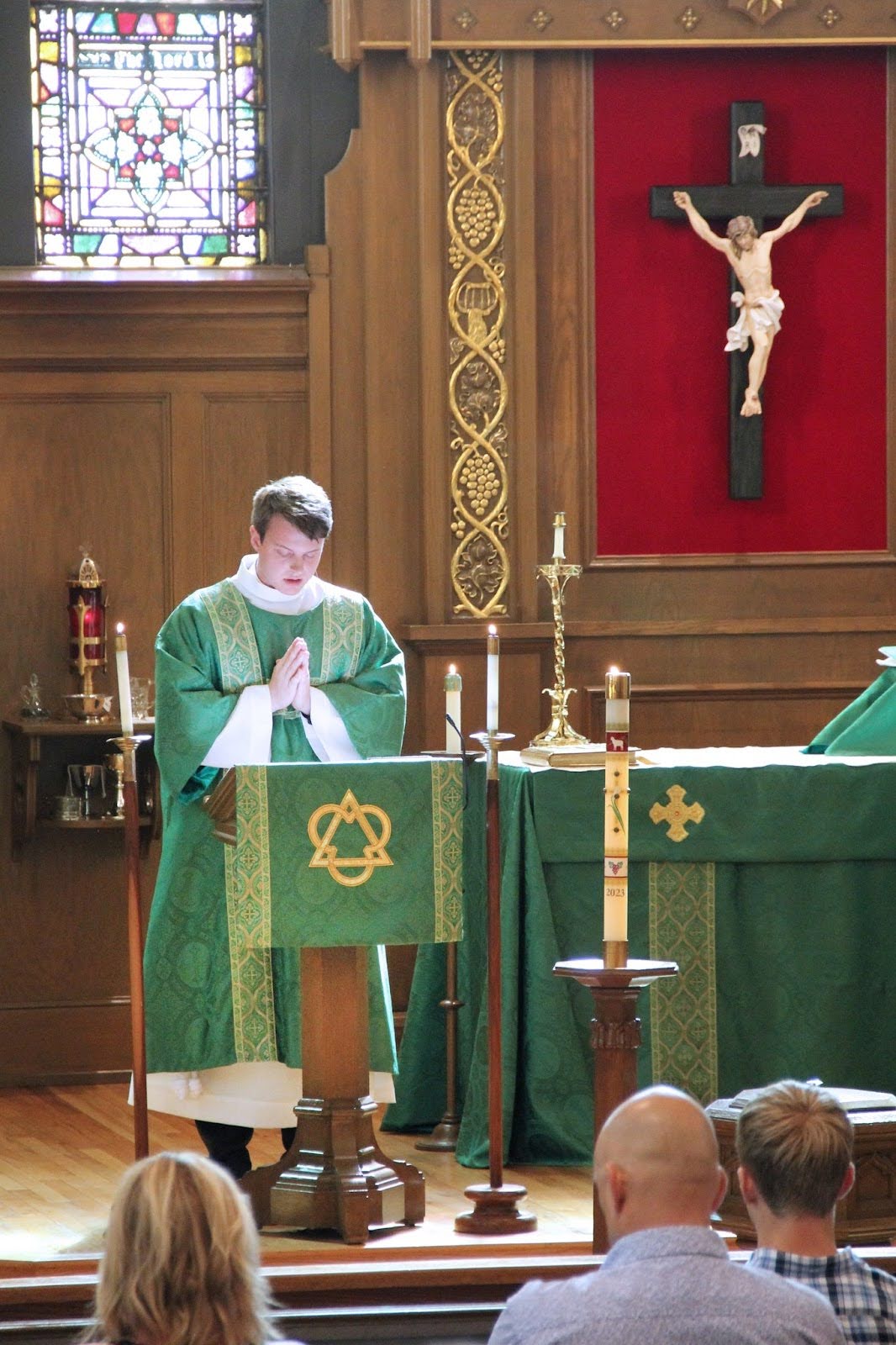
Harvey Peters ’22 serves at his field-work church, Redeemer Lutheran Church in Fort Wayne, Indiana.
Courtesy | Harvey Peters
What happens when God changes your post-grad plans? For some Lutheran Hillsdale alumni, that means seminary.
Nine Hillsdale alumni are currently enrolled in the two Lutheran Church Missouri Synod seminaries in the U.S., following a four-year path to ordination as pastors in the LCMS.
Christopher Atlee ’23, a second-year seminary student at Concordia Seminary in St. Louis, said he came into the Lutheran faith while at Hillsdale.
“I was in Koon my freshman year,” Atlee said. “My resident assistant, Isaac Spangler, who was just ordained last summer, invited a bunch of us to church with him.”
So Atlee went. Though he grew up an evangelical Christian, Atlee said he was attracted to the style of worship at St. Paul’s Evangelical Lutheran Church in Hillsdale, so he continued attending with friends. Through late-night theological conversations and his own study, Atlee said he grew to adopt many Lutheran beliefs.
“At a certain point, I was like, I guess I’ll be Lutheran,” Atlee said.
Atlee said he wanted to be a lawyer, not a pastor. But when friends of his in the Federalist Society encouraged him not to go to law school, he reconsidered. After getting married the summer before his senior year, Atlee realized he wanted a path that would allow him to prioritize his family.
“Having delved deeper into my faith and actually experienced some deep theology, it shaped me a lot,” Atlee said. “I had never considered any sort of church work or ministry work in my life before. It slowly developed into, ‘Well, actually, I could be a pastor. Maybe I should do that.’”
Atlee describes his daily schedule now as one of classes and reading — similar, he says, to Hillsdale. Seminarians attend daily chapel, as well as a Divine Service every Wednesday.
“There is just a wonderful community of believers here, and that’s especially wonderful for my wife and two daughters,” Atlee said.
Matthew Sauer ’16, a second-year student at Concordia Theological Seminary in Fort Wayne, said he grew up Lutheran but experienced many different varieties of Lutheran worship before coming to Hillsdale.
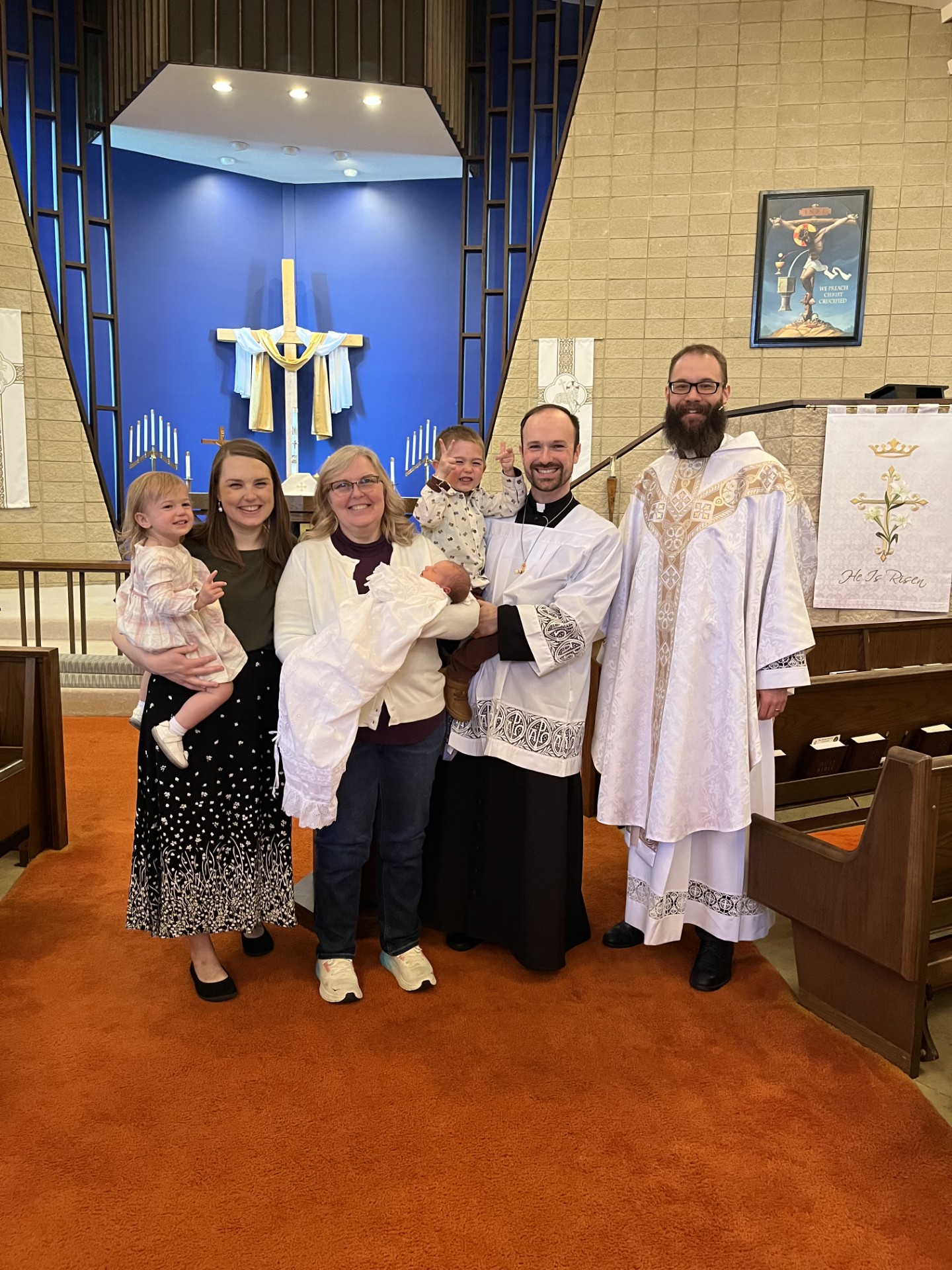
Courtesy | Matthew Sauer
“Hillsdale confirmed for me that there’s some beauty behind the traditional mode of worship and challenged me to take my faith more seriously,” Sauer said. “It confirmed that in the swirling fishbowl of Hillsdale, where you’re being fed all sorts of different ways of thinking and Christian traditions, being Lutheran seemed to be the best option out of a lot of options out there.”
According to Sauer, Lutheran Society was founded his sophomore year at Hillsdale.
“I kind of walked backward into it, because I noticed my Lutheran friends starting to wear green pants on Tuesdays. And so it became Lutheran Green Pants Tuesday,” Sauer said. “That turned into, ‘Oh, we’re also having a Bible study on Tuesdays, and also we’re having dinner on Wednesday.’ So it was great fun to start, and then it became a little bit more rigorous.”
By the end of his time at Hillsdale, Sauer said Lutheran Society was having morning and evening prayer, lectures, dinners, and Bible studies.
“It was cool to see the growth of that group into something that was pretty robust by the time I had graduated,” Sauer said.
Unlike some of his peers, Sauer didn’t go to seminary right after college. It was eight years after graduation that he started at Fort Wayne, the consequence of a series of happy accidents — or moments of grace.
“It had been put on my mind by my home pastor before I came to Hillsdale,” Sauer said. “I said, ‘No, I don’t think so. Pastors only work one day a week anyway. That sounds lame. I’ve got greater things to do.’ And then over the course of Hillsdale, I realized, ‘Oh no, pastors are so great. I’m never going to be able to do that. It’s too much of a task.’ So then I was kind of despairing of ever doing it.”
Sauer accidentally visited the seminary on the way home from a wedding to take a selfie with the Martin Luther statue on its campus. His home pastor walked out of a building, spotted Sauer, and congratulated him on joining seminary.
“I tried to back out of it, but then he told a bunch of other pastors who then also told me, ‘Hey, you should do this,’” Sauer said. “It was just an avalanche. So I reluctantly visited and couldn’t find a reason not to come.”
Sauer said Hillsdale has given him the drive to investigate his Christian beliefs.
“You can’t sleepwalk your way through your Christian life,” Sauer said. “You have to take it seriously. And if it’s true, it has implications for how you live and what you say and do.”
The communal aspect of seminary feels like a continuation from Hillsdale, Sauer said.
“The conversations between the classes and after class and on the weekends with friends here are as formative sometimes as what’s going on in a lecture,” Sauer said.
For Harvey Peters ’22, former Lutheran Society president and now a fourth-year student at Concordia Theological Seminary in Fort Wayne, seminary had been a longtime consideration.
“I was raised Lutheran,” Peters said. “My dad is actually a pastor in the LCMS. So I went to Lutheran grade school and Lutheran high school.”
Peters said by the time he got to Hillsdale, he was interested in going to seminary: a gradual realization shaped by his own interests and the example of his father.
“I realized I had a great love for the work of studying the scriptures, studying our Lutheran theologians and ‘The Lutheran Confessions,’” Peters said. “My dad was a second-career pastor, which means he started seminary when I was 7. I saw him go through the process of seminary and then becoming a pastor. He always had me helping out at church.”
Peters said Rev. Sean Willman, pastor of St. Paul’s, and Chairman and Associate Professor of History Korey Maas were role models and mentors.
“Pastor Willman was always very eager to engage with us students,” Peters said. “He was very helpful in guiding the Lutheran students at Hillsdale and being a very, very faithful man for us to turn to with questions. For me at least, Dr. Maas was also extremely influential.”
Like Atlee, Peters said his day is structured around classes and reading, with a break at 10 a.m. every day for a communal chapel service.
“Then we all shift over to the student commons. We all have coffee and chat until about 11 o’clock,” Peters said.
Peters said at Hillsdale, he learned to read and understand great thinkers — skills that have transferred well to theological studies.
“The academic rigor that Hillsdale prides itself on prepared me more than anything,” Peters said. “By the time I got to seminary, I didn’t have to think so hard about how to work out a research paper.”
Peters’s best man in his wedding, Henry Eising ’21, is a fourth-year student at Concordia Seminary in St. Louis. Like his friend, Eising also came from a family deeply rooted in the LCMS.
“My grandfather’s a pastor. His dad was a pastor,” Eising said. “It was what I was born and bred in, what I knew. At Hillsdale, I was exposed to a bunch of different things, and I wanted to make sure that I believed what I believed for a reason.”
Eising said he came out of Hillsdale able to back up his beliefs — and ready to pass them on to others.
“My senior year, I didn’t really know what I was going to do the next year,” Eising said. “At that time, the church was really what was keeping me together and my stronghold. I was seeking the most meaningful thing that I could do, and somehow, by the grace of God, I was given to see that the best thing that I could do was to share and proclaim the forgiveness of sins that’s found in Jesus alone.”
According to Eising, everything seemed to fall into place once he realized he could go to seminary.
“It’s the best job in the world,” Eising said. “And guess what? I can do that for the rest of my life.”
Eising met his wife, Stacey Eising (née Egger) ’18, shortly after moving to St. Louis. There, Eising said, they have found seminary to be a continuation of the Hillsdale model of education, albeit in a theological direction.
“At Hillsdale, everyone is so dedicated to really pursuing the good life and figuring out what it means to lead a good life,” Eising said. “Being in that kind of community is super helpful, and it has prepared me really well for seminary. Even the approach that people at Hillsdale take to handling texts and looking at history becomes super helpful when you’re a student of theology and student of the Church.”
Eising described seminary as a similarly vibrant community.
“You take classes in the different sectors of theology, and then the rest of the time is spent having discussions with your classmates, hanging out with your family and friends,” Eising said. “There’s always something to go to.”
According to Eising, the substantial number of Hillsdale alumni in Concordia seminaries reflects a broader push in the LCMS for vocations.
“Recently that’s been kind of one of the church body’s focuses — recruiting young people to pursue the pastoral office,” Eising said. “That initiative is bearing fruit. And it’s great to see my class is one of the smallest classes, but each class after me has grown in size.”
As he looks forward to ordination in the spring, Eising says he will bring elements of his formation at Hillsdale into his role as a pastor.
“Hillsdale does a great job of getting us to consider what the good life is, and the Church is, of course, the best way to pursue the good life,” Eising said. “I thank Hillsdale for really getting me to consider that, and I’m excited to try and share that with the people that I serve.”
