
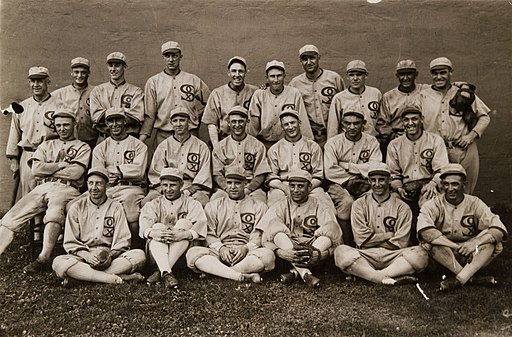
The 1919 Chicago White Sox | Courtesy: Wikimedia Commons
The Detroit Pistons last won the NBA Championship in 2004, when point guard Chauncey Billups and a spirited Pistons team toppled the mighty Los Angeles Lakers. Twenty-one years later, Michigan sports legend Billups might soon find himself behind bars for a long, long time. This latest example of yet another pro sports hero enveloped in a criminal scandal highlights an ever-expanding crisis of sportsmanship in American athletics.
For two words so similar, “sportsman” and “sportsmanship” evoke two astoundingly different images. When I hear “sportsman,” I picture Mel Hein receiving a watch, Bob Gibson smiling from the dugout, or Dale Earnhardt sitting in a fishing boat. But for anyone who’s ever played sports, “sportsmanship” means helping an opponent up, shaking hands, saying “good game,” or thanking the referee. These are all good practices for athletes. They are also not sportsmanship in any real sense.
Sportsmanship means nothing less than to be a sportsman — not simply a man who plays a sport, but a man who behaves sportingly. It is the expectation that those who play sports will maintain gentlemanly behavior, both on and off the field. That’s a relatively small ask for a minimum yearly salary upwards of $700,000 in each of the big four professional sports: football, baseball, basketball, and hockey.
Nonetheless, crime and scandal have found their ways into professional sports. Every decade inevitably delivers one shocking scandal: fixing, point-shaving, steroids, concussions, violent crime, and so on. Even organized crime makes appearances: the 1919 Black Sox scandal, cocaine trafficking rings in 1980s basketball, baseball, and football. There was also the New Orleans Saints Bountygate scandal — though no charges were ever filed.
In the most recent case, an FBI investigation into a series of fixed poker games operated by the honest-to-goodness mafia implicated Chauncey Billups, now the head coach of the Portland Trail Blazers, and Miami Heat guard Terry Rozier III. In this case, however, nobody seemed surprised. Nobody expected them to be sportsmen — a simple glance at social media shows that fans have long suspected the two of shady dealings both on and off the court. As of yet, the same fans have shown an astounding lack of reflection on how exactly criminal behavior came to be an expected and unsurprising part of the game.
Because the story behind that is simply that they, the fans, allowed it to happen. They let American professional sports organizations not enforce standards. It used to be that organized pressure from the fanbase and members of the community forced teams to fight tooth and nail to ensure that they upheld true sportsmanship. And while today’s teams are less accountable to their actual fans than ever before, the fallout of 2020 — and the swift capitulation of all professional sports to social justice politics — showed that collective action on the part of the audience can still change the game.
Brooklyn Dodgers manager Leo Durocher was suspended for the full 1947 season after the Brooklyn Catholic Youth Organization raised hell about his friendships with gamblers and his affair with a married woman. Now, Sunday Night Football devotes a full glamor graphic to Kansas City Chiefs wide receiver Rashee Rice’s glorious return after a felony conviction for driving 120 miles per hour, causing a six-car crash, and then fleeing the scene. That stunt caused the NFL to suspend him for a whopping six games.
Standing beside the masses who silently accept this ridiculousness are those few willing to respond. They call for leagues and organizations to restore the abstract ideas of “integrity,” “dignity,” “accountability,” and, of course, “sportsmanship.” This accomplishes nothing. Professional sports is a business, and businesses don’t sell ideas. If you’re going to demand something from professional sports, start demanding things. Start demanding sportsmen. They’ve supplied sportsmen before, and they can do it again. Not every athlete can be Jim Brown or Bill Russell, but everyone, athlete or not, can avoid reckless driving and mafia poker games.
If you want scandals to be shocking again, start calling for the return of the sportsman.
