
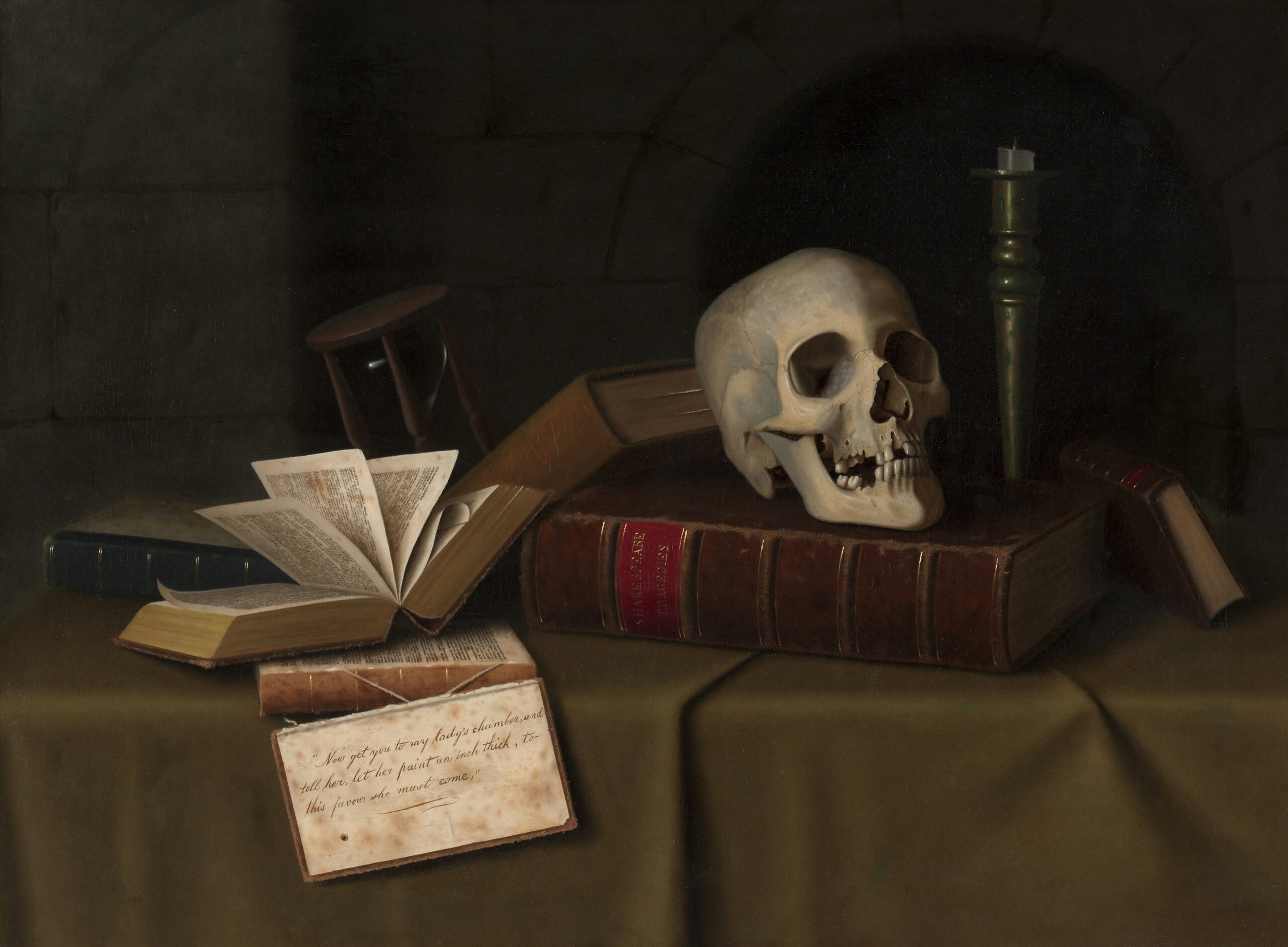
Memento Mori, “To This Favour,” by William Michael Harnett, 1879. Courtesy | Unsplash
You will die.
We like to ignore this inconvenient fact. The morbid and macabre are improper in pleasant conversation. Our language has more than 200 euphemisms for “die,” such as “pass away” and “bite the dust.” But despite our best efforts to push mortality aside, we still parade death and decay in dress and decorations on Halloween, a brilliant annual celebration of our mortal condition.
Halloween, or “All Hallows’ Eve,” is the night before the Feast of All Saints, when Christians remember the dead believed to be in heaven. It calls to mind the brevity of life and the effects of the present world on the next. Although the holiday carries less religious weight, the remembrance of death remains central to its festivities. And we need it, because only by remembering death can we truly live well.
While going through old family pictures, I found a photo of my distant cousins, then little girls, smiling and sitting on my great-grandfather’s fresh grave in the 1950s. It disturbed my 21st-century American mind. I’m the kind of person who shudders just driving past a cemetery. I still don’t like to think about my proximity to dead people, and I especially don’t like to think about how I’ll one day become food for worms myself.
Yet the more I contemplate it, the more familiar and less scary it becomes.
Christian monks have often kept human skulls as reminders of mortality. See Caravaggio’s famous painting of St. Jerome for an example. Halloween serves a similar function today. It arrives in the season when nature looks and smells of death: falling leaves, browning grass, and waning sunlight. It’s difficult to avoid the subject of death when you see it every time you leave the house. Then Halloween smacks you in the face with it: graveyard tours, stories of ghostly hauntings, and costumes of the grim reaper and the undead.
Deep down, we are still mystified and disturbed by death. You will leave behind everything and everyone you know to go — where? Eternal bliss? Weeping and gnashing of teeth? Nothingness? These questions demand answers, and the stakes are high.
Modern medicine has eradicated diseases that slaughtered our ancestors, and today, most of us have a decent shot at making it to our full lifespan of threescore and ten, as the Psalmist says. We have postponed death, and thank God for it. But because death no longer lurks just around the corner, at least not as often as it once did, we think about it less, to our detriment.
Forgetting death means we have trouble facing it when it comes. Wakes and funerals were once assumed to be the next logical step after someone died. It was a chance for family and friends to see their loved one’s lifeless body, accept that a person was truly gone, and receive support from others. Family members donned black for months to tell the world that the worst had happened. Death was integrated into life.
Today, funerals are increasingly replaced by memorial services and “celebrations of life,” wherein the deceased’s remains are missing, no one wears black, and attendees merely eulogize without closing a coffin or burying the dead. There is no finality when the ritual dodges the heaviness of death. We have done both the living and the dead a great disservice.
We fear death because it ends our earthly joys, but it is equally our liberator from this life’s sorrows. It’s freeing to remember that every humiliation and failure, every material success, my appearance — it will all die with me. No one will pass my grave and applaud me for my college GPA, or weight, or possessions. Nor will anyone recall that one time I said that really stupid thing or got a C+ in a particular English class. It will be forgotten forever. All things will pass away.
We must face death to reconsider our own lives. Among the most common regrets of dying people are not spending enough time with loved ones, spending too much time working, and wishing they had enjoyed life more. But if we lived every day aware of death, we would live better. Remembering death ahead of time is also remembering to live with intensity and intention, to strive for truth, to leave legacies behind, to love people better.
Halloween in all its morbid glory remains a helpful acknowledgment of our end. Ready or not, death will still find every one of us. So eat the candy, but memento mori.
Adriana Azarian is a senior studying politics.
