
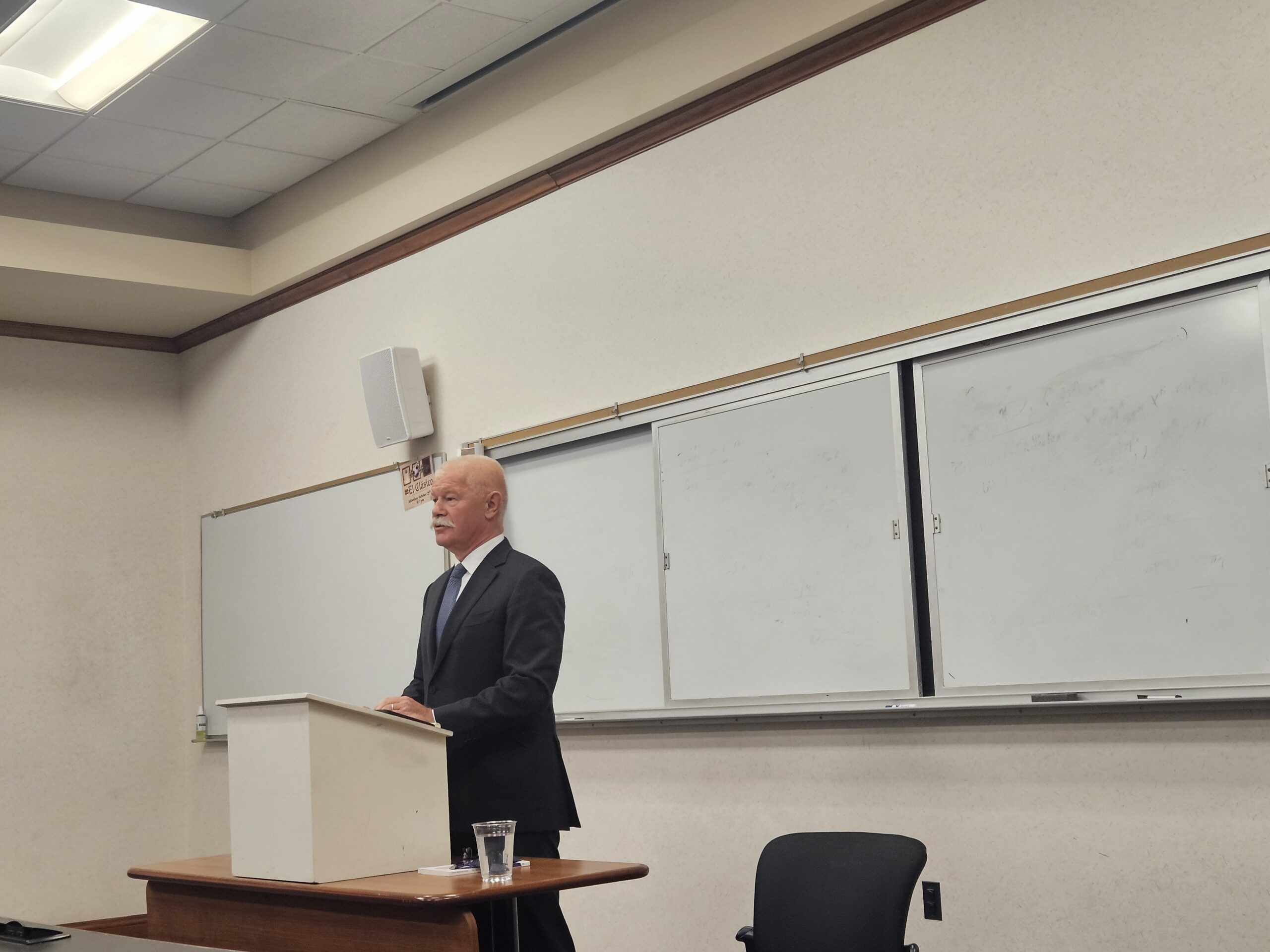
Leadership means acting as a guide for a group’s journey, according to János Csák, former Hungarian ambassador and minister of culture and innovation in Hungary.
The President’s Office sponsored Csák’s visit last week. He delivered two speeches: “Leadership: Virtues and Techniques” and “Offense vs. Defence: Challenges to Western Civilisation.”
In his first speech, he said it is important that leaders know who they are, where they come from, and where they are going. Good leaders pursue a good life, according to Csák.
“A good life means that it should be good for your family, wife, children, parents, and beyond that, friends and fellow citizens,” he said.
People should nurture the good life, not just contemplate it, according to Csák.
“If you want to be a leader, have a vision, and have a vision of the unity of order,” Csák said. “You cannot put the whole world in order. You cannot put all the American cities in order, but you can do it with your organization, with your family, with your community. And, if we are lucky, and many people do it, all of a sudden, we will see a great country.”
Junior Sophia Mandt said it is important for students to hear those like Csák, who are engaged in the arena of politics.
“I love Hillsdale, and I love listening to the professors and stuff here because they very much know the contemplative life, but the active life matters too, and I don’t think it’s necessarily wise to just totally retreat from it when you can’t just let our culture go to whoever will take it in its place,” Mandt said.
In his second talk, delivered on the 69th anniversary of the Hungarian Revolution, Csák said he would give a realistic assessment of how the political state of affairs looks from a central European position in a global and European context.
“There is no individual freedom without constitutional freedom, and there is no constitutional freedom if there are no free citizens,” Csák said.
As a smaller nation, Hungary relies on big powers who are interested in preserving and respecting Hungarian interests, Csák said.
“We were in the Soviet empire between 1947 and 1990. That meant that central countries became periphery, and there is no worse thing for a country than to be on the periphery,” Csák said.
People must come to terms with their heritage and identity, and choose to cherish it, according to Csák.
“In my opinion, if we in the West don’t respect our Judeo-Christian roots and our families, why would other people respect us? Why would our way of life be attractive to other people?” Csák asked at the talk.
Csák also spoke about the war going on in Hungary’s neighboring country, Ukraine.
If Hungary chooses to impose sanctions on Russia, then the Russians will counteract with their own measures, according to Csák.
“When I talk about the balancing act, our policy is to make as many players on the international ground to be interested in our success,” Csák said.
Junior Clara Bozzay said she walked away from Csák’s speech with a new understanding of current events, primarily regarding the state of Central and Eastern Europe.
“I think my biggest takeaway from the lecture was how much we as Americans have left to do in order to preserve what we’ve built,” Bozzay said.
