
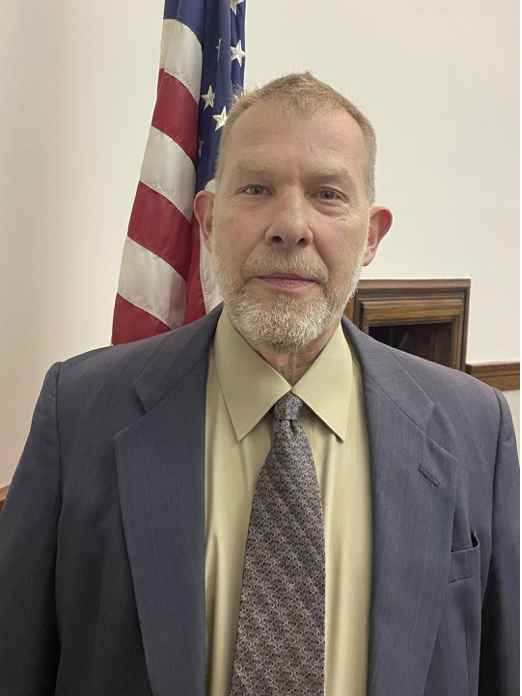
Matthew Bentley is a current city councilman. Courtesy | City of Hillsdale
Matthew Bentley said he fled Ann Arbor in 2020 to escape the “twin tyranny” of COVID-19 and bike lanes. Now, he’s running for mayor of Hillsdale.
Bentley, 58, currently represents Ward 2 on Hillsdale’s City Council. He grew up in Hillsdale and graduated from Hillsdale High School before attending the University of Michigan. After serving in the Army and working in the securities industry in Chicago, he returned to his hometown to assist his aging parents. His son, Adam Bentley ’24, graduated from Hillsdale College.
Now retired, Bentley said he would approach the office of mayor as a full-time job.
The councilman has received endorsements from Mayor Pro Tem Joshua Paladino and former mayor Adam Stockford. His opponent in the Nov. 4 election is former mayor Scott Sessions, who held the office 2013-2017. The candidate elected this November will serve a one-year term and have the option to run again in the August 2026 primary and November 2026 general elections to serve a full four-year term.
Bentley said he decided to run for city council in 2024 at the prompting of then-councilman Paladino.
“Paladino twisted my arm for 18 months to get me on council,” he said. “I had no interest.”
On the last day to file for candidacy, Bentley gave in. He and Paladino collected 25 signatures in one day to get him on the ballot. He ran unopposed and took the seat, hoping to give Paladino a hand.
“I just wanted to help out my buddy,” Bentley said. “So it seemed like a small pill to swallow to go be on council and sit there quietly. It turned out I couldn’t sit there quietly.”
Council members received an email after his first meeting that they had to reveal their anonymous votes for mayor pro tem, he said.
“Without getting into the Federalist Papers and the meaning of democracy, the farce of having a secret ballot and then exposing a secret ballot is ridiculous, so I wrote an email and made a stink on council that it was wrong,” Bentley said.
He said he decided to run for mayor to oppose the “road diet,” which would change the traffic pattern on Broad Street and add bike lanes.
“All sides agree that the bike lanes are a farce,” Bentley said. “But the road calming proponents think that’s a sacrifice worth paying, and I do not.”
The Michigan Department of Transportation traffic calming plan would narrow Broad Street from four lanes to three, configure the middle lane as a two-way turn lane, and add bike lanes and extra parking. Advocates say the plan will improve access to downtown businesses and increase safety for pedestrians and cyclists.
The council passed the road diet plans over the summer and allocated $135,000 toward the project in August. Adding bike lanes helps Hillsdale qualify for a significant Transportation Alternative Program Grant through the MDOT to fund the project. In addition to those funds, $250,000 will be provided by the Tax Increment Finance Authority — which collects revenue from downtown businesses — and Hillsdale Renaissance will contribute $10,000.
The elected mayor will have little leeway to stop the road diet now that it has been approved by the council, but Bentley said he will still prioritize road repairs. If elected, he hopes to reform the special assessment districts the city uses to fund road repairs. A hotly contested point in the race, SADs require individual property owners in a designated district to pay up to $5,000 to fund road repairs on their street. Bentley said he would like to lessen that price tag.
“If the council doesn’t take responsibility to reform the special assessments, then the residents of Oak Street and South Street in particular will take it upon themselves to show this is not a viable solution to our road problems,” he said.
Residents in a district can override the council’s approval by collecting letters from a majority of property owners opposed to the special assessment. A group of citizens on Barry Street rejected the city’s special assessment in April 2025. The council would need to vote 7-1 to override these objections.
Sessions told The Collegian he is running for mayor to stop a negative culture in city politics toward city staff that he attributes to Bentley and Paladino. Five city officials have resigned since March, including the city’s engineer, zoning administrator, airport manager, and two public utilities supervisors
Bentley said he thinks this claim is false, and that he has a decent working relationship with most council members and will continue to cultivate those relationships should he become mayor. He said he only speaks to most city staff members during city council meetings, which are recorded.
The only negativity he brought to the council, he said, was directed at the road diet.
Bentley said he wants to encourage more accountability for public officials and engagement from the people of Hillsdale, which may entail disagreements.
“When those who would like to have more self-governance try to make that happen, it looks like negativity to many,” Bentley said.
Bentley has also expressed frustration with the limitations of the mayoral office as outlined in the Hillsdale City Charter. A full reform of the structure of city government is likely unrealistic, he said. But if elected for a full term in 2026, he said he would be open to initiating a review of the charter.
In the short term, Bentley said he hopes to reform the special assessments and improve the day-to-day operations of the council. Small changes, such as using better audio/visual equipment to record city council meetings, would make the happenings in council more accessible to the people of Hillsdale, he said.
Leading up to the November election, Bentley said he would be open to a debate with his opponent. He said he believes speaking openly would facilitate greater transparency from the candidates and engagement from potential voters.
“The people have the right to know who they’re voting for and why,” he said.
