
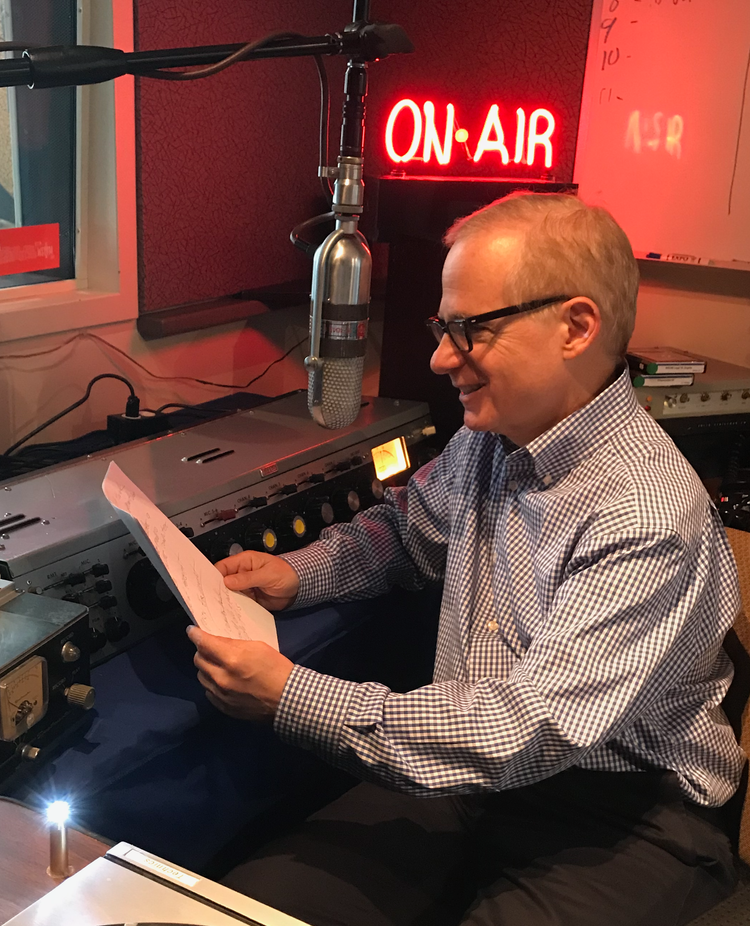
Harris on air.
Courtesy | Radio Hall of Fame
Lee Harris is a radio broadcaster inducted into the Radio Hall of Fame in 2024. Harris first went on air at 13 to do school reports on WGBB-AM on Long Island. Harris spent 30 years working with station 1010 WINS, which at one point amassed the largest cumulative audience of any locally-hosted radio program in the country. He is now CEO of RadioRedact. Harris visited campus Sept. 19, 2025.
How did you get on air at age 13? What was it like doing radio at such a young age?
I often say it’s a little weird to be doing in your 60s what you were doing at 13. It was a local radio station on Long Island where I grew up. At night, they would have some local high school and junior high school kids come in and do a thing called School Scope, and you would tell what was happening at the school: “We had a fire drill on Wednesday and Friday. It was franks and beans for lunch.” It was pretty pointless, except the idea was that you would tell your friends, “Hey, I’m going to be on the radio,” and they would tune in. And it would elevate the audience of this otherwise not-very-listened-to radio station.
Why did you pursue radio?
At the time I was looking into this, there weren’t a lot of other options in terms of what you could do in media. I did have an underground newspaper in elementary school, so I guess I always had some inclination for being a media mogul, but radio was something you could kind of “fake up.” A bunch of friends and I had little FM transmitters that would cover maybe a block, and we took it very seriously. We built studios, we learned engineering, we learned programming, we learned management to a degree. So by the time I got involved with college radio, I had already worked in commercial radio and knew how to build a radio station.
In that group of classmates, several of them went professional, from bedroom radio to the Radio Hall of Fame. It was a common story back then. It wasn’t legal, by the way, technically speaking — these were literally pirate radio stations, and a few of them did get shut down by the Federal Communications Commission, but we always kept our power pretty low.
What happened when you were on air in New York City on the morning of 9/11?
It started out as a very ordinary day, as they always do. Then at 8:46 a.m., we got on the police scanner — we listened to police radio in the newsroom — “small plane hits World Trade Center.” Well, all right, that’s pretty good as stories go. We did not yet understand it was an airliner — we thought it was a Cessna or a Comanche or something. So we get on the air with that. Then the second one hits at 9:01 a.m., and we know what’s going on. I think my major contribution was to two things. One, when the second plane hit, and I was live on the air, and I said, “We are under a terrorist attack.” Of course, nobody in a position of authority had said that yet or would say it for quite a while, but just deducing clear skies, two planes, 15 minutes, there was no other rational explanation. To myself, I said, “If somehow you are wrong, nobody will remember, but I don’t see how I could be wrong.” And I wasn’t. The other thing I think I did that was helpful is I kept a pretty calm demeanor on the air.
Did crime reporting in Chicago and New York City weigh on you?
I will tell you exactly the extent to which it weighed on me. I thought that the information was valuable to people, because it told you where you could go and where you couldn’t go. If you heard every morning that five people were shot in East New York, you probably figured you should stay clear of East New York. So when I stopped working on the morning show on WINS in 2023 and got a day job, I was a little astonished at first — I was taking the subway to work and standing there going, “Hey, how come nobody’s pushing me in front of the train?” Then I get out at Grand Central and go, “Why isn’t there a gun battle going on out here?” And I lived in the city, so I should have known better, but I was astonished by the normality of life, day to day, taking the subway to work compared to what we were reporting on the radio. Now, the things we reported on the radio happened, and they were often tragic, but the reality was that they weren’t the entirety of life in New York, but they were the entirety of the newscast. And so you might get the impression that you were living in a war zone.
How did working around the country prepare you for working in New York City for 30 years?
think it was extremely helpful, because a lot of people I’ve worked with were native New Yorkers who had never worked outside the market and had very little knowledge of how the rest of the country operated and thought. The general assumption was that everybody in the rest of the country was like New York, only dumber, particularly in the middle of the country. So having worked in the Midwest for the most part, and Southwest in the case of Phoenix, and having been a radio station owner operator in Wisconsin, I had a very different viewpoint when I came back to New York. So initially, people who didn’t know me thought I was some hick from the sticks because I had some of these viewpoints.
The best example of this would have been in 2016, the morning when Donald Trump was declared president-elect. I walked into the newsroom at about 2:30 in the morning, maybe 10 minutes after the announcement was made, and you would have thought a bomb had gone off in that room — people were walking around, shell-shocked and dazed, and nothing had prepared them for that possibility — whereas now, if you were paying a little attention, it was pretty obvious that this could be, not would be, the outcome.
Are reporters in New York close-minded?
Well, it’s insular; it’s a bubble. When I started at 1010 WINS, there was an editor who had been there quite a while, and she gave what I thought at the time was a tremendous rule of thumb: nobody from listening to you on the air should be able to tell how you’re going to vote. I thought that was brilliant guidance. Then a few years later, I realized, you’re a news anchor in New York — everybody knows how you’re going to vote most of the time. Good rule, except because of the business you work in and the location of that business, your business is known to the general public because there’s a lot of hive mind.
How did you hear about Hillsdale?
I think most of my awareness of Hillsdale came from listening to the radio, because the college has done a tremendous outreach job to like-minded people. So by advertising and also doing advertisements on talk radio, I became very aware of Hillsdale, Dr. Arnn making appearances, and other people from the university. In my world, Hillsdale is very prominent.
