
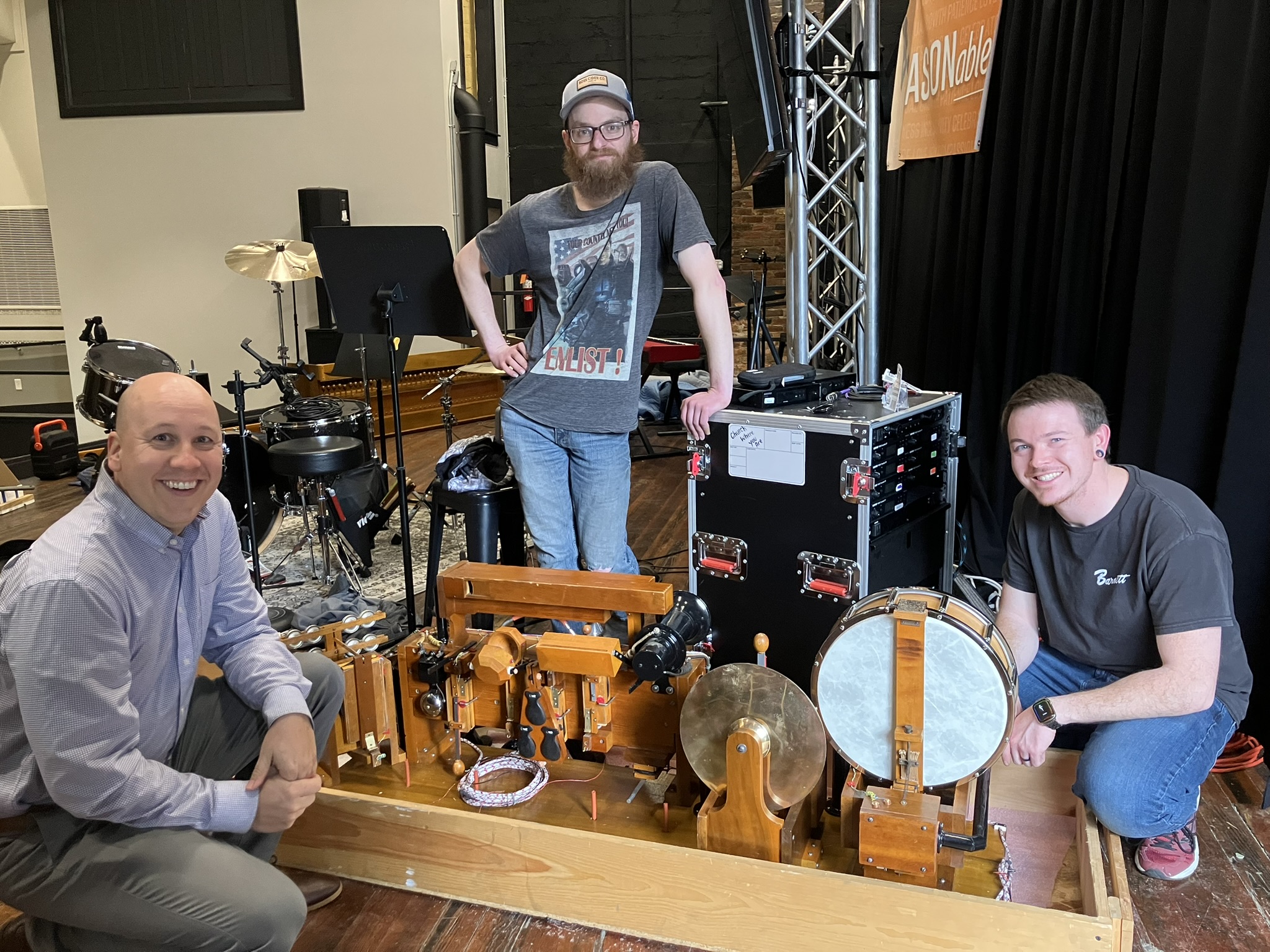
Calvin Stockdale, Aidan Sullivan, and Toby Washburn (left to right) pose with the organ’s instrumentation.
Courtesy | Mary Wolfram
A 100-year-old theater pipe organ — bells, whistles, and cymbals included — will return to its original home in Hillsdale’s Dawn Theater this fall.
“It’s in original condition. It’s never been messed with,” said John Ourensma, professional organist and former Director of Music at Hillsdale First United Methodist Church. “It needed total restoration, but it hadn’t been hacked up and added to or ruined to the point where it couldn’t work again. It just needed some loving TLC.”
The Wurlitzer pipe organ was originally installed in the Dawn Theater in 1925 but fell out of use and was removed by the 1940s. It will soon return to its original venue after two additional installations, several moves to different storage facilities, and a three-year restoration process.
“These instruments were the voice of silent film, and they were intended basically to replicate an orchestra that could be played by one person,” said Chicago-based pipe organ conservator Jeff Weiler, whose company restored the organ for the Dawn. “In addition to some very orchestrally-voiced organ pipes, there were things like a xylophone, a glockenspiel, drums of all kinds, cymbals, and some effects that were specifically included for the accompaniment of silent films. That could be birdwhistles, doorbells, horse hooves, fire gongs.”
The pipe organ is one of 2,243 produced between 1910 and 1943 by the Rudolph Wurlitzer Manufacturing Company in North Tonawanda, New York, according to Weiler. Common during the inter-war period, theater pipe organs were used to accompany silent films and vaudeville shows. When it returns to the Dawn, the instrument will be one of only about a dozen Wurlitzer theater organs still working and installed in their original venues.
The instrument places the Dawn firmly on the national cultural stage, Weiler said.
“If you were a teenager in the ’20s, the rage of the day was going to the silent movies with a whiz-bang theater organist going at it,” Ourensma said. “They were like rock stars of the day, and it’s really hard for us 100 years later to really get a sense of what that was like. We think it’s just old-fashioned history, but at the time, it was the rage.”
The pipe organ spent most of its lifetime in storage but never left Hillsdale County. With the rise of “talkies” in the 1930s, the theater had no use for the organ. The organ was donated to Hillsdale College in 1944, according to Hillsdale Collegian archives. It was installed in the top floor of Central Hall, which was used by the Tower Players for theater performances at the time. The organ eventually ended up in storage until the 1970s, when Hillsdale local and organ enthusiast Jerry Jordan purchased it from the college and set it up in his barn in Jonesville.
After another few decades in storage, Hillsdale resident and then-owner of the Dawn Theater Jeffrey Horton bought the instrument from Jordan in 2004. Not knowing anything about it, he contacted Ourensma.
“Mr. Horton called me and said ‘Hey I’ve got this organ and I don’t know what to do with it. What do you think?’” Ourensma said. “And I went over to look at it, and I was stunned that it was a classic Wurlitzer pipe organ.”
After further research, Ourensma and Horton determined it was the same organ that had been installed in the Dawn in the ’20s. Soon, the Dawn wanted it back.
The Friends of the Dawn, a volunteer organization that facilitates fundraising and programming for the theater, received a significant grant from the Hampson Albert Sisler Foundation for the restoration and reinstallation of the organ. The project was also supported by the Michigan Arts and Culture Council and the National Endowment for the Arts.
Though it is the smallest organ his company has ever restored, Weiler said the process involved a deep cleaning of the entire instrument and meticulous refurbishment.
“This instrument will function and sound exactly as it did a century ago. That makes this a time machine,” Weiler said. “When you go and hear it, you know that you’re experiencing the same sounds, the same musical tonalities, that people would’ve experienced 100 years ago.”
He said his company used materials and techniques when restoring the instrument that will allow the instrument to be restored again 75 years from now and preserved for future generations.
After meeting its final fundraising goal over the summer, the theater is working to finish preparing the space for the organ. The blower and windline, which provide air to the organ, must be assembled in the basement, and the organ console and pipes must be shipped from Chicago and installed on either side of the stage. The components of the percussion chamber were installed in the Dawn earlier this year.
Restoring the organ to its original glory is part of a larger project to make the Dawn a centerpiece of downtown Hillsdale, according to Friends of the Dawn Chair Mary Wolfram.
“We think this is really special that we have the original organ, and it’s really going to maybe drive other events,” Wolfram said. “We hope it becomes a draw for the venue.”
Wolfram said a digital playback system will allow the organ to play on its own during events, similar to a player piano.
Ourensma, who taught organ at the college for four years, said he looks forward to trying his hand at the theater organ and would like to see Hillsdale College organ students learn to play it as well.
In the spring, the Dawn hopes to invite professional organists to perform and to welcome school and community groups for educational concerts. The venue also plans to screen silent movies accompanied by the organ.
“It’s a one-man orchestra, really, and I think people will be just stunned to hear it,” Ourensma said.
Editor’s Note: A previous version of this article misstated the number of Wurlitzer organs originally manufactured as 20,000. The error has been corrected.
