
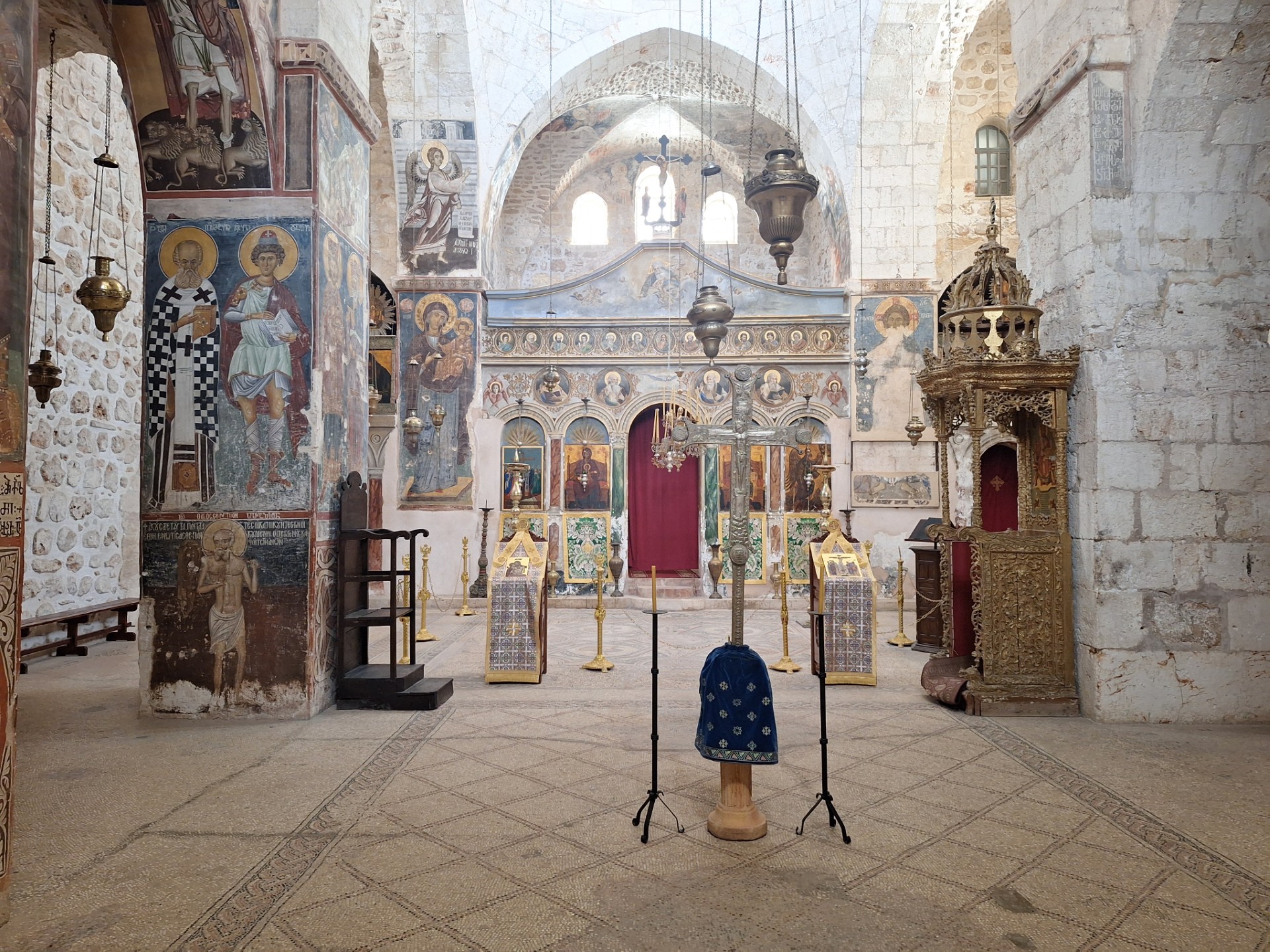
Photo of the Monastery of the Cross, a 5th-century Greek Orthodox monastery in Jerusalem.
Courtesy | Michael Weingrad
Piercing sirens broke the silence of a warm Israeli night as Iran fired missiles into the country. Michael Weingrad and his wife Tara Helfman joined local Israelis, volunteers, and tourists in rushing to bomb shelters every night. Although they would spend as long as 90 minutes crammed into a shelter, people were generally good-natured.
“I’m now a connoisseur of bomb shelters,” Weingrad said in a Sept. 5 panel discussion, “Why Travel to Israel.”
Weingrad, a visiting professor of Jewish studies who arrived at Hillsdale in January 2025 at college President Larry Arnn’s invitation, has been traveling to Israel every year for more than 30 years. Helfman flew into Jerusalem on June 12 for what was supposed to be a five-day visit.
In the weeks before Helfman arrived, the Houthis, a terrorist group in northwest Yemen, fired missiles into Israel almost nightly. Israel’s Iron Dome defense system intercepted the missiles before anyone had time to get out of bed to a bomb shelter, according to Weingrad.
“It almost became fairly normal,” said Weingrad, who teaches courses titled “Fantasy Literature and Religious Imagination” and “Film and the Four Loves.”
The night Helfman arrived, sirens went off. She jumped out of bed, but Weingrad told her to relax, because the Houthi missile would be shot down before they got out the front door.
“And suddenly our phones start ringing,” Weingrad said. “And I look at the phone, I’m like, ‘This is not a one-off Houthi missile.’ It was the beginning of the war. It said everybody has 10 minutes to get to bomb shelters and expect to be there for a while.”
For the next 10 days during Israel’s 12-Day War with Iran, which lasted from June 13 to 24, the couple went to a bomb shelter periodically, usually twice a night.
“Watching people come in in their bathrobes at five in the morning, but with humor and with real gentle compassion for everyone in the room, no matter the background — it was really extraordinary,” Weingrad said during the panel discussion.
Helfman’s five-day trip to Israel turned into a three-week stay. Her family in Israel have a reinforced bomb shelter in their house that doubles as a coat closet.
“It was wonderful,” Weingrad said. “Just being in these different places with all kinds of people, religious and secular, Jews and Arabs, Israelis and guest workers from India and Asia, cute dogs, babies, tourists, and everyone just kind of pulling together and passing the time. It was one of the most beautiful things I’ve ever seen. And at one point, I just looked around and I just thought, Iran is crazy. Hamas is crazy, if they ever think they’re going to beat this people. These people love life, they’re going to live life no matter what. It felt like a privilege to be there.”
The couple went for a walk a few days into the war with Iran. They went to one of Weingrad’s favorite spots in Jerusalem, the Monastery of the Cross in West Jerusalem.
“It’s a monastery built where the tree of the cross grew, and it’s a beautiful Eastern Orthodox church inside,” Weingrad said. “And it’s just a gorgeous place. I wasn’t sure if it would be open during the war, but I knocked and they were letting people in.”
The Israelis did not know what to expect during the bombing and did not dare expect help from another country, according to Weingrad.
“The operation on the Israeli side was unbelievable,” Weingrad said. “I mean, people were clearly on the ground for a long time operating in Iran. And the stories that we’ll probably never know are probably some of the most brave and heroic and accomplished things in all of military and intelligence history.”
Weingrad said it was “gratifying” when the Trump administration made the strike on Iran.
“Having America, having my country, come through at the end to finish the job, was just really wonderful,” Weingrad said. “And just there was so much relief and gratitude from the Israelis that I talked to.”
Before the war with Iran started, Weingrad went to the Hebrew Book Week, an annual event in Israel where Israeli writers and publishers sell books in stalls. During the event, a siren went off, and an announcement said that there was an incoming missile from Yemen, fired by the Houthis, but it would be intercepted by Iron Dome.
“So standing there surrounded by all these book stalls and book-loving Israelis, and we look up and suddenly see this kind of little smoke ring in the sky as the missile got shot down by Iron Dome,” Weingrad said. “Everybody applauded, and everybody just went back to shopping for books. So I really think that you’ve got one side that’s lobbing missiles into civilian areas and another side that wants to buy books.”
Israelis live with joy and gratitude even during dangerous and difficult situations, according to Weingrad during the panel discussion.
Senior Tully Mitchell saw this firsthand when her Israeli friends, who she met during Hillsdale’s Passages trip to Israel last winter, said what struck her was how her friends were more concerned with not being able to go about daily life than they were with the attacks.
Mitchell said that she got a text from a friend that read, “My city is getting bombed, lol, but I’m fine. Just sad because work got canceled today, and the gym was closed.’”
Weingrad said that the way Israelis manage to have compassion for each other despite suffering is incredible. During a visit last summer, he was in a bookstore, and the woman who owned the store asked if she could leave him in the store while she ran an errand.
“Being left in a bookstore is paradise for me,” Weingrad said. “So I said, ‘Yeah, no problem.’”
The store owner left and was gone for 45 minutes.
“I am there with her phone, her handbag, and her store,” Weingrad said. “Like, she does not know me, but it’s a high-trust society. And she came back, she’d run into her dad, and of course, they had to sit down for a cup of coffee because it’s her dad, and I love that.”
Weingrad compared the trust in Israeli society to the trust at Hillsdale with the Honor Code.
“I have actually the same sort of jaw-dropping response where I’m going to the dining hall and the phones are on the tables,” Weingrad said. “I’m like, this is amazing. Don’t they know this is crazy, but it’s wonderful. It’s the way it should be, actually, and you know, maybe the lesson is that the wrong thing is how it is elsewhere that, you know, Hillsdale and Israel have it right.”
Weingrad said the trust and community in Israel are remarkable, given the diversity of the country.
“I don’t think there is a country on the planet, including America, that is as multicultural and diverse as Israel,” Weingrad said. “Because the 80% Jewish population of Israel has come from all over the world. So they’re from Morocco and Canada and Ethiopia and Australia and there are so many different traditions and languages and ethnicities.”
Weingrad described a Jerusalem shopping mall as a place where Arabs, orthodox Jews, and secular Israelis go about their business shopping together.
“It’s a little country under tremendous pressures, but it really figures out how to pull together and make the best of it,” Weingrad said.
Yahli Salzman, sophomore and president of the Jewish Mishpacha, had a personal connection to the conflict. Salzman’s brother is in the Israel Defense Forces and served during the conflicts with Hamas and Iran this summer.
“It was scary,” Salzman said. “That’s the way to put it, how my family felt with my brother being there. But every day is scary because we don’t know what’s going to happen the next day.”
Salzman has known Weingrad since he came to campus last semester. The Weingrads sponsored the first Jewish Mishpacha event of the semester, a Shabbat dinner.
“He and his wife are just really incredible, fantastic people,” Salzman said. “And in their short time, even being connected to us has done so much. And it’s just really great for us to have more Jewish professors on campus, more Jewish leadership.”
Weingrad hopes to see a Hillsdale in Jerusalem program at some point.
“I think Hillsdale would really learn a lot from, and be able to engage in very deep levels with Israel today,” Weingrad said.
