
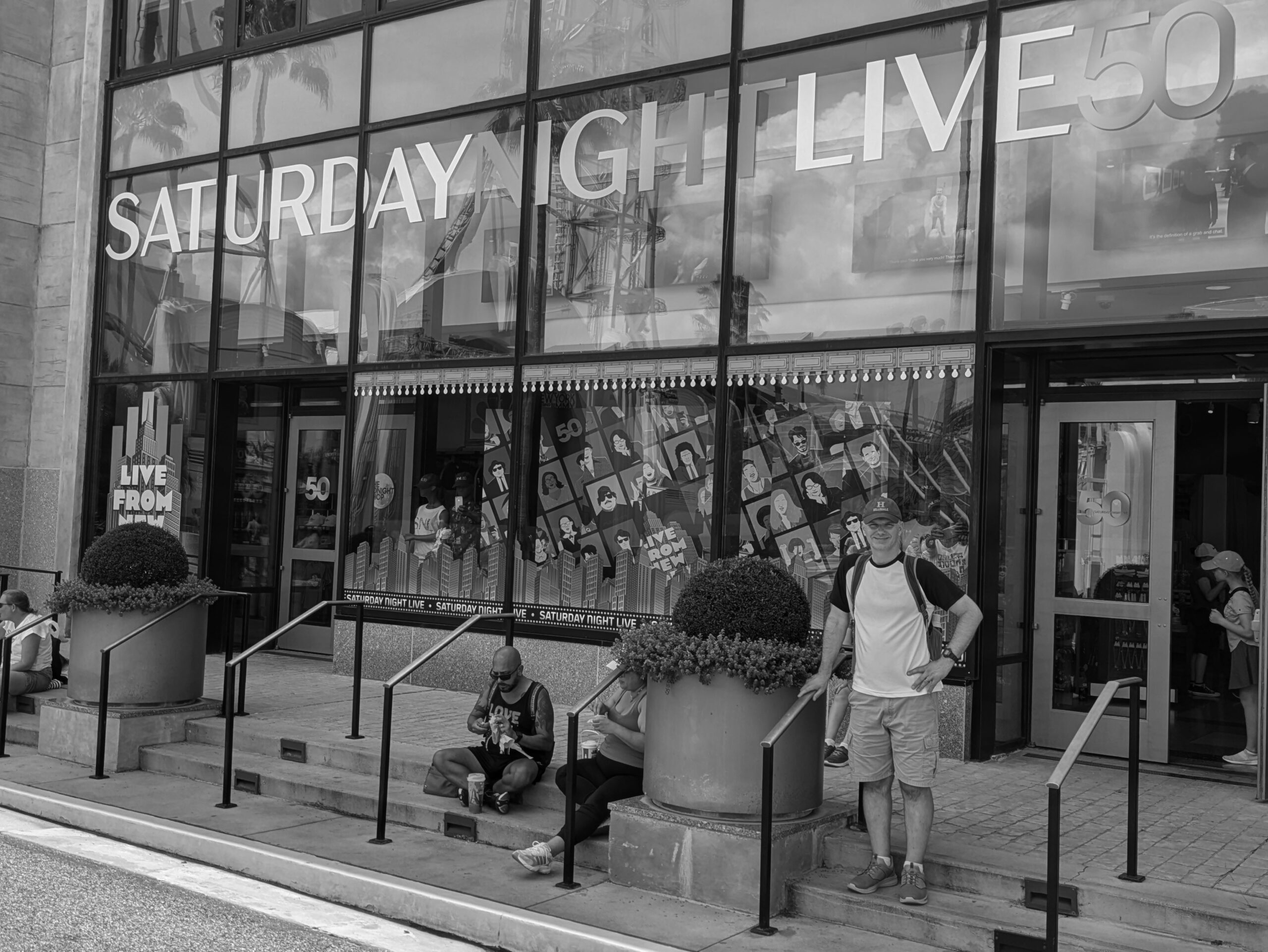
Bertram in front of the SNL Fan Shop at Universal Studios Orlando. Courtesy | Scot Bertram
Scot Bertram has watched every episode of “Saturday Night Live.” It took him two years to watch 50 seasons with 1,000 episodes.
“People said it couldn’t be done,” Bertram said, who is General Manager of Radio Free Hillsdale 101.7 FM. “In fact they said it shouldn’t be done, and yet we proved them wrong, because we did it.”
His podcast “Wasn’t That Special,” co-hosted by Christian Schneider of the Pacific Legal Foundation, reviews, ranks, and discusses all things encompassing SNL.
Now that Bertram knows more about SNL than most cast members do, he is teaching a one-credit class titled “The Forbidden Humor of SNL.”
The class seeks to answer two questions about the political and cultural side of SNL, according to Bertram. The first question comes from the well-known fact of SNL primarily having a liberal bias.
“But the perspective of the show writ large has always been from the left liberal worldview,” Bertram said. “But there have been very good, very funny sketches throughout history in which they have a conservative or libertarian perspective or making fun of the left, which is not what they normally do.”
Bertram said he plans to ask his students what led SNL to sometimes switch up the political side they wanted to make fun of.
“Why did they do it? Was it funny?” Bertram said. “What was happening in the world or the country at that time that made them comfortable enough to step out from that worldview to say ‘Maybe this is another way to look at it. This is actually funny.’”
The second question comes from analyzing episodes that Bertram said SNL wishes were forgotten because they aged poorly as culture has shifted. Jokes that used to be funny are now considered offensive; Bertram and his class are going to analyze why that is.
SNL is important because of its documentation of public thought in moments of political and cultural events, according to Bertram. Since the show ran weekly, every sketch was a humorous tribute to that week’s news.
“You really see this sort of visceral response to things that are happening, whether it be in culture, politics, or news, they’re reacting in real time,” Bertram said.
Bertram explained how comedy peaked during SNL seasons 14-17 and is now failing both inside and outside of SNL. The world of comedy outside of SNL has shifted — there are no longer sitcoms like “Cheers” and “Seinfeld” on platforms like CBS and NBC — and comedians have nowhere to go outside of SNL and stay on as cast longer than they should.
“There’s nowhere to jump off and continue to be funny comedians,” Bertram said. “So people are staying much longer on the show. And since people are staying much longer, you have these expanded casts, and that’s been a change for the worse.”
According to Bertram, another reason SNL is not as funny as it used to be is due to the departure of writer Jim Downey and a shift in the political writing.
“They started to write politics in a different way, which was instead of having a perspective on something that happened, or taking something that happened and sort of moving it to a logical next point, they essentially started reenacting things that happened during the week,” Bertram said.
When SNL first started, the normal platform for a comedian was on the stage or in a sitcom. Now, younger generations find comedy in 10-second clips on Instagram and TikTok. Humor is always shifting, and the students of Bertram’s class are ready to find out why.
“I’m excited to see what he’s pulled out for what he considers forbidden comedy,” Senior Megan Pidcock said.
Pidcock, senior producer at the college’s radio station, has worked with Bertram for years and knows his enthusiasm for SNL from past conversations.
“It seems fun to go to a class once a week where you laugh at something or don’t laugh at something, and then talk about why you did or didn’t laugh at all,” Pidcock said.
Sophomore Sophia Carey said she grew up sneaking around her parents to watch SNL with her older sister.
“We called it ‘snail’ because we weren’t allowed to watch it,” Carey said.
Now that Carey no longer has to hide the fact that she loves watching SNL, she said she is ready to have a greater appreciation for all that goes into the show.
“I think when people think of SNL, they just think of basically a cracked-up writing machine,” Carey said. “But there’s so much technical stuff that goes on, like what makes everything work, that I think I’m going to have a greater appreciation for not just the writing and the structure of the jokes, but also everything that goes on in the production of the show.”
