
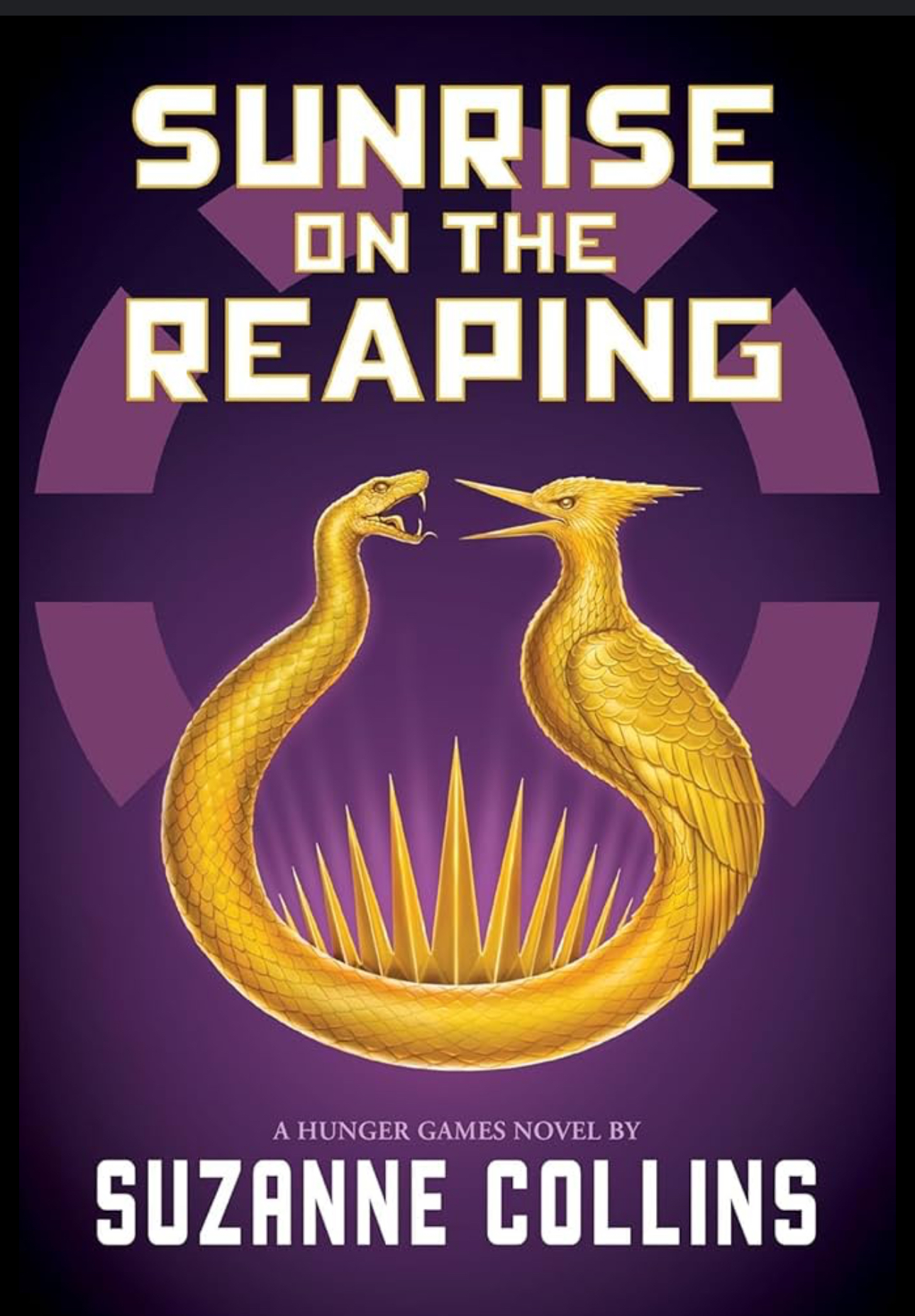
Sunrise on the Reaping book cover.
COURTESY | Amazon
Suzanne Collins released the first prequel to her popular “The Hunger Games” series in 2020, and now, she’s back with another. Though an additional Hunger Games novel seems repetitive, Collins’ second prequel “Sunrise on the Reaping” delivers an entertaining, action-packed, and thought-provoking installment.
Between the events of “The Ballad of Songbirds and Snakes” and the first novel of the original Hunger Games trilogy, the 50th Hunger Games looms over the nation of Panem. The Second Quarter Quell — a twist version of the Games held every 25 years — is upon them, and this year, twice the usual number of tributes must compete. Sixteen-year-old Haymitch Abernathy finds himself reaped as one of the male tributes from District 12, and his journey through the games cements him as an early rebel, dedicated to breaking the Capitol’s arena by destroying its power source.
Abernathy’s character arc is a strong point of this book. Collins seamlessly takes him from a caring — albeit rebellious — teenager to the flippant drunk we all know from the original trilogy. Young Abernathy loses everything and everyone he ever loved. His story is arguably more tragic than Katniss’ because he fails in setting off the spark of revolution.
“Sunrise on the Reaping” follows a similar plot structure to the first novel in the series, “The Hunger Games,” rendering it a bit familiar, but packed with differences. The arena is one of the most unique settings in the series — an expansive, flowery meadow, surrounded by a beautiful forest, with a snow-capped mountain in the distance. But the arena’s beauty hides a deadly secret: everything is poisonous. The tributes are forced to restrain themselves from eating off the berry bushes or drinking from the sparkling stream, as they will die instantly if they do. On top of that, it’s game over if anyone gets caught in a swarm of ladybugs or butterflies.
Helping Abernathy along his journey are many returning characters like Mags, Wiress, and Beetee. The novel strengthens the series’ cohesiveness by using these characters to bridge the gap between the other prequel, “The Ballad of Songbirds and Snakes,” and the original trilogy. President Coriolanus Snow is as intimidating as ever, and whatever humanity he had in “Ballad” is stripped away entirely in “Sunrise.”
These returning characters are also the weakest part of the novel. The appearance of Effie Trinket added nothing to the overall story and took up time that could have been used to further develop Drusilla Sickle, her predecessor. By the time Trinket shows up, a plethora of other familiar characters had already made appearances, so her inclusion in “Sunrise” was unnecessary fan-service that bogged down the pacing.
The book succeeded in its thought-provoking commentary on propaganda and media censorship. Before entering the games, Abernathy takes it upon himself to try and break the arena. It is his attempt at bringing hope to the districts, and while he partially succeeds in his goal, none of it is shown on TV. All his rebellious exploits are edited out of the final version. No one — neither the Capitol citizens nor the districts — knows what he does. Through this, Collins communicates her belief that the media controls every narrative, and therefore has its hands in how people think. It is a haunting and timely message that, no matter what one does to rebel, if the media controls the narrative, it cannot be beaten.
“Sunrise on the Reaping” stands as a worthy installment in the popular “The Hunger Games” series. Despite a few weaknesses scattered throughout, it adds depth to characters fans already know, especially Abernathy. Collins does not deliver the greatest novel in the series, but she certainly delivers another entertaining and thought-provoking narrative.
