
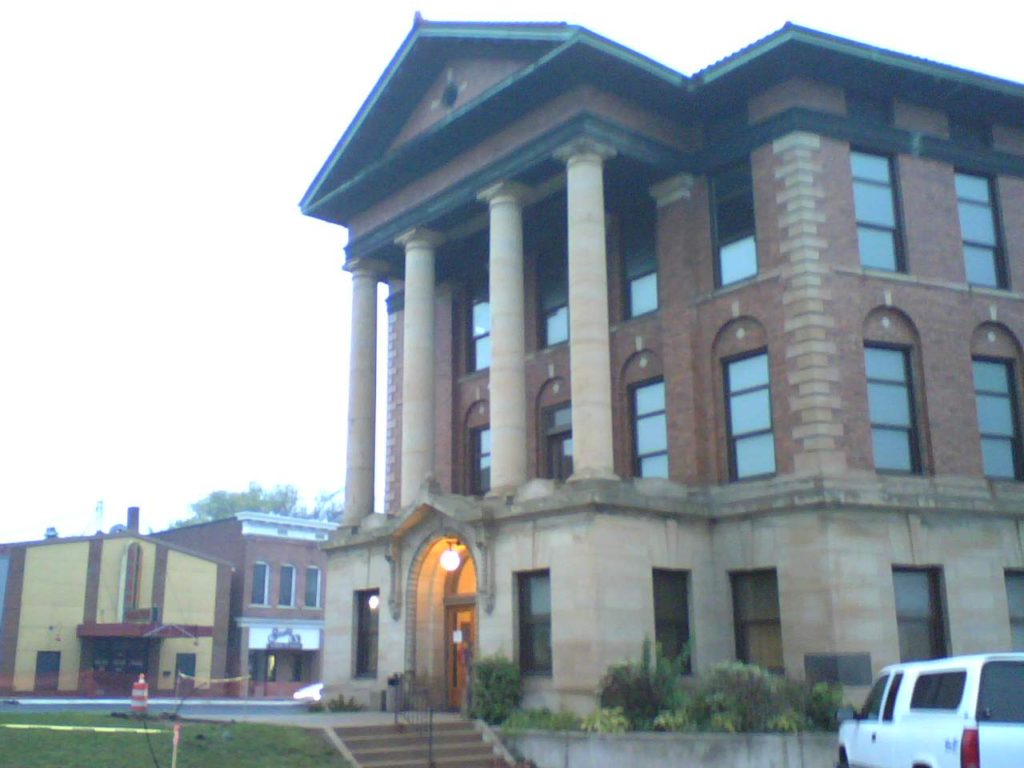
Hillsdale City Hall. Courtesy | Collegian Archives
A special election will be held in August, followed by a run-off in November
Four candidates filed to run in Hillsdale’s Aug. 5 primary election for mayor, which will begin the two-step process of choosing former Mayor Adam Stockford’s successor.
The deadline to get on the ballot passed Tuesday, and the candidates are Ward 3 Councilman Matthew Bentley, former Election Commission member Cathy Kelemen, former Mayor Scott Sessions, and Ward 4 Councilman Robert Socha. The top two vote-getters will be on the general election ballot Nov. 4.
The elected mayor would finish Stockford’s term through 2026. To serve longer than a year, the mayor would then run in the August 2026 primary and November 2026 general elections.
Stockford stepped down in December shortly before moving outside the Hillsdale city limits. Just before Stockford resigned, Paladino defeated Ward 2 Councilman Will Morrisey in a 5-4 council vote to become mayor pro tem. Paladino has been serving as acting mayor since December but told The Collegian last week he will not run in August.
The Candidates
Bentley said in an interview his campaign is focused on two mottos: first, “It’s the people,” and, second, “Roads, roads, roads.”
“‘Roads, roads, roads’ being no bike lanes, lower the SADs, and fix the roads,” Bentley said, referring to the city’s use of Special Assessment Districts to fund road repairs. “That’s our No. 1 job: the roads.”
Kelemen announced her candidacy at the April 21 city council meeting.
“I live, work, and worship in the city. I have no political agenda,” Kelemen said at the meeting. “I just would like to be a voice for the people of the City of Hillsdale.”
Sessions, who served as mayor from 2013 to 2017, said his experience in local politics makes him the most qualified candidate out of the four.
“I have served in the position of mayor for four years, and I would step right in, day one, with that experience,” Sessions said. “I was also on the planning commission for four years, along with three years on the city council from 2011-2013. I have that experience.”
Socha also pointed to his experience, including his four years on the city council.
“I will be able to take the criticisms, maintain civility and decorum in the council chamber, and maintain the council’s direction over the city manager when he provides the city’s recommendations,” Socha said. “We can move forward in a way that will be beneficial to all the citizens.”
Kelemen told The Collegian she had not been in politics before.
“I‘m just a resident,” Kelemen said. “This would be my first time being in politics. I look at the role of mayor as more of a community service position, not a political venue. My goal is just to serve.”
City Staff
Sessions said he was motivated to re-enter politics by the resignations of two city employees in the past month: Airport Manager Ginger Moore and City Engineer Kristin Bauer. Moore, in an interview with The Collegian, cited “the drama of the negative,” and Bauer, in her resignation letter, pointed to the “negative culture being developed” by some city council members, including Bentley and Paladino.
Sessions said he would look into the possibility of bringing Moore and Bauer back on staff, and defer more to city staff as mayor.
“I would like for the council and the mayor to be more respectful of city staff because right now leadership is browbeating the staff, and that was brought up at a meeting,” Sessions said. “Let the city manager, who knows how to run the city, run the city. He needs to do his job, and we need to let him do his job.”
Bentley said he sees a conflict of “the city staff versus the people.”
“I’m solidly on one side. I’m with the people,” Bentley said. “The city staff needs to understand that the elected officials represent the people, and the people will be heard.”
Socha said recent reports of division between the city staff and the council are overblown.
“There’s an old adage that perception is reality,” Socha said. “I don’t believe anyone on the council is intentionally trying to be divisive or argumentative. I think we’re all serving to try to better the community. Unfortunately, in some of the discussions and exchanges, they’ve gotten a little heated.”
Road Repairs and SADs
As mayor, Sessions said his top priority would be continuing to repair Hillsdale’s roads and streets. He said he supported Special Assessment Districts, which require each property owner in a designated SAD to pay up to $5,000 to fund road repairs on their street.
Sessions said he personally paid $5,000 for the Westwood Street SAD and that either ending SADs or lowering the price cap would discriminate against residents, like him, who have already paid for road repairs.
“I believe it’s unfair to change it halfway, so some people pay more and some people pay less,” Sessions said.
Bentley said he would rather reform, not end, the use of SADs.
“I think there’s a middle ground, at least a transition,” Bentley said. “If we lower the caps to say, $3,000 — at least for most projects — the anger and the rage that people feel against special assessments would go way down, because they know they need the roads.”
Since the city’s budget is smaller compared to its neighbors, Socha said he thinks SADs are the city’s best option now. But he also said he would like to fund road repairs differently in the future.
“We have to work with what we have,” Socha said. “In order to make constant progress on the roads and infrastructure, even as little as it is, the special assessments are a necessary component at this point. Hopefully, we can find a way to fund our projects without them in the future. But there’s just not a viable alternative right now that I’ve been shown.”
Kelemen called reforming SADs a “really big question.”
“I can‘t really give you a solid answer without taking a deeper dive into the city budget and seeing if there are areas that can be reformed to allow some changes,” Kelemen said.
The ‘Road Diet’
Socha expressed mixed support for the “road diet,” a city proposal which would use state funds to slim down Broad Street to three lanes, end direct access from Hillsdale Street to Broad Street, and add bike lanes. While Socha said he was “indifferent” on adding bike lanes, he said he supported a middle turning lane for both directions.
“I like the idea of three lanes on Broad Street,” Socha said. “I live on Broad Street. I have to turn left into my home. Having a protected left lane for those left-hand turns is a good idea.”
Sessions said he was concerned about the safety of the plan.
“They say that it’s supposed to be safe,” Sessions said. “I’m worried that it’s not going to be safe, that somebody might get hurt, like a bicyclist. That’s my main concern.”
Although the mayor does not have the executive power to stop the plan on his own, Bentley said he would use his position to build public opposition to the project.
“I can bring attention to it, and I can call the citizens to action,” Bentley said. “I have evidence that the people of Hillsdale want neither the bike lanes nor the road diet.”
Send tips to the City News team: collegiancitynews@gmail.com
