
Shakespeare in the Arb presents “Love’s Labor’s Lost”
COURTESY | Alethia Diener
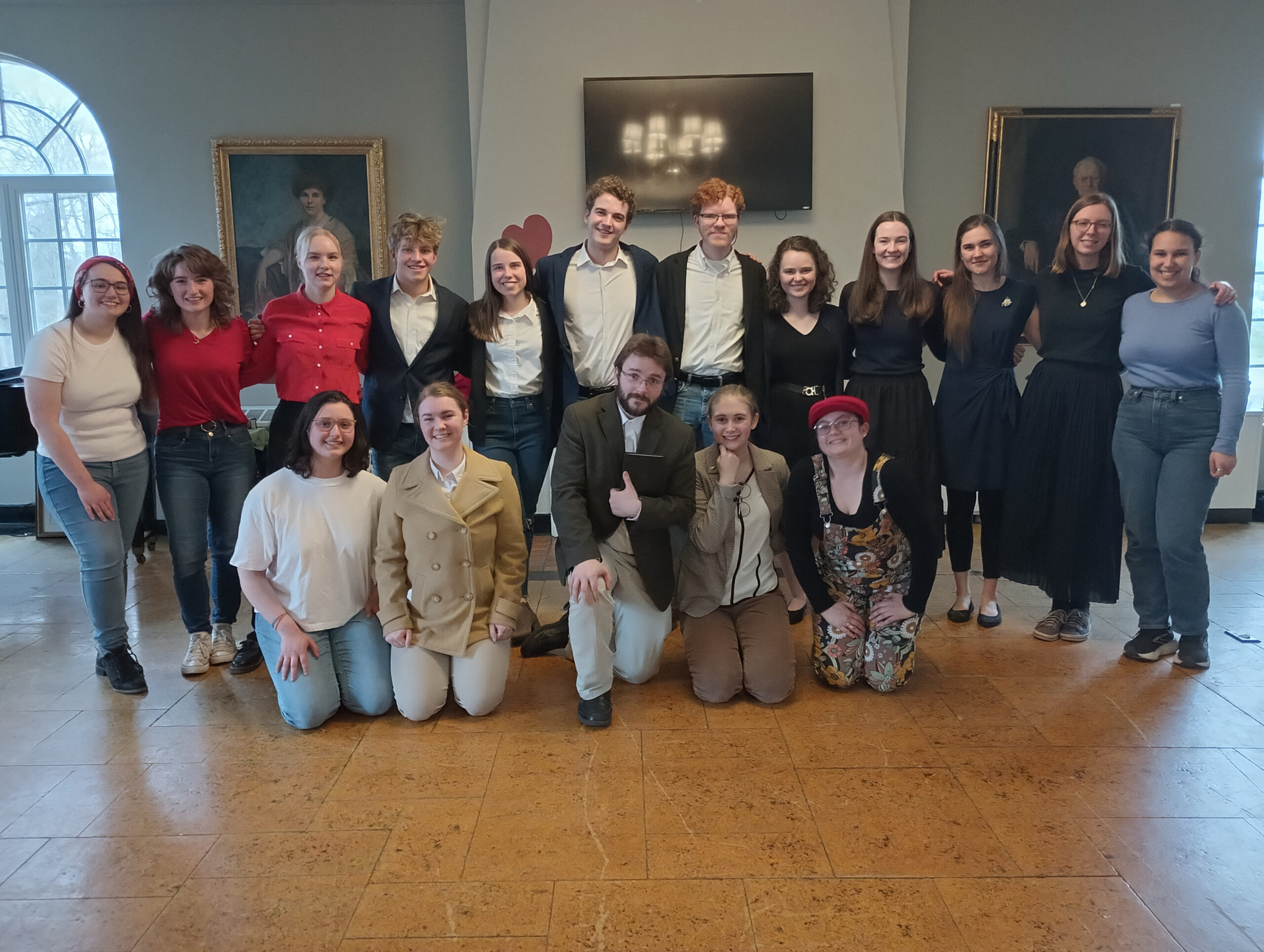
A band of bard imitators portrayed Hillsdating in action in the recent, annual Shakespeare in the Arb performance in Slayton Arboretum on April 4.
“Basically it’s this play about Hillsdating, where these four lords get together and decide they’re only going to fast and study and pray and never talk to women,” freshman Alethia Diener, who performed in the play, said.
This year, the 16-member Hillsdale student cast presented “Love’s Labor’s Lost,” one of Shakespeare’s earlier comedies, which began in the Arb on Friday, before weather forced it indoors to Mauck Dorm for both performances.
Senior Katrin Surkan, who directed the play, was joined by seniors Libby Gannon, Zelda Gilbert, Peter Gilchrist, and Parker Reed performing in “Love’s Labor’s Lost.”
Kevin Franco, a first year classical education graduate student, attended the production for the first time but has witnessed other outdoor Shakespeare productions.
“I find particular delight in such productions because of the degree to which the thespians, who by performing in nature, surrender a reasonable ability to implement sets and props beyond those which are portable and master their stage as the good Lord and a few landscape architects designed it,” he said in an email. “The company of ‘Love’s Labor’s Lost’ certainly accomplished this.”
One of the principal lords, Diener, who grew up in Hillsdale, said she was excited to perform in Shakespeare in the Arb after watching it for years, and that the play addresses other characters who begin falling in love.
“It’s all about sacrificing what your expectations were to find more of a happy and fulfilled life than you thought you could have,” she said.
Diener highlighted her character’s struggle and how the play raises questions about staying true to your word.
“He’s caught in this inner turmoil and conflict because he doesn’t want to go back on his vow to not talk to women,” she said.
Diener’s performance as Lord Berowne elicited compliments from Franco, who said her British accent matched her impassioned character.
“This practice both added dimension and enhanced the comedic effect of her performance,” he said. “Whether or not Diener’s practice was intentional, it is but one example of the nuances, many of which we in the audience rarely recognize, that comprise theatrical arete.”
Franco said the scene in which the lords emerged dressed as Muscovites was the most striking and included an entire stage change due to the rain, resulting in the lords entering from the rear of the Mauck solarium.
“Amidst a well-timed pause in the dialogue, the lords proceeded to the front of the room dressed as anything but Muscovites, three of whom each donned a random and quite un-Muscovite hat, among them a cowboy hat and a flat cap. The fourth fellow, meanwhile, was masked and caped like a Mexican wrestler,” he said. “This scene elicited more laughter than any other from the performance.”
Surkan shared the importance of watching Shakespeare live, and not just reading it alone.
“Shakespeare’s English is beautiful, but watching people take the words written on the page and present them physically in space gives them life and a more practical meaning,” Surkan said. “I find it especially important for comedies, as Shakespeare loved visual humor, which can be hard to communicate through just the words.”
Franco said the performance was enjoyable and demonstrated “Hillsdalian camaraderie” between cast and audience.
“Their presentation of Mr. Shakespeare’s quest at portraying the absurdity of men swearing off women (at least permanently) appeared effortless, and their desire to partake and share in this quest, authentic,” he said. “The audience too, executed their role in receiving the performance. Heads turned, eyebrows rose, and applause ensued.”
